


12V Battery vs 24V Battery: Differences
 827
827What is a 12V Battery?
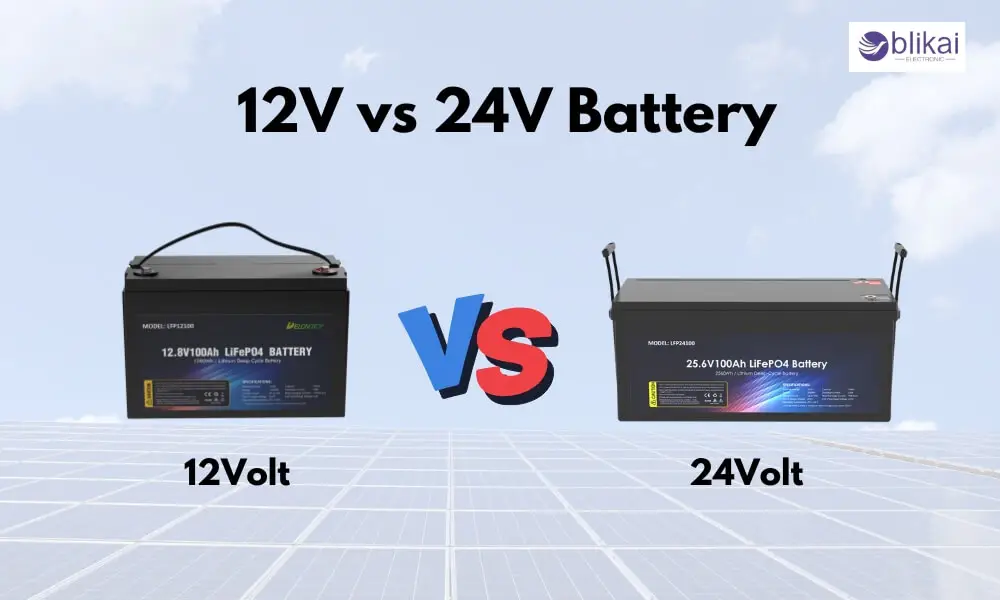
The battery can be 12V, which is rechargeable or not. It is also among the most common types of batteries since it is an all-purpose battery and quite cheap. They tend to be the battery of the smaller, lower power tools because their size is small and they are easy to fit in.
What is a 24V Battery?
A battery with a voltage of 24V can produce twice the voltage of a battery with a voltage of 12V, which has the advantage of being stronger. Such batteries are usually employed in products with higher energy use and a longer run time. 24V batteries are usually present in electric vehicles (EVs), powered tools with a higher power usage, and off-grid solar systems.
Comparison Table
Power Differences
A 24V battery usually can power more than a 12V battery, and can supply more power at any one time, and it is important in high-power applications. The power output was calculated in watts, and the calculation of watts is as below formula:
Power (W) = Voltage (V) x Current (A)
It has a 12V battery with a current of 10A that would yield 120 watts of power (12V x 10A = 120W). It would generate an equivalent of 240 watts of power (24 V x 10A=240W). This indicates that 24 V has the potential of generating 2 times higher power at the same current and, thus, it is highly efficient in high-load equipment.
In the case of high power consumption, e.g., in large motors, industrial appliances or high-performance machinery, the more power that 24V systems can deliver is a requirement. An illustration example here is an industrial forklift that operates on a 24V battery system, which will need additional power to enable it to lift heavier loads and work longer hours in the long run. Equally, in off-grid solar systems, higher solar panel arrays can be powered by 24V batteries, and can deliver reliable power through long periods of time. Such systems take advantage of the capacity of a 24V battery to store and supply more power, eliminating the necessity of having too many battery banks and also ensuring that there will be less loss of power in the process.
Efficiency and Performance
The 24V systems are more efficient in terms of energy efficiency compared to the 12V systems, particularly in applications with high demand. This is because of the effect of voltage on power losses in transmission. To deliver the same power as in 24V, twice the current is required in the 12V system, and this doubles the loss in the wires and resistances at the points of connection. This is referred to as the I²R loss (I current and R is the resistance), which means that the higher the current, the higher the energy loss (heat) produced.
Conversely, a 24V system has less current to supply the same power, hence saving on losses in transmission. Such high efficiency results in the improvement of performance, extended battery life, and reduced power drops, which makes 24V systems best suited to a situation where energy efficiency is an important factor. As an example, a 24V or more voltage electric vehicle system allows it to travel further on a single charge. On the same note, in solar-powered systems, 24V batteries are used to store and distribute the energy in a better way without necessitating huge wiring as well, and energy is wasted in the storage and recovery process.
Performance at Different Loads
The 12V system design can result in poor performance under high loads due to the large current required to deliver high loads. Higher loads may cause a 12 V battery to reduce the voltage across the battery further, and the overall system efficiency will be less, resulting in a reduced length of time that a battery will operate before it requires a recharge. This is particularly so in cases when it requires bursts of power, i.e., power tools or larger appliances.
Quite the contrary, a 24V system is more effective in controlling heavier loads without excessive voltage drops. Since the increased voltage is able to run reduced currents to produce equal power, 24V batteries can power more demanding loads, including running large motors, or maintaining the power demand of commercial equipment, better. As a case in point, an electric vehicle with a 24V battery can have a larger engine in it that can work longer and more efficiently under heavy load and conditions.
Size, Weight, and Cost Considerations
Physical Size and Weight
Since a 12V battery operates at a lower voltage, more batteries will generally be required or a more substantial battery bank to provide the same amount of energy as a 24V system. This is an argument to indicate that a 12V system may be a bit bigger and weight-deficient, but may deliver the same energy supply, and more additional cells or bigger wiring may be needed to obtain the desired performance.
Conversely, a 24V battery provides a more lightweight and smaller option when required to have higher power. Its operation at a higher voltage means that fewer batteries are required to produce the same power output at the reduced size and weight of the battery system. In all applications where space and weight are important considerations, such as in electric vehicles, recreational vehicles (RVs), and portable power systems, the use of 24V batteries is commonly called upon due to their smaller overall size and ability to fit into smaller spaces.
Cost Analysis
A 12V battery system is normally cheaper than a 24V system, primarily due to the ease with which the system has been designed, and fewer parts would be required in a 12V system. A 12V battery may be one of the cheapest in small applications, like in automotive or low-power system applications. Nevertheless, in bigger systems or applications, which require greater power, 24V batteries are cheaper in terms of energy consumption and in the long term.
The cost of batteries, chargers and supporting equipment (e.g., inverters and wiring) is higher in 24V systems, thus costing more in the short term. Nevertheless, in systems where it matters most (e.g., in electric vehicles or solar installations or industrial-scale operations), the higher initial cost of a 24 V system can result in huge long-term savings.
Application Suitability
Applications of 12V Batteries
- In cars, the 12V batteries are normally employed to supply power to the engine starter, lights, among others. They can also be used in motorcycles, RVs, and boats to supply them with power to move and have recreational use.
- Small Solar Systems: With small solar power systems, solar panels charge 12V batteries which supply small demand lights, small appliances and electronics.
- Portable Electronics: 12V batteries are used in portable electronics such as GPS units, mini fridges and small fans, and provide a safe and efficient answer to outdoor activities, travel and camping.
Applications of 24V Batteries
- Electric Vehicles: Electric vehicles, such as forklifts and golf carts, utilize electric batteries with 24V. They are stronger to run bigger motors and are therefore applicable in the heavy-duty cars that need longer run time and better performance during loading.
- Industrial Equipment: In industries, heavy equipment such as conveyor belts, large machinery, etc., is run on 24V batteries. They also have a greater energy capacity that guarantees efficiency of continuous working in tasks that are demanding, such as manufacturing and warehouse working.
- Power Tools: The high-power tools, such as the drills, saws, sanders, etc., will require the use of a 24 V battery to meet their unrealistic requirements.
Can a 12V Battery be used with a 24V System?
A 24V voltage system cannot have a 12V battery installed, as operation under high voltage will take place, and a 12V battery will be incapable of supplying power as required by the system.
Voltage Mismatch:
It will be a 24V system, and the 12V battery will be stacked to give the required voltage. Just once to inform you, in case you would like to work with one 12V battery, it will only supply half of the power needed, and the system will not operate properly, and might even damage the system.
Risk of Damage:
Entrepreneurship. In a 24V system, when the voltage is too low (as when using a 12V battery) then it may cause overcurrent to flow in the system, or worse, the system may short or suffer irreversible damage due to having the improper voltage supply. This may reduce the lifetime of the battery and the system.
Conclusion
Whereas 12V batteries are perfect in low-powered and smaller-scale operations such as cars, handheld electronics and small solar systems, 24V batteries are better suited to high-powered tasks, such as electric cars, industry, and larger off-grid solar systems. The main benefits of the 24V systems are that they can operate on more massive loads, have increased run times, and save more energy through reduced current and energy loss. The knowledge of the differences between these two types of batteries can help you make a better choice that guarantees maximum performance and long life of your devices or systems.
FAQs
Can a 12V battery be used with high-power consumption?
A 12V battery is usually used in small processes, such as cars, as well as processes with large loads of electronics that are not very high power, such as large motors and heavy processing, which, in combination with the higher power, ought to be powered by a 24V battery to extract the maximum power.
Can 12V and 24V batteries be used interchangeably?
No, 12V and 24V batteries are not to be applied to one system. This can cause problems in voltages, ineffectiveness, overheating and eventual destruction of the batteries and the system.
Some images are sourced online. Please contact us for removal if any copyright concerns arise.





