


How to Test a Battery With a Multimeter: Detailed Steps
 750
750A multimeter is a very essential electronic equipment that is used to detect several electrical properties, including voltage, current, and resistance. It has two large types, including digital and analog. DMMs also give a digital display on an LCD screen, which is specific and can be understood even by newcomers. Analog multimeters make use of a needle to show measurements on a scale. Although in the case of detecting a trend or fluctuations, the analog meter should come in handy, a digital multimeter would be the better choice in battery testing because it is more accurate and has a clear display alongside other features such as continuity checks and diode testing.
Why Testing Battery Voltage Matters
Completely testing batteries with a multimeter can enable a user to correctly measure the voltage output of a battery, representative of its state of charge and overall health. The voltage of the battery is important since low or depleted batteries may affect the performance of the devices to malfunction, act unpredictably or even stop functioning altogether. So, knowing the exact voltage helps to be able to change or recharge batteries before they get defective, before time, money and destruction of devices.
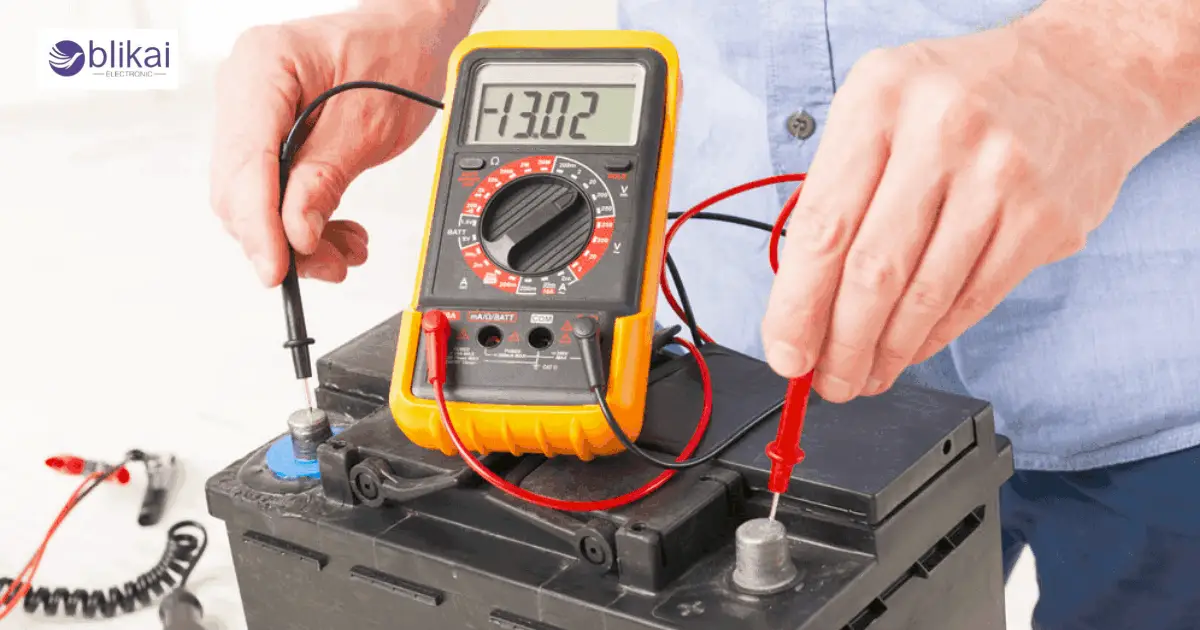
What Are the Tools That You Need to Test the Battery?
Required Tools
- Multimeter
- Battery
- Protective gloves (suggestive)
Safety Tips
- Do not short-circuit and be in contact with the positive and negative terminals of the battery.
- Batteries that are swollen, leaking or damaged should not be used and are potentially hazardous.
- You must always clean up your workspace, and then you should not put metal objects on your workspace so that you do not create unintended conduction.
- The probes must also be in good condition, and ensure that they are not in bad condition when using them.
How to Set up a Multimeter
- The first one is to turn on the multimeter and verify that it is in proper condition with no broken probes and no battery loss inside. After switching on, you should switch the gadget to DC voltage mode since direct current (DC) is supplied by house batteries. DC voltage has a straight line above the V to indicate its type, unlike AC voltage, which has a wavy line.
- The second step is to select the right voltage range after selecting DC voltage mode. In the case of a majority of household batteries, a low-voltage range is optimal.
How to Test a Battery Using a Multimeter
Determine Battery Terminals
Discover the positive and the negative side of the battery. With a cell battery of the cylindrical shape (AA, AAA), the positive aspects in a cell battery are rounded, and the negative aspects are plain. The negative connector is big, and the smaller connector is positive in 9V batteries. In the case of coin cells, the flat top is positive.
Hook the Multimeter Probes
Connect the red probe to the terminal positive ( + ) and the black probe to the terminal negative ( - ). Ensure that it is firm to avoid showing gyrating results. The reversal of probes can be safely done, but it will show a negative voltage. The steady battery and probes should be held on a stable surface and should be measured.
Measure the Voltage
Adjust the range of your multimeter to DC voltage and the range that is most appropriate to the type of battery you are measuring. Note the voltage, which, when steady, is exhibited. Wipe the battery contacts in case the reading turns out to be unstable. This process identifies the level of charge and bad or defective batteries.
Interpret Results
Compare the voltage measured to standard ranges:
- AA/AAA: 1.5V charge full, 1.1-1.2V partly depleted, under 1.0V almost flat dead.
- 9V: 9.0–9.6V fully charged, <7.0V weak.
- Coin cells (CR2032): Approximately 3.0V and less than 2.5V weak.
How to Test Different Types of Batteries
AA, AAA, and AAAA Batteries
These universal cylindrical batteries are normally rated at 1.5 volts with the alkaline and 1.2 volts with the rechargeable NiMH batteries. Multimeter testing ensures the meter is adjusted to the DC voltage. A range of any value exceeding the nominal voltage of the battery should be used. The alkaline AA or AAA batteries should be fully charged and should indicate around 1.5V, whereas partially drained batteries may indicate 1.2-1.3V. A smaller reading in less than 1.0 V will most likely mean that the battery is approaching a discharge. To get accurate tests, clean terminals and solid probe contact are necessary in order to prevent false low readings due to corrosion of the surface or loose connections.
9V Batteries
Special consideration should be given to 9V batteries because they are higher-voltage and their terminals are laid out differently. Depending on the condition of the battery, these tend to give out 9.0 -9.6 volts when new or charged. To test it, on a smaller positive terminal, put the red probe and on the larger negative one, the black probe. Less than 7.0 V was read by the 9V, and this implies that the battery is near becoming faulty. Some 9V rechargeable batteries may indicate slightly lower voltages, and one must always check the specifications of the manufacturer.
Button and Coin Cells
Watch, calculator, and small electronics often contain the battery in the form of a button or coin cell batteries, like CR2032 or LR44. Such batteries are typically between 1.5V and 3.0V, depending on the chemistry (alkaline or lithium). During testing, it is necessary that the red probe be placed on the flat top (positive) and the black probe be placed on the bottom (negative). Since these batteries are small, it is of significance that the probe be stable- that is, that the probes are held stationary to avoid variation in the measurements and to achieve accuracy.
Rechargeable Battery
The rechargeable batteries do not behave like the disposable cells, as they have varying voltage with alternate charge states. Full charged batteries in the NiMH AA or AAA can have a regular reading of 1.2V, and the Li-ion batteries category has a range of 3.6V-4.2V.
What Are the Common Mistakes When Testing Batteries?
Faulty Multimeter Reading
The most common error in testing batteries is the incorrect multimeter setting. The battery testing needs to be configured to the DC voltage, not the AC voltage, since the batteries provide direct current. An erroneous setting may give wrong results or even bewilder inexperienced individuals so that a healthy battery will be perceived as a weak one. Moreover, the wrong choice of voltage range may decrease the accuracy of measurements.
Reversed Probe Connection
The other mistake is that the probes can be placed in opposite order; when using the red probe in the negative terminal and the black probe in the positive. This will not ordinarily damage the multimeter, but will show a negative value of voltage, which may be mistakenly taken to be a faulty battery. Anyway, before connecting probes, the positive and negative terminals of the battery must be examined twice.
Battery Testing Under Load vs. Battery Testing No-Load
Multimeters do not draw large currents, and this is viewed as a no-load measurement. When a battery is tested on a multimeter, the voltage can look good; however, when the battery is under the actual load of the device, the voltage may be much lower than when it was tested.
Failure to Take Temperature Effect into Account
Low temperatures are likely to slow down chemical reactions within the battery, leading to smaller voltage measurements, and too hot temperatures may temporarily raise voltage. One may not get accurate conclusions on battery health because of neglecting ambient temperature. To test accurately, it is best to measure batteries at room temperature or record environmental conditions and modify your interpretation of these conditions. This is more so with the lithium-ion batteries, whose sensitivity to temperature is greater.
Conclusion
The main benefit of battery testing using a multimeter is that it is an accurate, convenient, and versatile tool. A multimeter offers a specific numeric voltage, unlike simple battery testers, which simply show something as good or bad, and let one gain a better insight into battery health.
FAQs
Can I test a battery while it’s in the device?
Yes, switch the device off and make sure that you touch the probes to the terminals. For the highest accuracy, testing outside the device is recommended.
What if the voltage is slightly below the rated value?
A slightly lower voltage is usually acceptable. Compared to expected ranges: AA/AAA ≥1.2V, 9V battery ≥7V. Replace only if performance suffers.
Can a multimeter detect internal battery damage?
Multimeters show low voltage but cannot reveal internal damage. Load testing or device use is needed to detect hidden faults.
How often should I test household batteries?
Test rarely used batteries once every 6-12 months, high-drain devices once per month and rechargeables before or after charging instructions.
Some images are sourced online. Please contact us for removal if any copyright concerns arise.





