


DC-DC Converter: Working Principle, Types & Applications
 377
377Introduction
A DC-DC converter is a basic power electronic component that is utilized in contemporary electronic systems in order to transform one level of direct current (DC) voltage to another. The problem of the efficient conversion of DC voltages has become a serious concern with the advanced miniaturization of electronics, their increased dependence on batteries and reduced power consumption. In the mobile phone industry with smartphones and laptops, in the automotive industry with car control units, in industrial automation systems and renewable energy installations, DC-DC converters are the key to the stability and constant power supply to the delicate electronic circuits. Unlike simple linear regulators, DC-DC converters rely on high-frequency switching techniques to achieve superior efficiency, reduced heat dissipation, and flexible voltage conversion. This paper gives an in-depth technical description of the operation of DC-DC converters, the principal forms, essential components, performance, and applications.
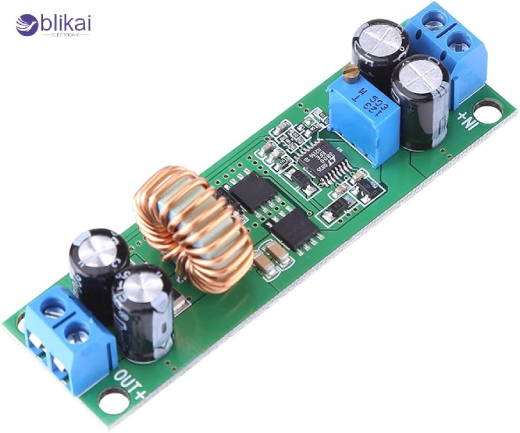
What Is a DC-DC Converter?
A DC-DC converter is an electronic circuit or module that converts a DC input voltage to a different DC output voltage. Depending on the needs of the system, the conversion may include dropping the voltage, boosting the voltage or both. Conversely to transformers, which operate with the use of alternating current (AC), DC-DC converters internally generate a high-frequency switching waveform that facilitates energy transfer and control in a DC power system.
In advanced electronics, one piece of equipment may need more than one voltage rail. An example would be a battery that can be used to provide 12 V or 3.7 V, but processors, sensors, memory and communications modules can be provided at 5 V, 3.3 V, 1.8 V (or even less). DC-DC converters enable such levels of voltage to be produced effectively using a shared power supply.
Why DC-DC Converters Are Used in Electronic Systems
Efficiency is one of the major causes. Linear regulators dissipate the excess voltage as heat, which is more inefficient with an increase in the voltage difference between the input and output. By comparison, DC-DC converters store energy in inductive or capacitive storage devices, then transfer it with efficiencies of between 85 and 98 percent.
The other reason is thermal management. Less power loss implies less heat production, and this translates to smaller enclosures, increased reliability, and increased longevity of the components. This is particularly important in compact consumer electronics and automotive systems.
DC-DC converters are also needed in battery-operated equipment, in which the maximum energy use is directly proportional to the operating life. Moreover, they permit dynamic system design with large input voltage operating points and dynamically adjusted output voltage with varying load conditions.
Basic Working Principle of a DC-DC Converter
A DC-DC converter, in its most basic form, is a device that can switch a semiconductor on and off at a very rapid rate to manipulate the incoming energy into the output. This switching operation changes the DC input into a high-frequency signal, which undergoes energy storage elements to generate a constant DC signal.
The switching device is normally a power MOSFET, which is driven by a special controller IC. When the switch turns on, energy is stored in an inductor or a capacitor. When the switch turns off, the stored energy is released to the load through a diode or synchronous rectifier. By adjusting the duty cycle—the ratio of on-time to total switching period—the converter regulates the output voltage.
Pulse-width modulation (PWM) is the most common control method used in DC-DC converters. The feedback signal of the output voltage is always compared with a reference voltage to ensure that the controller can regulate the duty cycle and contend with the variations in input voltage or load current.
Step-by-Step DC-DC Conversion Process
Switch-On Phase
Current is passed on an input source, and energy is stored in the inductor or capacitor.
Energy Storage Mechanism
Inductors store energy in magnetic fields, while capacitors store energy in electric fields.
Switch-Off Phase
Stored energy is transferred to the output and load.
Output Filtering and Regulation
Capacitors smooth the voltage ripple to produce a stable DC output.
Main Types of DC-DC Converters
Buck Converter (Step-Down DC-DC Converter)
A buck converter reduces the input voltage to a low output voltage that is low. It is one of the most popular types of DC-DC converters as it is easy and most successful. The average voltage of the output is proportional to the switching signal duty cycle in a buck converter. Buck converters are widely used to power microcontrollers, digital logic circuits, and low-voltage ICs from higher-voltage power sources.
Typical applications include converting 12 V or 24 V industrial supply rails down to 5 V or 3.3 V. Buck converters are valued for their excellent efficiency, low output ripple when properly designed, and scalability across a wide range of power levels.
Boost Converter (Step-Up DC-DC Converter)
A boost converter magnifies the input voltage to a greater output voltage. The principle of operation is that it stores the energy in an inductor in the switch-on phase and releases the energy in series with the input voltage in the switch-off phase. This additive effect gives a larger output voltage than the input.
Boost converters are used in devices that are battery-operated and whose voltage reduces with time. For example, a boost converter can raise a 3 V battery voltage to 5 V to power USB devices, sensors, or display modules.
Buck-Boost Converter
A buck-boost converter can be a converter which can boost and cut its voltage depending on the conditions under which it works. The polarity of the output voltage is the reverse of that of old buck-boost converters, but the polarity is the same in new non-inverting converters. This is what makes buck-boost converters the most appropriate choice in situations that encounter a broad spectrum of input voltages, e.g., automotive electronics and handheld electronics.
Isolated vs Non-Isolated DC-DC Converters
Non-isolated DC-DC converters share a common electrical ground between input and output and are typically simpler, smaller, and more efficient. Isolated DC-DC converters use a high-frequency transformer to provide galvanic isolation, enhancing safety and noise immunity. The common isolated topologies are flyback, forward, push-pull, half-bridge and full-bridge converters. This is typical of industrial, medical and telecom plan designs.
Key Components Used in DC-DC Converters
High currents are carried, and high frequencies are used by power switches, which are normally MOSFETs. Efficiency directly depends on the switching speed and on-resistance of them. Inductors store energy and smoothen the current flow. The core material used in the inductor, as well as the saturation current rating, are important design factors.
Capacitors provide output filtering and transient response. Low equivalent series resistance (ESR) capacitors are preferred to minimize ripple voltage. Control ICs manage switching, feedback, protection features, and synchronization, enabling compact and robust converter designs.
DC-DC Converter Efficiency and Performance Factors
Efficiency is one of the most important metrics of a DC-DC converter. It depends on switching losses, conduction losses, magnetic losses, and control overhead. Higher switching frequencies allow for smaller inductors and capacitors but increase switching losses.
Load regulation refers to the converter’s ability to maintain a stable output voltage as load current changes, while line regulation describes performance under varying input voltage. Ripple voltage and output noise are very important in sensitive analog and RF circuits, and may necessitate extra filtering.
Common Applications of DC-DC Converters
In all fields of electronics, DC-DC converters are utilized. They are used to power processors, memory, and peripherals in smartphones, tablets, and laptops in consumer electronics. In embedded systems, they supply regulated voltages to microcontrollers and sensors.
Automotive electronics rely on DC-DC converters to step down battery voltage and provide stable power to control units, infotainment systems, and safety modules. A DC-DC converter is used in industry in motor drives, PLCs, and instrumentation. They are used in solar charge controllers, wind turbines and the storage of energy that is renewed. Compact DC-DC converters increase battery life and ensure reliability in some applications in IoT devices.
DC-DC Converter vs Linear Regulator
DC-DC converters are far more efficient than linear regulators, particularly when the difference between the input and the output voltage is large. Linear regulators are easier and generate less noise, though unnecessary energy is wasted in the form of heat. DC-DC converters are more complicated and can cause switching noise, but their power efficiency and their ability to be more flexibly applied are what make them the most popular in most modern designs.
How to Choose the Right DC-DC Converter
Selecting the right DC-DC converter involves evaluating input voltage range, output voltage and current requirements, efficiency targets, physical size, cost constraints, and environmental conditions. Protection facilities like overcurrent, overvoltage and thermal shutdown have to be considered by the designers as well to make the systems reliable.
Common DC-DC Converter Problems and Troubleshooting
Typical issues include unstable output voltage caused by poor feedback loop design, excessive ripple due to inadequate filtering, and overheating from undersized components or insufficient airflow. The design, choice of components, and following the manufacturer's instructions also led to the successful work.
FAQs
What does a DC-DC converter do?
A DC-DC converter changes one DC voltage level into another while maintaining efficient power transfer. It is applied to supply the required voltage to the electronic components and systems in the right amount.
How efficient is a DC-DC converter?
Most DC-DC converters achieve efficiencies between 85% and 98%, depending on topology, load conditions, and component quality.
Where are DC-DC converters used?
They have consumer electronics applications, automotive applications, industrial applications, renewable energy applications, embedded applications, and Internet of Things applications.
Future Trends in DC-DC Converter Technology
Advancements in wide-bandgap semiconductors such as gallium nitride (GaN) and silicon carbide (SiC) are enabling higher switching frequencies, improved efficiency, and smaller converter designs. The combination of control, power stages, and passive components into packaged systems is also miniaturizing and simplifying system design. With increasing energy efficiency demands, DC-DC converters are going to keep changing as a fundamental technology in the electronics of the present day.
Some images are sourced online. Please contact us for removal if any copyright concerns arise.





