


Digital Signal Processor for Car Audio: DSP IC Guide
 186
186Introduction
There are special acoustic issues in modern car audio systems that are non-existent in home or studio situations. Unbalanced location of speakers, reflective walls in the cabin, and a lack of space for installing speakers can have devastating results on the quality of sound. A Digital Signal Processor (DSP) IC solves these problems by digitally controlling and optimizing audio signals before they reach the amplifiers and speakers. This guide describes the operation of car audio DSP ICs, their major functions, specifications and applications and identification of appropriate DSP chips to be employed in an automotive audio project.
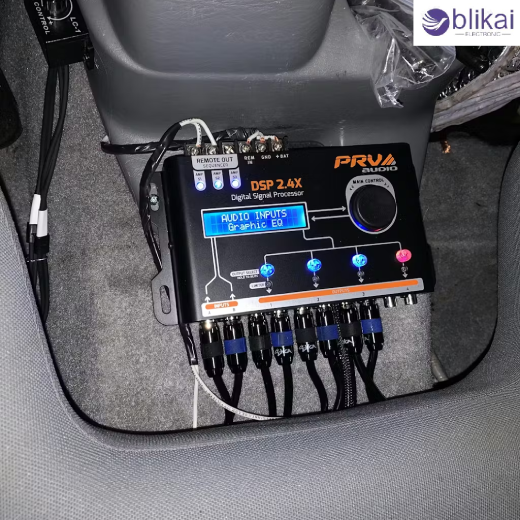
What Is a Digital Signal Processor (DSP) in Car Audio?
In car audio, a Digital Signal Processor (DSP) is an electronic component that is an integrated circuit that has the mathematical capacity to process audio signals in the digital domain. Instead of relying on fixed analog components, a DSP IC uses algorithms to adjust frequency response, timing, and dynamics with high precision. In automotive audio systems, DSPs are used to compensate for cabin acoustics, improve sound staging, and deliver consistent audio performance across different listening positions.
How Car Audio DSP ICs Work
The car audio DSP IC takes the audio signals through a number of phases. An Analog-to-Digital Converter (ADC) transforms the incoming analog signal from an incoming head unit or media source into digital data. Real-time processing of the signal, like equalization, filtering, and delay control, is then done by the DSP core. Lastly, the Digital-to-Analog Converter (DAC) transforms the signal that has been processed back to analog to be amplified. This digital workflow allows flexible, software-controlled tuning without changing hardware components.
Key Functions of Car Audio DSP ICs
Equalization (EQ) and Sound Tuning
The DSP car audio is equalization, which is one of the most crucial functions of equalization. DSP ICs are provided with graphic and parametric EQ to control individual frequency bands, fixing peaks and dips due to the positioning of speakers and cabin resonance. This translates into crisper vocals, tighter bass, as well as more balanced sound in the frequency spectrum.
Time Alignment and Delay Control
Since speakers in a car are at various distances from the listener, they take different times to reach the listener. DSP ICs provide the exact time delay on each channel to align the arrival of sound to enhance stereo imaging. Proper time alignment creates a centered soundstage and enhances spatial realism.
Active Crossover and Filtering
Car audio DSP ICs realize digital crossovers which separate audio signals into high, mid and low frequency ranges. Each speaker is permitted to function in its optimum frequency range through high-pass filters, low-pass filters, and band-pass filters. Active crossovers based on DSP are more efficient and flexible, as well as more tuned than passive crossovers.
Dynamic Range Control and Bass Enhancement
The DSP ICs are also able to control the dynamics of audio, compression and limiting. These characteristics eliminate distortion when played at high levels and allow the same loudness. The bass enhancement algorithm is able to enhance low frequencies without speaker overdriving and enhance the perceived bass response in a small car cabin.
Main Specifications of Car Audio DSP ICs
In the assessment of a DSP IC in car audio, a number of technical requirements are effective. The audio resolution and clarity are based on bit depth and sampling rate, and the typical values are 24-bit/48 kHz and 32-bit/96 kHz. The number of channels determines the number of audio ports or sources that the DSP is able to handle at a time. DSP ICs used in automobiles are also specified to have large temperature ranges and operate reliably with variable vehicle supply voltages. Low latency and real-time processing capability are essential for seamless audio playback.
Car Audio DSP IC vs Traditional Audio Amplifier IC
A traditional audio amplifier IC increases signal power but does not modify the signal content. In contrast, a DSP IC manipulates the audio signal itself before amplification. Most modern car audio systems combine both components, using a DSP IC for signal optimization and amplifier ICs for power delivery. This combination provides superior sound quality and system flexibility.
Typical Applications of DSP ICs in Car Audio Systems
OEM Factory Car Audio Systems
DSP ICs can be found in the original equipment manufacturer (OEM) car audio systems as a means of providing similar sound quality in the various vehicle models and trim levels. Through digital tuning of equalization, crossovers and time alignment, manufacturers are able to adjust the speakers' placement, cabin area and interior materials at very low hardware expenses.
Aftermarket Car Audio DSP Processors
Dedicated DSP ICs are important to aftermarket DSP processors to enhance factory or custom car audio systems. These processors allow installers and enthusiasts to fine-tune frequency response, channel routing, and delay settings without replacing the head unit, making DSP ICs a popular solution for sound quality improvement.
Car Head Units and Infotainment Systems
The car head unit and infotainment systems used today incorporate DSP ICs to control the audio playback, automobile navigation prompts, hands-free calls, and multimedia sources. The DSP facilitates the constant alternation of audio streams and constant sound volume and reproduction of voices without compromising on low latency and high reliability.
Multi-Channel and Surround Sound Car Audio Systems
DSP ICs are essential in multi-channel and surround sound car audio systems, where precise channel synchronization and spatial processing are required. Functions such as matrix decoding, virtual surround effects, and channel balancing depend on the real-time processing capability of the DSP.
High-End and Competition-Level Car Audio Setups
DSP ICs have explored the limits in tuning flexibility and processing accuracy even in high-end and competitive-grade car audio systems. Complex equalization, high-resolution and small time alignment enable competitors to adjust sound staging and tonal balance in the best way possible to satisfy tough judging criteria.
Active Speaker and Amplifier Systems
In other contemporary car audio amplifier designs and active speaker designs, the computerized software is literally incorporated into the amplifier module with the DSP ICs. This technology facilitates the wiring of systems, is more efficient, and allows per-channel tuning, making DSP-based active systems progressively popular in OEM and aftermarket systems.
How to Choose the Right DSP IC for Car Audio Projects
The choice of a DSP IC is based on the performance and complexity of the system. The number of channels must be equal to the number of speakers and subwoofers in the system. Software support and tuning interfaces also play a vital role because easy-to-use tools make the calibration of the system easier. Designers are also required to take into account the power consumption, electromagnetic compatibility and cost-performance ratio during the selection of a DSP IC.
Basic DSP Car Audio System Block Diagram
A standard car audio with a DSP will consist of an audio source and ADC stage, DSP IC, DAC stage, power amplifiers, and speakers. The DSP is positioned between the source and amplifiers and serves as the main control option in the optimization of audio. This is a design with a modular design that can be easily upgraded as well as expanded.
Common Design Challenges and Solutions
The automotive environments bring electrical noises, temperature variability and erratic voltages. Good PCB layout, filtering, and shielding can minimize interference. DSP ICs with low latency reduce the problems of synchronization in audio and video systems. It has long-term reliability by applying automotive-qualified components.
Future Trends in Car Audio DSP Technology
In the field of car audio, the DSP technology is still developing to use AI-assisted tuning, automatic calibration and immersive sound. It is becoming integrated with vehicle infotainment and driver-assistance systems. An increasing number of high-resolution audio and object-based sound processing are being found in high-end vehicles.
FAQ
What does a DSP do in car audio?
A DSP computerizes and enhances audio signals to enhance focus, balance and spatial imaging in a car.
Can a DSP improve factory car audio systems?
A DSP can dramatically enhance factory systems by correcting frequency response and timing issues.
Do all car audio DSPs require tuning software?
In the majority of DSPs, configuration and fine-tuning are done with software or mobile applications.
Conclusion
One of the primary elements of modern car audio is a Digital Signal Processor. DSP ICs allow accurate control over audio signals, which address acoustic issues specific to vehicles. Through the knowledge of DSP functions, specifications, and design issues, engineers and audio enthusiasts are able to design high-performance car audio systems, which offer excellent sound quality and flexibility.
Some images are sourced online. Please contact us for removal if any copyright concerns arise.





