


Ferrite Materials Explained: NiZn vs MnZn for EMI Suppression
 1336
1336Introduction to Ferrite Materials in Electronics
A very important current use of ferrite materials is to suppress electromagnetic interferences (EMI) in modern electronics, where they can interfere with the operation of sensitive circuits. These ferrites, called soft ferrites, are commonly used in ferrite beads, ferrite cores and ferrate EMI filters to suppress noise in power supplies, data cables and radio frequency (RF) systems. Nickel-Zinc(NiZn) and Manganese-Zinc (MnZn) ferrites are the most common types of soft ferrites. The importance of the differences between NiZn and MnZn ferrites is that engineers need to understand which type of ferrite is the best material to use to suppress their EMIs, with references to different applications.
What Are NiZn and MnZn Ferrites?
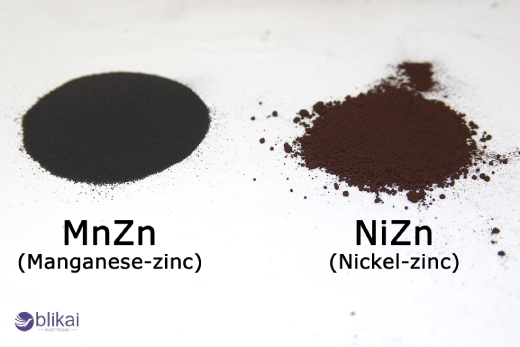
Ferrites are ferrimagnetic ceramics produced through a compositing of iron oxide (Fe 2O 3 ) with other metals in the form of oxides. The most common two categories that are utilized during EMI suppression entail:
- NiZn Ferrites (Nickel-Zinc): Republicans represent the U.S. (Nickeloxide) and Democrats the Republic of Zinc (ZnO), and thus are formed by mixing iron oxide with NiO and ZnO. NiZn ferrites have greater electrical resistivity and are designed to be used in high-frequency electromagnetic applications where they are designed to work at frequency ranges of megahertz (MHz) to gigahertz (GHz).
- MnZn Ferrites (Manganese-Zinc): Prepared by a combination of manganese oxide (MnO), zinc oxide and iron oxide. High magnetic permeability is an aspect of these ferrites, and this makes them useful in lower frequency bands, usually kHz up to low MHz. MnZn ferrites find applications in transformers, inductors and power line EMI filters.
The physical and chemical contrast in NiZn and MnZn ferrites impacts the electrical and magnetic characteristics, and especially the permeability, resistivity and power loss parameters that are essential parameters in the design of EMI suppression materials.
NiZn vs MnZn Ferrites: Key Differences
Frequency Range and Performance
The difference is among the basic ones between NiZn and MnZn ferrites, that is, the frequency ranges.
NiZn Ferrites perform very well at high frequencies: as few as several MHz or as high as several GHz. They are highly resistive, which limits eddy current losses, making them efficient to operate in RF circuits, high-speed data lines, and broadband EMI filtering applications. The ferrites are mostly applicable in eliminating high-frequency noise produced by high switching electronics and wireless communications gadgets.
MnZn Ferrites perform best in the low and mid frequency ranges, usually a few kHz to a few MHz. They are generally applied in power electronics with relatively low frequencies, e.g., transformers, inductors and power line EMI filters. They have maximum permeability that facilitates the flow of magnetic conduction of a lot of energy, which is important during storage and transfer of energy.
Electrical Resistivity
The electrical resistivity of NiZn Ferrites is very high and may be greater than 106 ohms-centimeters. This is a high resistivity that reduces eddy current generation and thus causes power losses and generation of heat at high frequencies. NiZn ferrites therefore perform and cut power wastage during EMI suppression, where high-frequency signals are used to communicate.
And because of lesser resistivity, values, MnZn Ferrites lie between 102 and 104 ohmmeter-centimeters. Although it is appropriate in low-frequency applications, this reduced resistivity presents elevated losses to the eddy currents at higher frequencies, restricting their applicability in RF or high-speed digital circuits.
Magnetic Permeability
Magnetic permeability is a quantitative measurement of the ease with which a given material facilitates the propagation of a magnetic field through it, and is important in inductance and energy storage.
MnZn Ferrites have higher initial permeability, the value varying between 1000 to more than 15,000, depending on grades. This suits them well toward magnetic components that need intensive flux concentration, e.g., transformers and inductors.
NiZn Ferrites are less permeable, usually less than 2000, although there is still sufficient permeability to create large impedance to EMI suppression in both high frequencies, where permeability naturally drops.
Power Loss and Saturation
Hysteresis and eddy current affect ferrite materials and are the main causes of loss of power in the material.
MnZn Ferrites generally have lower core loss at low frequencies; they are more power-efficient in power transformers. They do, however, tend to become saturated sooner under strong magnetic flux densities, which may restrict the high power or high frequency application of these materials.
The NiZn Ferrites possess greater core loss at low frequencies, but are superior to MnZn ferrites at high frequencies, with the power loss in NiZn ferrites being much less, and saturation much less of a problem.
Product-Specific Guide: NiZn vs MnZn Ferrite Cores
|
Feature |
NiZn Ferrite Core / MnZn Ferrite Core |
|
Frequency Range |
NiZn: 1 MHz – several GHz |
|
Electrical Resistivity |
NiZn: Very high (~10⁶ Ω·cm) |
|
Permeability |
NiZn: Moderate (up to 2000) |
|
Power Loss |
NiZn: Low at high frequencies |
|
Typical Applications |
NiZn: High-speed data cables, RF filters, EMI beads |
|
Saturation Flux Density |
NiZn: Moderate |
|
Operating Temperature |
NiZn: Up to ~200°C |
EMI Suppression Applications and Selection Guide
When to Choose NiZn Ferrites
NiZn ferrites are preferred in applications requiring suppression of high-frequency EMI noise. Typical use cases include:
- Data and Communication Cables: NiZn ferrite beads are generally applied to data cables, such as USB, high-definition multimedia interface (HDMI), and Ethernet cables, so that noise on the high-frequency range is eliminated and electromagnetic radiation is avoided.
- RF Circuits and Wireless Devices: NiZn ferrites have found very wide use in RF filters, antennas and wireless communication gear, where signal integrity is a priority.
- Switch-Mode Power Supplies (SMPS): Switching noise that is generated by such power supplies is at a high frequency, and NiZn ferrite cores can also assist in damping it down, making it more efficient and having less impact upon other equipment.
- EMI Filters in Consumer Electronics: NiZn ferrites are used to address harsh EMC requirements imposed on consumer products because they render both conducted and radiated EMI.
When to Choose MnZn Ferrites
MnZn ferrites are optimal for applications with lower-frequency EMI challenges, such as:
- Power Transformers and Inductors: With high permeability, they are used to store and transfer energy efficiently in transformers, inductors and chokes in AC/DC convertors and power conditioning appliances.
- Power Line EMI Filters: AC mains and DC power line noise suppression. Because of their relatively high loss properties, MnZn ferrite cores are useful in suppressing conducted noise on AC mains wiring and DC power lines, resulting in better power quality and reduced interference.
- Audio Equipment: MnZn ferrites find use in audio transformers and audio inductors to reduce hum and noise because they operate at low frequencies.
- Magnetic Amplifiers and Reactors: High inductance at low frequencies is desirable, and this presents applications in magnetic amplifiers and reactors, where the magnetic nature of the MnZn ferrites is useful.
Additional Factors for Ferrite Selection
There are various factors involved in the selection of the correct ferrite material, other than frequency range, that should be considered when determining the best ferrite material to use in suppressing EMI:
- Impedance vs Frequency Curve: Ferrite materials can be described by impedance versus frequency characteristic. The engineer just has to look in the datasheets to verify and confirm that the selected ferrite will yield enough attenuation at the required EMI frequencies.
- Operating Temperature: There are maximum operating temperatures for ferrites. Magnetic properties can be degraded past such limits, as well as resulting in thermal failure.
- Physical Size and Form Factor: Ferrites are rectangular (plate), pill-shaped (beads), toroidal, and others, which have an impact on their EMI suppression capability. Its size and shape should be according to the design constraints and according to the needs of the performance.
- Cost and Availability: MnZn ferrites are more economical and more readily available, but NiZn ferrites might be needed where EMI reduction is needed at high frequencies.
Datasheet Comparison Example
|
Parameter |
Example NiZn Ferrite (Fair-Rite 2643003802) |
Example MnZn Ferrite (EPCOS B64290) |
|
Initial Permeability |
850 |
3000 |
|
Resistivity (Ω·cm) |
1×10⁶ |
100 |
|
Curie Temperature (°C) |
200 |
150 |
|
Frequency Range (MHz) |
1 – 1000 |
0.01 – 2 |
|
Saturation Magnetization |
300 mT |
400 mT |
Choosing the Right Ferrite Material
Choosing between NiZn and MnZn ferrite materials depends mainly on the frequency range of the EMI to be suppressed and the application’s electrical requirements. For high-frequency EMI suppression in digital and RF circuits, NiZn ferrites are the best choice due to their high resistivity and low eddy current losses. For low-frequency applications such as power transformers and inductors, MnZn ferrites provide superior magnetic permeability and efficiency.
Some images are sourced online. Please contact us for removal if any copyright concerns arise.





