


Gate Drivers Explained: Types, Working & Applications Guide
 418
418What Is a Gate Driver?
A gate driver is an electronic circuit or integrated circuit designed to control the gate of a power semiconductor device by rephrasing low-power control signals into high-current drive signals. Power MOSFETs behave like voltage-controlled capacitive devices rather than simple switches, meaning energy must be supplied quickly to charge and discharge the gate capacitance during switching transitions, which a gate driver accomplishes efficiently.
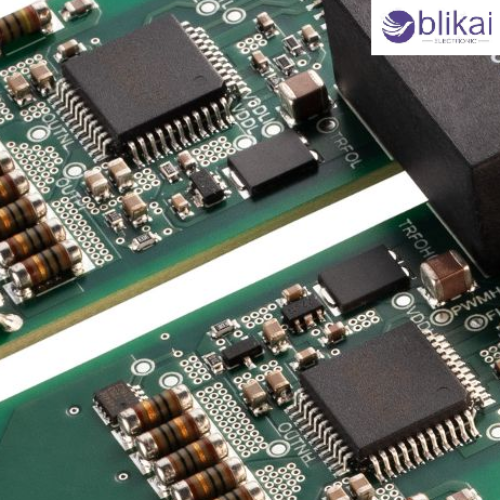
Gate Driver vs Direct Microcontroller Control
Microcontroller general-purpose input/output pins generally have many milliamps of drive current, and MOSFET gates may need amperes of immediate drive current. Gate drivers amplify current capability, give position shifting for high-side operation, and integrate protection mechanisms that microcontrollers can not deliver directly.
How Gate Drivers Work
Basic Operating Principle
The principle of the Gate drivers is that a PWM, or logic signal, is fed to the gate drivers, which convert the signal into high-current pulses that alternate between sourcing and sinking current to the MOSFET gate. When turning on, the driver charges the gate capacitance to a defined voltage, creating a conductive channel; when turning off, it rapidly discharges the gate to ground to stop conduction and prevent overlap conduction losses.
Gate Charge and Switching Dynamics
Switching performance depends heavily on total gate charge and driver current capability. Faster charging reduces switching time, lowering switching losses and improving efficiency, particularly in high-frequency buck converters used in computing and power supply systems.
High-Side vs Low-Side Driving Concepts
Low-side drivers reference ground directly, while high-side drivers operate at switching node voltage levels and therefore require bootstrap circuits or isolated supplies. The high-side operation allows half-bridge and synchronous rectification in modern DC-DC converters.
Turn-On and Turn-Off Control Mechanisms
Gate drivers precisely control switching timing using propagation delay management and internal logic. Numerous devices apply shoot-through protection to ensure high-side and low-side MOSFETs do not conduct contemporaneously, precluding disastrous short circuits.
Types of Gate Drivers
Low-Side Gate Drivers
Low-side drivers control MOSFETs connected between the load and ground and are commonly used in simple switching or motor control circuits where level shifting is unnecessary.
High-Side Gate Drivers
High-side drivers enable switching on the supply side of a load and typically use bootstrap capacitors to generate gate voltages higher than the input supply.
Half-Bridge Gate Drivers
Half-bridge drivers integrate both high-side and low-side control, enabling concurrent buck converters and inverter stages extensively used in power inventories and CPU voltage regulators.
Full-Bridge Gate Drivers
Full-bridge configurations combine two partial-bridges and allow bidirectional current inflow, generally used in motor drives and power inverters.
Isolated Gate Drivers
Isolated drivers use capacitive, glamorous, or optic coupling to separate control and power disciplines, perfecting safety in high-voltage systems.
Smart Gate Driver ICs
Modern smart drivers integrate diagnostics, undervoltage lockout, thermal shutdown, and adaptive timing to simplify power stage design.
Gate Driver IC Internal Architecture
Input Logic Stage
The input stage conditions PWM signals, ensuring compatibility with digital controllers while providing noise immunity and logic threshold control.
Output Driver Stage
The output stage typically uses a push-pull configuration capable of sourcing and sinking high peak current to rapidly control gate charge movement.
Protection Circuits
Protection functions include undervoltage walkout, shoot-through forestallment, and controlled arrestment countries that cover both MOSFETs and system power rails.
Isolation Technologies
Depending on operation conditions, drivers may apply position shifting or galvanic isolation to safely control floating high-side switches.
Key Electrical Parameters of Gate Drivers
Peak Output Current
Peak source and sink currents directly affect switching speed. The RT9610CGQW provides approximately 2A source/sink capability, enabling fast MOSFET switching in synchronous buck designs.
Propagation Delay and Timing Matching
Propagation detention determines how directly switching signals follow PWM inputs; minute-position detainments reduce dead-time deformation and ameliorate converter effectiveness.
Supply Voltage Range
Gate drivers must match system bias rails; many synchronous drivers operate from around 5V bias supplies suitable for motherboard and DC-DC regulator applications.
Common-Mode Transient Immunity
High switching speeds generate large voltage transients, making immunity to common-mode noise essential for stable operation.
Gate Driver Design Considerations
Selecting Gate Resistance
Gate resistors control switching speed and EMI geste by shaping current inflow into the MOSFET gate, balancing effectiveness and noise.
Bootstrap Circuit Design
Bootstrap capacitors store energy used to drive high-side MOSFETs. Proper sizing ensures reliable switching during high duty cycles.
PCB Layout Best Practices
Short gate circles, proper grounding, and minimized parasitic inductance are critical to help reduce ringing and voltage overshoot.
Thermal Management Strategies
Although drivers dissipate less power than MOSFETs, high switching frequency applications still require good thermal layout and exposed pad grounding.
Gate Drivers for Different Power Devices
MOSFET Gate Drivers
MOSFET drivers dominate low-to-medium voltage applications such as computer power rails and telecom converters.
IGBT Gate Drivers
IGBT drivers handle higher voltages and slower switching speeds in industrial motor and inverter systems.
SiC and GaN Gate Drivers
Wide-bandgap devices bear faster drivers with precise timing and advanced dv/ dt forbearance.
RT9610CGQW vs RT9624AZQW Gate Driver Comparison
Device Overview
The RT9610CGQW is a high-voltage coetaneous remedied buck MOSFET driver designed primarily for tablet and DC-DC converter operations, supporting high-side and low-side N-MOSFET control with bootstrap operation. The RT9624AZQW is a high-frequency half-bridge MOSFET driver optimized for CPU voltage regulator modules and high-current low-voltage converters, integrating fresh switching advancements.
Architecture Differences
RT9610CGQW focuses on compact synchronous buck driving with external bootstrap configuration, while RT9624AZQW integrates an internal bootstrap diode and enhanced PWM control logic, simplifying external component count and improving reliability.
|
Parameter |
||
|
Manufacturer |
Richtek |
Richtek |
|
Device Type |
Synchronous Buck MOSFET Driver |
Half-Bridge MOSFET Gate Driver |
|
Driver Configuration |
High-Side + Low-Side Driver |
High-Side + Low-Side Driver |
|
Target Application |
Notebook & DC-DC converters |
CPU VRM & High-current buck converters |
|
Input Logic Compatibility |
PWM Control |
Tri-State PWM Control |
|
Supply Voltage (VCC) |
5V typical bias |
5V bias supply |
|
Bootstrap Circuit |
External bootstrap diode required |
Integrated bootstrap diode |
|
Peak Gate Drive Current |
~2A Source / Sink |
Higher drive capability (optimized for high frequency) |
|
Switching Frequency Support |
Up to ~300 kHz (typical) |
Up to ~500 kHz |
|
Shoot-Through Protection |
Yes |
Yes (Enhanced control) |
|
Under-Voltage Lockout (UVLO) |
Supported |
Supported |
|
Enable / Shutdown Control |
Basic |
Advanced enable & tri-state shutdown |
|
Propagation Delay |
Low delay |
Optimized low delay matching |
|
Efficiency Optimization |
Standard synchronous buck |
High-efficiency VRM optimization |
|
Package Type |
WQFN package |
WQFN package |
|
Typical Applications |
General DC-DC regulators |
CPU/GPU power stages |
|
Design Complexity |
Moderate external components |
Reduced external components |
|
Performance Positioning |
Cost-effective driver |
High-performance integrated driver |
Switching Performance
The switching frequency supported by RT9624AZQW is about 500kHz, and therefore it can be used in the modern high-density VRM design when smaller inductors and faster transient response are needed.
Protection Features
Both devices implement shoot-through protection, but RT9624AZQW includes tri-state PWM shutdown and enable control mechanisms for improved system fault handling.
Application Positioning
RT9610CGQW is commonly suited for general synchronous buck converters and legacy notebook power rails, whereas RT9624AZQW targets higher-performance CPU and GPU power delivery designs demanding higher switching frequency and integration.
Applications of Gate Drivers
Switching Power Supplies (SMPS)
Gate drivers enable efficient switching in AC-DC and DC-DC converters, reducing conduction losses while maintaining tight voltage regulation.
Motor Control Systems
Brushless DC and servo motors rely on half-bridge drivers for efficient PWM motor phase control.
Renewable Energy Systems
Solar inverters and battery storage systems use gate drivers to manage high-effectiveness power conversion stages.
Electric Vehicles
Traction inverters and onboard chargers depend on fast gate drivers to minimize switching losses in high-power systems.
Industrial Automation Equipment
Robotics and automation platforms bear dependable switching performance for precision control and energy efficiency.
Common Gate Driver Problems and Troubleshooting
Shoot-Through Issues
Improper dead time or layout parasitics may cause simultaneous MOSFET conduction, leading to overheating and failure.
Noise and False Triggering
High dv/dt environments can introduce false switching unless proper grounding and filtering techniques are implemented.
Overheating and Switching Losses
Slow gate drive or insufficient current capability increases switching losses, often solved by selecting higher peak current drivers.
How to Choose the Right Gate Driver IC
Voltage and Current Requirements
Select a driver capable of supplying sufficient peak current relative to MOSFET gate charge and switching frequency.
Isolation Requirements
High-voltage systems may require isolated drivers for safety compliance.
Switching Frequency Considerations
Higher frequencies improve transient response but increase switching loss, requiring optimized driver selection.
Protection Features Checklist
Noteworthy characteristics are UVLO, shoot-through prevention, thermal shutdown, and enable control.
FAQ
Do MOSFETs always need a gate driver?
Low-power circuits may not bear one, but high-speed or high-current systems nearly always do.
What is the difference between high-side and low-side drivers?
High-side drivers operate at switching knot voltage using bootstrap or insulation, while low-side drivers source ground.
Can a microcontroller drive a MOSFET directly?
Only small MOSFETs at low speed; efficient power switching requires a dedicated driver.
Why is shoot-through protection important?
It prevents the simultaneous conduction of MOSFET pairs that could short the supply.
Conclusion
Basic building blocks of modern power electronics Gate drivers allow efficient, fast, and reliable switching over applications in consumer electronics to industrial automation and electric vehicles. The RT9610CGQW and RT9624AZQW offer efficient synchronous buck driving to general DC-DC converters, and newer units like the RT9624AZQW offer more advanced integration and switching to high-performance CPU power delivery systems. The choice of the gate driver depends on the switching speed, protection characteristics, and the application needs, which are essential to the highest efficiency, as well as the reliability of the system in the long run.
Some images are sourced online. Please contact us for removal if any copyright concerns arise.





