


Passive Infrared Detector: Working Principle, Types & Applications
 719
719Introduction to Passive Infrared Detectors (PIR)
One of the most common types of motion sensors that are used in residential and office premises, and on the streets, is a Passive Infrared Detector (PIR). You must have heard of them so much; most of the time, they are the sensor types that automatically switch on lights when a person enters a room or the alarm when a person walks.
These detectors work by sensing infrared radiation (IR) — a type of invisible light that humans and animals naturally emit as heat. The popularity of PIR detectors is that they are energy saving, dependable, and cheap and are therefore used in most of our daily lives in security systems, intelligent lights, and automatic doors.
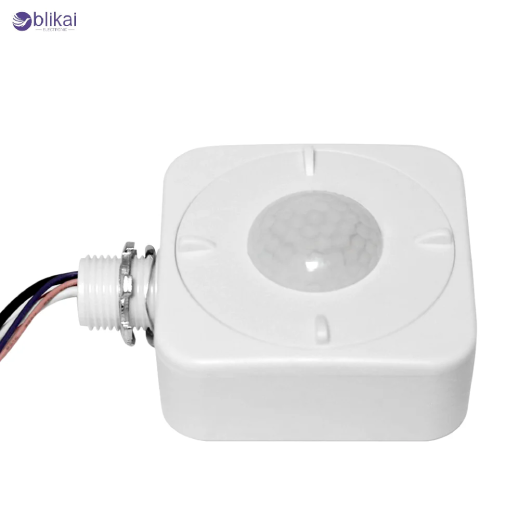
What Is a Passive Infrared Detector?
The term passive implies that this sensor does not transmit any signals on its own. Instead, it simply detects changes in infrared energy from its surroundings.
All the objects that have a temperature higher than absolute zero emit infrared radiation. Human beings, just to mention a few, emit a lot of heat substances that infrared sensors can intercept. A PIR sensor detects these variations of energy - as an individual passes over the field of its detection, the amount of infrared light varies and is then detected by the sensor as motion.
A typical PIR detector includes:
- Pyroelectric sensor – the principal element of the sensing that picks up infrared radiation.
- Fresnel lens – concentrates the infrared energy into the sensor.
- Electronic circuit – processes the signal and triggers an output.
- Output stage – causes the connected devices, such as lights, alarms or buzzers to be activated.
How a PIR Detector Works
A PIR detector works on the principle of the pyroelectric effect, i.e., some substances produce an electric signal when subjected to heat energy or infrared radiation variation.
The body heat of a person varies the infrared pattern, which is recognized by the sensor when entering the field of view of the sensor. This sudden change produces a small electrical signal. The circuit inside the PIR module amplifies and processes this signal to determine whether motion has occurred.
In case the change is sufficiently large, the PIR module produces an output signal - such as the activation of a light, the alarm or a signal to a controller.
Since the PIR detector responds solely to moving heat sources, it is ideal in energy-saving automatic systems that are not sensitive to the constant environment.
Main Components of a PIR Sensor Module
|
Component |
Function |
|
Pyroelectric Sensor |
Detects infrared energy changes in the environment. |
|
Fresnel Lens |
Focuses and shapes the detection area. |
|
Amplifier Circuit |
Increases the strength of the signal. |
|
Comparator or Logic Circuit |
Determines whether movement has occurred. |
|
Output Transistor or Relay |
Drives the connected device (e.g., light, buzzer). |
Each component plays an important role. The Fresnel lens helps expand the detection area, allowing one sensor to cover wide spaces. The pyroelectric element often has two sensing areas that detect the difference between “warm” and “cool” signals — this helps the sensor distinguish real movement from background noise.
Types of Passive Infrared Detectors
There are several kinds of PIR detectors, each designed for different applications and levels of precision.
1. Single Element PIR Sensors
These are the simplest type, using one pyroelectric element to detect motion. They are often used in basic lighting control systems or small security devices.
2. Dual Element PIR Sensors
Most modern PIR modules use dual elements arranged side by side. This is done by comparing the infrared levels of the two elements in order to detect motion. The design is useful in eliminating false alarms due to slow changes in temperature or electrical noise.
3. Quad Element PIR Sensors
Quad-element sensors have four sensing zones for higher accuracy and wider coverage. They are commonly used in advanced security systems where precise motion detection is critical.
4. Digital PIR Detectors
Digital PIR sensors include built-in signal processing chips that filter noise and improve reliability. They are used in smart homes and industrial automation systems for consistent performance under different environmental conditions.
5. Low-Power and Miniature PIR Modules
The small modules are battery-optimal and suitable for the IoT (Internet of Things) and battery-powered devices. They would be wireless motion detectors, smart thermostats, and portable devices.
Key Performance Specifications
When choosing a PIR detector, a few important specifications determine how it performs:
|
Parameter |
Description |
|
Detection Range |
Maximum distance (usually 5–12 m). |
|
Field of View (FOV) |
Angle of coverage, typically 90°–180°. |
|
Sensitivity |
Ability to detect small or slow movements. |
|
Response Time |
Speed of reaction to motion. |
|
Operating Voltage |
Generally 3–12 V depending on module. |
|
Power Consumption |
Extremely low for energy-saving designs. |
The optimal PIR module has a compromise between detection range and sensitivity to prevent false activations like changes in heat or sunlight (Baker and David 2018).
Common Applications of PIR Detectors
1. Security Systems
PIR sensors find a lot of applications in motion detection alarms and security systems. They monitor illegal movement and turn on the alarms or the security cameras to begin recording.
2. Automatic Lighting
Corridor, stairway, and outdoor lights that use motion detectors are one of the most noticeable applications. The lights are automatically switched on as one walks close to them and switched off after a few seconds - they save on energy and enhance convenience.
3. Smart Home Automation
PIR sensors can be used in smart homes with the IoT controllers to automate other functions in the smart home, including the HVAC system, the door opening and closing, and room presence.
4. Energy Management Systems
PIR sensors automatically turn lights on and off, air conditioning and other appliances in a room, which are much more efficient in saving energy by understanding whether people are present in a room.
5. Industrial Automation
PIR sensors are employed as worker safety systems in factories and workplaces, ensuring that machines can only work when human beings are around, or, in some cases, automatic lighting in the work areas.
6. Consumer Electronics
PIR technology is also applied to hand dryers, automatic faucets, TVs and cameras so that they can automatically react to human presence.
Example: Simple PIR Motion Detector Circuit
The simplest PIR motion detector circuit can be comprehended. It usually consists of:
- A PIR sensor module to detect motion.
- A transistor or relay to drive the output device.
- A load, such as an LED light or buzzer.
When motion is detected, the PIR module outputs a high signal. This turns the transistor or relay, which further powers the device connected to it. The output goes off again after a preset delay (which is usually adjustable on the module) and the device is switched off.
How to Select the Right PIR Detector
Choosing the correct PIR detector depends on your application needs. Here’s a simple checklist:
Application Environment:
Indoor sensors are different from outdoor ones. PIRs used outdoors are expected to be waterproof, sun-resistant and wind-resistant.
Detection Range and Angle:
Select based on the size of the area to be covered. A passage can require 5-8 meters, and an outdoor space can require 12-15 meters.
Mounting Method:
Ceiling sensors have a wide area, whereas the wall-mounted sensors are directional.
Power Requirements:
Choose low-voltage sensors for battery or IoT applications, and standard modules for AC-powered systems.
Output Type:
There are modules with digital output (HIGH/LOW), and there are modules that have relay or analog output to be controlled flexibly.
By aligning these parameters with your project, you will be guaranteed of the best performance and energy savings.
Advantages of PIR Detectors
Low Power Consumption: The use of PIR sensors consumes minimal power; hence, it is used in battery-operated gadgets.
Cost-Effective: They are cheap and do not need many installations.
Reliable and Long-Lasting: There are low moving parts, hence low maintenance.
Wide Range of Applications: From home lighting to industrial automation.
Disadvantages of PIR Detectors
Sensitivity to Temperature Changes: Sudden heat sources like heaters or sunlight can cause false triggers.
Limited Detection of Stationary Objects: They only respond to motion, not to still bodies.
Fixed Detection Angle: The range and direction are limited by the lens design.
These few weaknesses notwithstanding, PIR detectors are one of the most effective motion detection solutions in the market.
Conclusion
Passive Infrared Detectors (PIR) have emerged to form the backbone of contemporary sensing technology. They can use infrared radiation to identify the location of a human being, which is why they are indispensable in security, energy-saving, and intelligent automation equipment.
They are not complicated, cheap, and very reliable. With the ever-changing technology, PIR detectors will be even more important in designing safer, smarter and more energy-efficient living environments.
Frequently Asked Questions (FAQ)
Can PIR detectors work through glass or walls?
No. Infrared radiation penetrates glass and walls, and therefore, movement is not detected by PIR detectors.
Can I use a PIR sensor outdoors?
Yes, however, you are supposed to use weatherproof outdoor-rated PIR sensors which can tolerate sunlight, rain and changes in temperature.
How do I connect a PIR sensor to an Arduino or microcontroller?
A majority of PIR modules have a digital output (HIGH/LOW) physical signal that can be directly read by an Arduino input pin to be used in an automation project.
Some images are sourced online. Please contact us for removal if any copyright concerns arise.





