


Schmitt Trigger vs Comparator: Key Differences Explained
 50
50What Is a Comparator?
A comparator is an analog circuit board that compares two input voltages and produces a binary signal to record which voltage is larger, and it works effectively as a decision-making element, converting analog information into a digital signal. Comparators also usually work in the open-loop mode, with a gain that is very high, unlike linear amplifiers, which work in feedback mode and the output changes rather slowly between high and low states whenever the input voltage changes beyond a reference level.
How a Comparator Works
More internally, a comparator utilizes a differential input stage, which compares the voltage difference across its non inverting and inverting terminals and since the open loop gain is very large, even a minor difference in voltage causes the output to enter the saturation region near the supply rails, a faster transition is created, which is similar to a digital switching action; however, no feedback holds the switching point constant, so the output will bounce around when the input signal is noisy around the threshold point.
Key Characteristics of Comparators
By their nature, comparators are sensitive, have a short response time, can easily detect a threshold, and can be easily implemented in a circuit, but they do not have hysteresis in the conventional sense; that is, small variations in noise at the switching voltage can result in a series of unwanted output swings referred to as chatter or oscillation.
Common Comparator ICs
Popular comparator integrated circuits are dual comparators, quad comparators, and other high-speed comparators in communication systems, all designed to be optimized to make fast switching and precision in voltage comparison over a wide range of supply voltages and operating environments.
Typical Comparator Applications
Applications where comparators are far more crucial than noise filtering include zero crossing detectors, battery voltage monitors, analog-to-digital converter front ends, pulse-width modulation generators, overvoltage protection circuits, sensor threshold detectors and so on.
What Is a Schmitt Trigger?
A Schmitt trigger is a specialized voltage comparison circuit that introduces hysteresis through positive feedback, allowing it to switch output states only when the input crosses two distinct threshold voltages instead of one, thereby significantly improving noise immunity and signal stability. Unlike a standard comparator that reacts instantly to small voltage changes near the threshold, a Schmitt trigger intentionally creates a switching gap that prevents rapid toggling caused by noisy or slowly changing signals, making it ideal for real-world signals that are rarely perfectly clean.
How a Schmitt Trigger Works
The circuit is aimed at causing a part of the output signal to be fed back to the input, via a resistor network which dynamically shifts the reference voltage basing on the output state, requiring that the input should transcend a higher threshold to switch the output high, and lower threshold to switch the output low, in order to cause controlled switching behavior that eliminates unstable intermediate states.
Hysteresis Explained
Hysteresis is the line between the upper switching voltage and the lower switching voltage, with the voltage window between the upper and the lower switching voltage, within which the input fluctuation does not affect the output, which is desired in the slow-moving analog signals or mechanical switching conditions.
Common Schmitt Trigger ICs
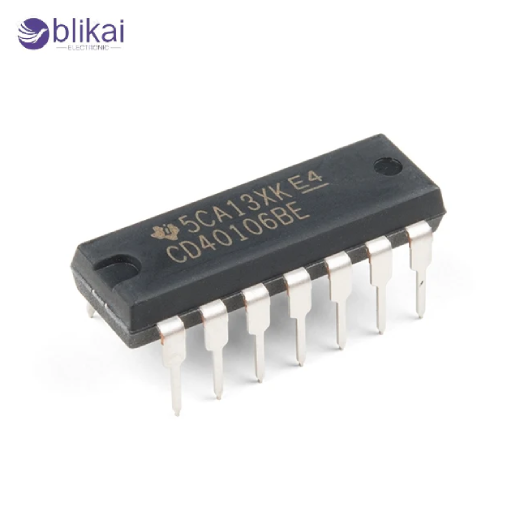
Well-known Schmitt trigger devices include logic families such as the 74HC14 hex Schmitt trigger inverter and CD40106 CMOS Schmitt trigger, both widely used for signal conditioning, oscillator circuits, and digital input stabilization.
Typical Schmitt Trigger Applications
Schmitt triggers are commonly used for switch debouncing, waveform shaping, square-wave generation, oscillator circuits, sensor signal cleanup, and converting noisy analog signals into stable digital transitions suitable for microcontroller inputs.
Core Difference Between Schmitt Trigger and Comparator
The fundamental difference between a Schmitt trigger and a comparator lies in how switching thresholds are handled, as a comparator uses a single reference threshold while a Schmitt trigger employs dual thresholds created through positive feedback, resulting in dramatically different behavior when signals contain noise or slow transitions. Comparators have high voltage comparison accuracy with regard to, and Schmitt triggers have high switching stability and noise rejection. Every device has a unique purpose, even though similar devices may be the same on the face of it.
Fundamental Functional Difference
A comparator changes output state immediately when the input crosses one threshold voltage, while a Schmitt trigger requires the signal to cross separate rising and falling thresholds, preventing repeated switching caused by minor voltage variations.
Feedback Mechanism Comparison
Comparators typically operate without feedback, whereas Schmitt triggers rely on positive feedback to modify switching conditions dynamically, which fundamentally changes circuit stability characteristics.
Noise Immunity Comparison
Because of hysteresis, Schmitt triggers offer significantly better immunity to electrical noise, electromagnetic interference, and signal ripple compared with standard comparators.
Output Stability Differences
Comparators may produce unstable outputs when inputs hover near the threshold, while Schmitt triggers maintain a stable output until a clear voltage transition occurs beyond defined limits.
Schmitt Trigger vs Comparator Comparison Table
|
Feature |
Comparator |
Schmitt Trigger |
|
Thresholds |
Single |
Dual (hysteresis) |
|
Feedback |
None (typical) |
Positive feedback |
|
Noise Immunity |
Low |
High |
|
Switching Stability |
Moderate |
Excellent |
|
Circuit Complexity |
Simple |
Slightly higher |
|
Best Use Case |
Precise detection |
Noisy signals |
|
Signal Conditioning |
Limited |
Strong |
|
Output Behavior |
May chatter |
Clean transitions |
Circuit Diagrams and Working Examples
A comparator circuit. In practice, a comparator circuit consists of a divider of reference voltage, connected to the reference input, a signal, connected to the signal input, and a switching output when the signal crosses the reference. In contrast, a Schmitt trigger circuit has a resistor between the output and the input. Analysis of a waveform shows that a noisy sine or ramp waveform triggers many comparator transitions, whereas a clean square waveform triggers few Schmitt trigger transitions.
Advantages and Disadvantages
Comparators offer precision in voltage sensing, high response times, and ease of implementation, which makes them an ideal choice in the measurement and monitoring domain, although comparator noise and variable switching at the threshold make it vulnerable and Schmitt triggers offer high stability, enhanced noise stability, and high precision in the detection of specific thresholds at the expense of somewhat higher circuit complexity.
When to Use a Comparator
A comparator should be used when precise voltage comparison is required, such as detecting battery limits, monitoring analog sensor thresholds, implementing zero-crossing detection, or generating timing signals where exact switching voltage matters more than noise suppression.
When to Use a Schmitt Trigger
A Schmitt trigger is preferred when signals are noisy, slow-changing, or mechanically generated, including push-button inputs, sensor outputs exposed to interference, analog waveform shaping, and microcontroller digital input conditioning where stable logic transitions are essential.
Real-World Application Examples
In real systems, comparators are used in power supply monitoring circuits to detect undervoltage conditions, while Schmitt triggers are used in keyboard inputs to eliminate switch bounce, motion sensors to stabilize analog outputs, oscillator circuits to generate clock signals, and embedded systems to ensure reliable digital interpretation of imperfect analog signals encountered in industrial environments.
Design Tips and Engineering Best Practices
In order to obtain a good design of the circuit, there must be proper threshold values, adequate supply decoupling, low PCB noise coupling, a proper choice of devices with desired propagation delay, and hysteresis windows must be large enough to make sure that the desired switching margins are bigger than the amplitude of noise, and that the responsiveness is adequate.
Common Mistakes Beginners Make
Novices who use comparators with noisy sources directly, without hysteresis, fail to understand why the output swings around hysteresis levels, why the op-amps should be used with such signals, and why hysteresis range design ought to be small enough to reject noise or large enough to reject noise, or why the op-amps act so qualitatively differently at different switching frequencies.
Conclusion
The distinction between a Schmitt trigger and a comparator then reduces to the question of stability versus precision, with comparators being better at making voltage comparisons accurately, but Schmitt triggers being more reliable in switching in noisy conditions due to hysteresis. The selection of the right device is a matter of signal quality, switching needs, and system reliability objectives, and can be reached by the insight that positive feedback with changes in circuit behaviour can allow engineers to develop cleaner, more reliable electronic systems in simple microcontroller interfaces than in complex industrial control electronics.
FAQs
Which Is Faster, a Comparator or a Schmitt Trigger?
Comparators are generally faster because they switch directly at a single threshold, while Schmitt triggers introduce hysteresis that slightly delays transitions for improved stability.
Why Does Output Chatter Occur in Comparators?
Output chatter happens when noise or slow input changes cause the signal to repeatedly cross the comparator’s single threshold voltage, leading to rapid unwanted switching.
Can an Op-Amp Replace a Comparator or Schmitt Trigger?
Temporarily, it can be used as an op-amp, although that is not the best option, since it does not switch as fast, and it is not designed to switch to saturation, as are specialized comparators or Schmitt triggerer devices.
Is a Schmitt Trigger Always Better Than a Comparator?
No, comparators are more suitable for detecting voltage accurately, whereas Schmitt triggers are more suitable for consistent switching in noisy conditions.
Some images are sourced online. Please contact us for removal if any copyright concerns arise.





