


What is Voltage Follower: Working & Its Applications
 562
562Voltage Follower is really chill, despite sounding fancy. Circuits like this just follow. No drama. There is no amplification. Matching the input voltage at the output is all it has to do. In other words, it's the middleman who keeps your signal stable without affecting it in any way. Circuits with op-amps use it to isolate stages, prevent loading issues, and keep everything running smoothly. I find it to be very useful, even though it isn't flashy. Taking a closer look at these devices and how they work, we'll see where they save the day.
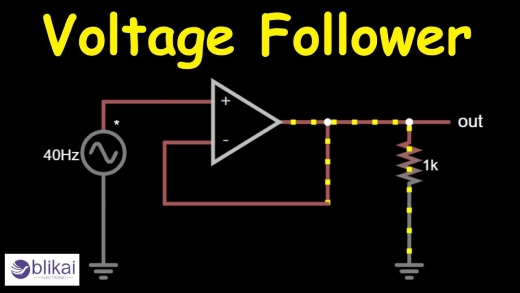
What is Voltage Follower?
It is basically an op-amp configuration with an output voltage identical to the input voltage, also known as a voltage follower. Doesn't that sound simple? It's all about that. This circuit uses unity gain, which means the gain is 1, so it doesn't amplify anything. It does, however, provide current amplification and high input impedance while maintaining low output impedance. The voltage can be passed along without causing the source to become overloaded. As long as it listens, mirrors, and stays out of your way, it's good to go.
I'm going to tell you something really cool now. Its high input impedance allows it to operate in the presence of sensitive or high-resistance sources, such as sensors and signal generators, without causing them to behave improperly. Afterwards, the same voltage is passed along, strong and stable. Imagine it as your signal's loyal bodyguard. Doesn't make a difference. Keep it safe and intact until it reaches its destination.
Working Principle
Voltage followers are based on the fundamental function of op-amps in feedback configurations. This setup connects the op-amp's output to the inverting input (-), while the input signal goes into the non-inverting input (+). A feedback loop is created, forcing the op-amp to adjust its output in order to maintain the same voltage level at both input terminals. The output voltage is always mirrored by the input voltage, which is why the voltage follower is called that. This is a case where the output exactly follows the input, maintaining a 1:1 relationship.
This phenomenon is interesting because while the amplifier passes the signal through without altering or enhancing it in terms of voltage, the output is the same as the input. This means that the voltage follower has a gain of one (or unity gain). The voltage follower, however, still provides current gain, even without voltage amplification. In other words, it can drive the current through a circuit despite a weak signal or a high impedance signal. In other words, it boosts a signal's current capability, allowing it to drive low-impedance loads without amplifying its voltage.
Voltage followers are widely used when a protected input source is needed or a signal has to pass without being loaded. A voltage follower ensures that a high-impedance source (such as a sensor) is not affected by a load (such as an amplifier or an ADC). Signals from high-impedance sources drop significantly when transferred to lower-impedance loads, potentially causing distortion or weakening. Voltage followers function as interfaces that prevent signal degradation, providing both isolation and current gain while maintaining signal integrity.
Applications
Impedance Matching
Okay, so impedance. It's very important. When used with low-impedance loads, high-impedance sources don't perform well. There you have it. When sensors are connected to amplifiers without buffers, things go wrong - the signal weakens, quality drops. Voltage followers are used to follow voltages. In other words, it isolates the source, maintains a strong signal, and prevents interference. Impedance at the input is high. The output impedance is low. No loss. Signals are controlled by it like traffic—everything flows smoothly without bottlenecks.
Signal Buffering
Setting up an audio system is what you're doing. Preamp to mic. Buffering that weak signal will prevent it from getting lost or distorted. The voltage follower performs its function there. The signal is not changed, it is simply passed through. Electric mirror, but with electricity instead of mirrors. No interference. There is no distortion. Signal transfer should be clean and safe. It is used everywhere, from audio equipment to sensors to measurement devices. In spite of its quietness, it is essential. It would prevent signals from collapsing under pressure if it didn't exist.
Active Filters
Let's talk about filters now. They're essential, aren't they? Nevertheless, active filters must not bury that precious signal. Voltage followers shine in this scenario. Protect the filter by sitting in front of it. Incoming signal is untouched, there is no voltage drop. You get a clean signal after the filter has done its job. There are no compromises. All of that is possible with active filters and voltage followers. Every system requiring precision, from audio to communications, needs it.
Precision Voltage Control
The importance of voltage control cannot be overstated. Power supplies and voltage-controlled oscillators (VCOs) both require accuracy. Voltage followers ensure precision is not compromised by fluctuations. There is no fluctuation in the input, and there is no fluctuation in the output. Nothing to surprise you. Voltage that is pure and clean. As a result, it is ideal for battery management systems, regulated power supplies, and many other applications. Voltage followers are your best friends when accuracy is essential.
Op-Amp Circuits and Instrumentation
The Op-amp. There is no denying their popularity. The problem arises when there is no proper isolation. Voltage followers ensure there are no interferences in op-amp circuits by buffering signals. In sensor interfaces or differential amplifiers, it serves as a smooth operator. There is no distortion or noise in the signal. Any device that requires clean, isolated signals uses it: medical devices, data acquisition systems, etc. Is that a voltage follower? There is a lot it is doing.
Low Noise Amplifiers (LNAs)
The world of RF systems is all about low noise. Hiss and hum should not be present in any signal. Voltage followers come into play here. Signals are kept clean and strong with the help of LNAs. In addition to boosting weak RF signals, it maintains purity. There is no noise. Clear communication is all that is needed. A wireless communication system, a satellite system, or a radio receiver all use this technology. Maintaining a crystal clear signal? Behind the scenes is a voltage follower.
Power Amplifier Isolation
A bit of distance between the amplifier and the source is necessary to avoid detrimental interactions, especially in high-power systems. This is where the voltage follower comes in. It prevents unwanted loading from being caused by weak signals. A steady and strong signal is what it does—it doesn't amplify it. No matter what the application is, a voltage follower ensures that the amplifier gets exactly what it needs without affecting the signal's quality.
Microcontroller Interfaces
Microcontrollers may be unable to safely read sensor outputs if the sensor's output is too weak or too high impedance. The voltage follower plays an important role in isolating the sensor from the microcontroller and ensuring smooth operation. The buffer preserves the signal integrity in microcontrollers, which have low input impedances. Voltage followers ensure that data gets through even when it comes from temperature, accelerometer, or pressure sensors.
Analog-to-Digital Converters (ADC)
With analog-to-digital converters (ADCs), voltage followers ensure clean and unaltered signals for the ADCs. The source impedance of an ADC is often too high and can make it difficult for it to sample the signal correctly. To ensure the ADC receives a steady and reliable signal, a voltage follower sits in between, providing low impedance. An accurate digital representation of analog signals is especially important for measurement devices and sensor readings.
Signal Conditioning for Data Acquisition
Data acquisition systems, particularly those dealing with sensor data or weak signals, rely heavily on conditioning. Voltage followers are designed to isolate signals from other parts of the system in order to prevent loss or corruption of data. In addition to protecting the system from fluctuations in sensor signals, it also ensures that the voltage does not fluctuate. Precision is critical in systems such as industrial control systems and automated testing setups.
Final Verdict
You might not notice the voltage follower because it doesn't shout. There is no amplification. The transform does not take place. However, it does what it is supposed to do perfectly. In addition to protecting, buffering, and isolating, it isolates. Ensure that your signal stays true throughout its journey. There is no drama. Distortion-free. Microcontrollers, ADCs, and precision circuits all rely on it. In the world of electronics, it is an unsung hero. On paper, this may seem simple, but in reality it is absolutely essential. As soon as you take it out of the circuit, everything falls apart. What do you think about keeping it? There is no problem at all. Reliability like that is what we all want.





