


WS2812 8-Bit LED Module: Specs, Wiring Guide & Lighting Control
 720
720What Is a WS2812 8-Bit LED Module?
A WS2812 8-bit LED module is a compact RGB lighting component that integrates a WS2812 LED and its driver IC into a small PCB. Single LEDs contain red, green and blue emitters and are driven by an internal controller that performs dimming of the PWM and serial communications. It uses the single-wire protocol rather than more than one wire per, as is the case with other color and brightness control systems; it can therefore be easily daisy-chained together to form pixel lighting systems. These 8-bit modules are commonly used in LED displays, DIY lighting projects, signage, gaming setups, and ambient illumination systems where precise color control is needed.
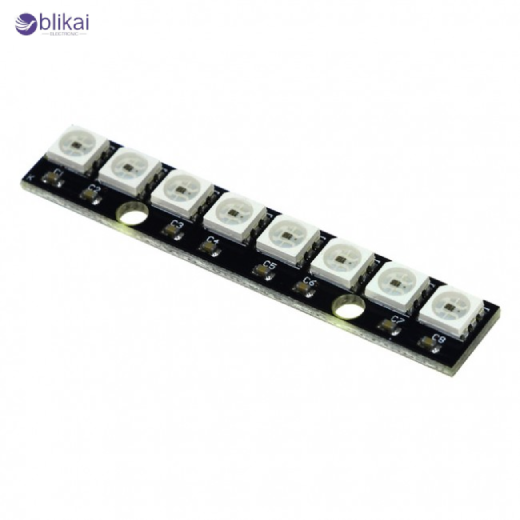
WS2812 8-Bit LED Module Specifications
Electrical Characteristics
WS2812 modules typically operate at 5V DC with a forward current of around 18–20 mA per color channel, reaching a maximum of ~60 mA per LED at full white brightness. The information transmission is based on a single-wire input, and the time constraints are close to 800 kHz. The refresh rate is high enough to allow animations, and each LED takes in and transmits data, which allows very long chains of modules with no extra wiring.
RGB Color Control Features
Each WS2812 LED has 8-bit PWM per color and provides the output of 24-bit full colors with 16.7 million different colors. The smooth gradients, proper color mixing, and effects of dynamism are made possible with this fine resolution. Depending on the design of the modules, the LED viewing angle is between 120 and 140 degrees. The brightness consistency and color accuracy of the module have rendered the module appropriate for the display panel and decorative lighting.
Module Dimensions & Pinout
The WS2812 8-bit module typically features a 3-pin or 4-pin design:
- 5V: Power input
- GND: Ground connection
- DIN: Serial data input
- DOUT: Serial data output (for chaining)
The small PCB often includes mounting holes, copper pads, and traces optimized for stable signal propagation.
How the WS2812 8-Bit LED Module Works
Integrated Driver IC Operation
The LEDs have a WS2812 control IC, which interprets the incoming digital data, performs PWM on the individual RGB channels, and recreates the information of the subsequent LED. The built-in design eliminates the use of external drivers and makes it simpler to wire.
Serial Communication Protocol
The WS2812 uses a serial, one-wire protocol where data is encoded through precise timing of high and low voltage pulses. Each LED reads the first 24 bits of data (representing RGB values), displays them, and then forwards the remaining bits to the next LED. This system creates addressable pixels without individual wiring.
WS2812 8-Bit Module Wiring Guide
Basic 3-Pin Wiring Setup
A simple WS2812 wiring diagram includes:
- Connect 5V to a stable 5V supply.
- Connect GND to the controller’s ground.
- Connect DIN to a microcontroller’s digital pin, usually through a 300–500 Ω resistor to reduce noise.
A 1000 µF capacitor across 5V and GND is recommended to prevent power surges.
Arduino Wiring Example
Using Arduino is one of the easiest ways to control WS2812 modules. Popular libraries include FastLED and Adafruit NeoPixel. A typical wiring setup uses pin D6 for DIN, with straightforward code to set colors, brightness, and effects. The libraries handle the timing, enabling smooth animations.
Multiple Module Daisy-Chain Wiring
For chaining multiple modules, the DOUT of one module connects to the DIN of the next. Power lines must remain parallel along the chain. For long LED chains, voltage drops can occur, so power injection at multiple points ensures uniform brightness.
Lighting Effects & Control Methods
Microcontroller Control
WS2812 is also compatible with Arduino, ESP8266 and ESP32, as well as Raspberry Pi Pico and even the STM32 boards. Microcontrollers support real-time animation, color chain, music-responsive patterns and display style pixel mapping.
Pre-Programmed Lighting Patterns
Typical effects include:
- Static color
- Breathing light
- Chasing effects
- Rainbow gradients
- Wave and pulse animations
These patterns are easy to implement with standard libraries.
Advanced Control Features
Further setups employ gamma correction to make the brightness of the displays look natural, and double-buffering to avoid flicker in the animations, and also synchronization between individual LED strips or matrices to create more elaborate displays. These features are essential in digital signage, LED art, and gaming projects.
Applications of WS2812 8-Bit LED Modules
WS2812 modules are widely used due to their convenience, bright output, and precise color control. Common applications include:
LED Matrices and Display Panels
The WS2812 8-bit LEDs are well-suited for the development of high-quality LED displays and matrices. Addressing each LED individually, it is possible to use complex patterns, animations and scrolling text. They are popular in advertising boards, information panels and digital signage where there is a need to have control over color and a smooth animation. Its small size and daisy-chainability allow the display to be easy to scale to large formats without a huge amount of extra wiring, particularly popular among DIY electronics enthusiasts and the display designers of major corporations, no matter which side of the camera they were working on.
Smart Ambient Lighting
These modules are commonly used for smart ambient lighting systems in homes, offices, or gaming setups. Controlled via microcontrollers or smart home platforms, WS2812 LEDs can create dynamic color-changing effects, mood lighting, or reactive illumination synchronized with music and media. They can have smooth gradients and transitions because they have a compact 8-bit PWM design, and can be installed in a daisy-chain, along the walls, ceilings, or furniture edges. These modules that are incorporated in the automation systems improve convenience and aesthetics in intelligent lighting applications.
Decorative and Holiday Lighting
WS2812 8-bit modules are ideal for the design of decorative lighting, such as holiday lighting, party lighting, and art installations. The complete RGB control of each LED enables designers to create the effect of rainbows, chasing lights, and animated patterns, and to make decorations brighter and more striking. The versatility of the modules in both locating and wiring makes it easier to create complex designs like wreaths, Christmas trees and outdoor light designs. Their low-voltage operating nature guarantees safe usage even in busy or interactive places, allowing designers to safely apply a complex lighting pattern.
Wearable LED Accessories
Due to their small size and addressability, WS2812 modules are often used in wearable electronics such as costumes, cosplay outfits, and LED bands. The user can program dynamic patterns and animations to react to movement or music and increase the visual effect. Their low power consumption and light PCB layout allow them to be used in applications that need to be carried around and be battery-powered, yet still have bright brightness and rich colors. The application is now popular in the hands of performers, hobbyists, and makers who want to make use of technology in fashion.
Gaming Desk and Ambient Accents
WS2812 is also widely used in gaming systems and PC back lighting systems, which provide high levels of immersion. The LED strips can be synchronized behind the monitors, desks, or shelves of the user with a game, music, or system alerts. The accurate 8-bit PWM control maintains a high quality of color transition and colorful lighting, which adds aesthetics as well as gaming experience. Modular daisy-chaining provides the user with the ability to expand the installation to many different zones, and software libraries such as FastLED or Adafruit NeoPixel provide the chance to create patterns, colours, and brightness levels to their fullest extent.
Backlighting for TVs or Monitors
Bias or ambient backlighting of TVs and computer monitors is also a common application of these modules. With WS2812 LEDs installed behind screens, users are able to decrease eye strain, enhance perceived contrast and provide dynamic ambient lighting that responds to what is on the screen. The LEDs can be individually adjusted to each color on the screen to provide users with immersive effects of lighting in movies, gaming, or streaming. This application takes advantage of the high refresh rate and details of the modules, which reproduce colors with high detail and fluidity, and thus it gives fluid and realistic effects.
Troubleshooting & Safety Tips
Common Issues
Some common issues would be flickering LEDs, wrong colors, or a lack of reply by a section of the chain. The reasons may be poor power supply, signal degradation, or improper grounding. Resistance to resistors and capacitors is better with the short wires.
Best Practices for Long-Term Reliability
In order to prevent overheating and degradation of the LED, you should always use a high-quality 5V power supply. On large installations, inject power every few meters. Make sure that it is well ventilated and not bent on the PCB. Handling and grounding eliminate the chances of damage from static.
FAQ
What power supply is required for WS2812 8-bit modules?
A constant 5V DC power supply having sufficient current capacity.
Can WS2812 run with 3.3V microcontrollers?
Yes, but a level shifter or strong data line is recommended.
How many modules can be chained?
Dozens to hundreds, depending on power distribution and signal quality.
Why do colors shift or flicker?
Usually caused by insufficient power or an unstable data signal.
What is the difference between WS2812 and WS2812B?
WS2812B has a wiring layout that is improved, signal stability is also better, and reverse polarity protection is also built in.
Some images are sourced online. Please contact us for removal if any copyright concerns arise.





