


TVS Diode Guide: Working Principle, Types, Specs & Selection
 687
687Introduction to TVS Diodes
A Transient Voltage Suppression (TVS) diode is a fast-acting protection device used to protect the electronics circuit against voltage spikes of unforeseen origin. These spikes may originate because of ESD, lightning, inductive switching or power-line disturbances. TVS diodes have very high response times: typically in the sub-nanosecond regime, and they can block surge voltages before they cause harm to delicate ICs. The reason behind TVS diodes' application in consumer electronics, industrial and automotive electronics, telecom protection, and high-speed data interfaces is due to their reliability and broad voltage range.
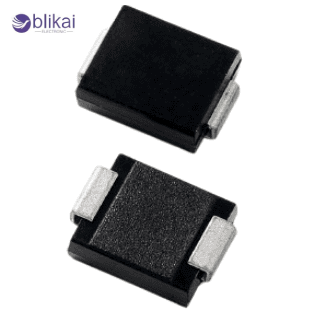
How a TVS Diode Works (Working Principle)
TVS diodes are based on avalanche breakdown. In normal conditions, the diode is in a high-impedance state, and it does not influence the circuit. The diode goes back into its high-impedance state automatically after stopping the transient event. TVS diodes can respond to very large, short bursts of voltage as compared to Zener diodes, which have to maintain a constant voltage.
The device then absorbs and diverts the surge energy to ground, protecting downstream components. Once the transient event ends, the diode automatically returns to its high-impedance state. Unlike Zener diodes, which regulate voltage continuously, TVS diodes are optimized for handling extremely large, short-duration surge pulses.
Types of TVS Diodes
Unidirectional TVS Diodes
Unidirectional TVS diodes behave like conventional diodes in their regular performance, hence they are perfect for the protection of DC-powered circuits. They conduct forward current when the line reverses polarity while still offering avalanche protection on the reverse side. These are commonly used in DC power supplies, automotive DC lines, battery circuits, and low-voltage logic systems.
Bidirectional TVS Diodes
Bidirectional components have symmetrical (or slightly asymmetrical) conduction paths designed for AC or bidirectional signals. They clamp both positive and negative surges equally. They are the preferred choice for data lines, communication ports, audio interfaces, CAN bus, RS-485, and mixed-signal environments.
SMBJ / SMCJ / SMF / SOD / Axial TVS Series
TVS diodes are available in different package families, each optimized for size and surge capability:
- SMBJ series: 600–1500 W typical pulse power, medium size
- SMCJ series: 1500+ W, larger surface-mount footprint
- SMF series: ultra-small SMD package, used for portable devices
- Axial-leaded TVS: used in high-power AC lines, industrial surge protection
These package series help designers balance power rating, board space, and cost.
Automotive & High-Power TVS Diodes
Car-grade TVS diodes are AEC-Q101 qualified and are available in adverse environments. They are designed to withstand load dumping, jump-start transient and relay switching surges that are typical of vehicle power systems. In surge protection in industries, high-power TVS components are able to take tens of kilowatts during very short pulses.
Key Specifications & Parameters
Standoff Voltage (V_RWM)
The rated maximum voltage that the TVS diode can withstand without conducting. It must be higher than the system’s normal operating voltage to prevent leakage or false clamping.
Breakdown Voltage (V_BR)
The voltage at which avalanche breakdown occurs under test conditions (usually measured at 1 mA). The designers must choose a breakdown voltage that would cause the device to go on when there is a transient, but would not result in any kind of interference when the device is operating within the normal state.
Clamping Voltage (V_C)
The maximum voltage the diode allows across the protected line during a surge event. Lower clamping voltages provide better protection, but must still meet the system’s survival limits. This is one of the most critical parameters.
Peak Pulse Current (I_PP) & Peak Pulse Power (P_PP)
The TVS diodes have a rating in terms of the maximum current or power that they can withstand when subjected to a surge pulse of 8/20 us. Common families include:
- 600 W SMBJ TVS diodes
- 1500 W SMCJ TVS diodes
- 3000–5000 W high-power TVS diodes
Higher power ratings correspond to better surge absorption but larger package sizes.
Capacitance (C_J)
Capacitance affects signal integrity on high-speed data interfaces. Low-capacitance ESD/TVS diodes (<1 pF) are essential for protecting USB 3.0, HDMI 2.0, PCIe, CAN FD, Ethernet, and RF lines without signal distortion.
Response Time
TVS diodes react in the range of picoseconds, which is orders of magnitude faster than MOVs or gas discharge tubes. This renders them suitable for shielding delicate semiconductor devices against ESD strikes.
Leakage Current (I_R)
At the standoff voltage of the TVS diode, small leakage currents pass through the diode. Lower leakage is preferred for battery-powered or energy-sensitive circuits.
How to Choose the Right TVS Diode
Match Standoff Voltage to Operating Voltage
Select a standoff voltage slightly higher than the circuit’s maximum DC working voltage. Too low will cause false triggering; too high may fail to protect.
Check Clamping Voltage vs. Component Ratings
Ensure the clamping voltage is below the maximum voltage rating of downstream ICs. This determines whether the surge will successfully be mitigated.
Verify Surge Power Rating
Use the expected surge level (like IEC 61000-4-5) to choose the proper peak pulse power. High-power systems need SMCJ, SMDJ, or axial TVS families.
Use Low-Capacitance TVS for High-Speed Data Lines
This is because signals such as USB, HDMI, Ethernet and RF demand low capacitance to prevent signal quality degradation. These lines should be protected with special ESD protection arrays.
Choose Unidirectional or Bidirectional
- Unidirectional: DC and polarity-sensitive lines
- Bidirectional: AC lines and high-speed differential pairs
Consider Package Size & PCB Thermal Constraints
A larger package improves heat dissipation and surge capability but increases board area. Compact mobile devices benefit from DFN or SOD packages.
Confirm Automotive or Industrial Reliability Requirements
Look for AEC-Q101, ISO 7637, and surge-compliant diodes where required.
TVS Diode Application Examples
USB, HDMI & High-Speed Interfaces
Modern ports require ESD protection at low capacitance. TVS diodes protect PHY chipsets from IEC 61000-4-2 ESD events without affecting signal performance.
Power Supply Input Surge Protection
TVS diodes at the input stage shield switching regulators, DC-DC modules, and battery chargers from spikes generated by inductive loads or external cables.
Automotive Electronics & Load Dump Protection
A load dump can cause spikes up to 120 V in automotive power networks. TVS diodes clamp these spikes, protecting ECUs, sensors, infotainment units, and LED drivers.
Telecom, RS-485, CAN Bus & Ethernet Ports
Differential and long-distance communication lines are prone to lightning and industrial EMI. Bidirectional TVS diodes ensure stable communication.
Consumer Electronics & ESD Protection
TVS diodes in smartphones, laptops, appliances, and gaming devices prevent the discharge of static in the USB ports, buttons, display interfaces and internal circuits.
TVS Diode vs. Other Protection Devices
TVS vs. MOV
MOVs handle large amounts of energy but respond slowly. TVS diodes offer much faster clamping for semiconductor circuits.
TVS vs. Zener Diode
Zeners regulate voltage but cannot tolerate high surge power. TVS diodes are purpose-built for transient suppression.
TVS vs. ESD Arrays
Arrays provide multi-channel protection with extremely low capacitance for high-speed lines, but lower surge capability.
When TVS Diodes Are Best
They are the ideal choice for fast transient and ESD protection in electronics.
Common Failure Causes & Reliability Tips
TVS diode failure often results from incorrect voltage selection, insufficient surge rating, or poor PCB layout. Repeated surges exceeding its rating lead to thermal stress and degradation. Designers should minimize track inductance, place the TVS diode close to connectors, and ensure solid grounding to maximize surge-handling effectiveness.
Conclusion
In modern electronics, TVS diodes are involved in the protection of modern electronic devices against ESD, surge pulses, and threats of transient voltages. Knowledge of operation principles, major specifications and selection parameters is the guarantee of due security of power systems, communication lines, car electronics, and household appliances. The TVS diodes can enhance the system reliability, durability and international immunity standards with proper design and choice of the components.
FAQ
Does a TVS diode’s surge rating drop at high temperatures?
Yes. Its peak-pulse current and power drop significantly as the temperature rises. Always apply the datasheet derating curve.
What capacitance is acceptable for high-speed interfaces?
Use ultra-low capacitance TVS devices under 1 pF. USB-C, HDMI, and PCIe often require 0.2–0.5 pF.
How do I choose VRWM and VC correctly?
VRWM must exceed normal operating voltage. VC must stay below the protected IC’s absolute maximum rating.
TVS vs. MOV — when to use each?
Use TVS for fast transient and ESD protection. Use MOV for high-energy AC mains surges.
Should I use multi-line TVS arrays for USB-C/HDMI?
Yes, but check per-channel capacitance and clamping performance. Ensure they match the interface’s speed requirements.
What PCB layout rules matter most?
Place the TVS close to the connector. Keep traces short and use a low-inductance ground path.
What is special about automotive load-dump protection?
It needs very high-power AEC-Q101 TVS diodes, suitable for the load-dump bursts of ISO 7637.
Some images are sourced online. Please contact us for removal if any copyright concerns arise.





