


1N914 Diode: Specs, Pinout, Applications & Replacement Guide
 317
317Introduction to the 1N914 Diode
The 1N914 diode is a classic small-signal silicon switching diode that has been widely used in electronic circuits for decades. It is claimed that the 1N914 has a high switching rate, low junction capacitance and is also considered to be very effective in low-current applications, and is still useful in both legacy (vintage) and modern signal-processing circuits.
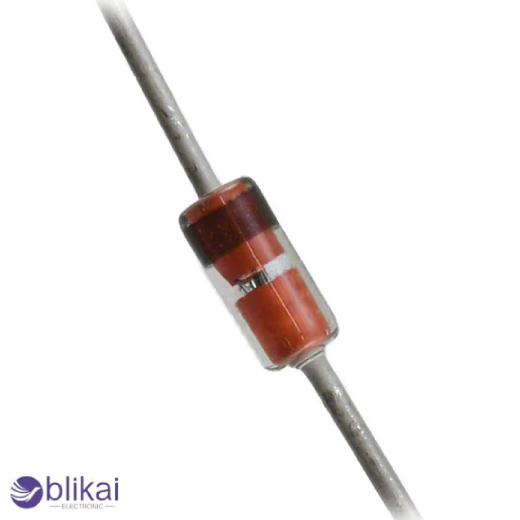
What Is the 1N914 Diode?
Definition and Basic Function
The 1N914 is a diode of a very small size, whose size is not that of a power diode but that of a fast switching diode. Its main function is to control the direction of current flow in low-voltage, low-current circuits, allowing rapid transitions between conducting and non-conducting states.
Why the 1N914 Is Classified as a Switching Diode
The 1N914 is not a rectifier diode; unlike a rectifier diode, it is a diode with a short reverse recovery time and low charge storage. This renders it appropriate in high-frequency signal switching, digital logic steering and waveform shaping.
1N914 Diode Key Specifications
Maximum Reverse Voltage (VRRM)
The 1N914 has a typical repetitive maximum reverse current of approximately 75V that is appropriate in most low-voltage signal applications but not high-voltage power.
Average Forward Current (IF)
Having an average forward current rating of approximately 150mA, the diode can only be used with currents at signal levels and not in sustained load conduction.
Forward Voltage Drop (VF)
The forward voltage drop is usually around 0.6V to 0.7V at nominal operating currents, consistent with standard silicon PN junction behavior.
Reverse Recovery Time (trr)
The 1N914 also has a feature of low reverse recovery time (usually around 4ns), which is the ability to operate successfully in high-speed switching circuits.
Power Dissipation and Thermal Limits
The small size of the diode in a glass package limits its power dissipation, often to a value of 500mW, which must be given great attention in continuous-operation circuits.
1N914 Diode Pinout and Package Details
1N914 Pin Configuration Explained
The 1N914 is a two-pin product whose pinout is simple, with one anode and one cathode, and therefore, easy to connect with a circuit design.
Anode and Cathode Identification
The other end of the glass body has a distinct band on which the cathode is indicated. It is of paramount importance to be properly orientated in order to guarantee a proper current flow and functioning of circuits.
DO-35 Glass Package Overview
The diode is packaged in a DO-35, axial-leaded, glass package, which has good thermal stability, low leakage and mechanical strength when doing through-hole mounting.
PCB Mounting and Orientation Tips
In a bid to remain reliable, the designers ought not to bend the lead too much around the glass body and must be able to allow space for heat dissipation, particularly in crowded PCB designs.
How the 1N914 Diode Works
PN Junction Operation in Switching Applications
At its core, the 1N914 operates as a PN junction diode, allowing current to flow when forward-biased and blocking it when reverse-biased. The optimized junction structure minimizes charge storage during switching.
Forward Bias vs Reverse Bias Behavior
When forward-biased, the diode conducts with minimal delay, while in reverse bias it rapidly transitions to a blocking state, reducing signal distortion in high-speed circuits.
Role of Fast Recovery in Signal Processing
Quick recovery is necessary to make sure that the diode does not stay momentarily conductive on the reverse of the bias, not only in digital logic, pulse circuits and RF signal paths.
Switching Speed Compared to Rectifier Diodes
The 1N914 is several orders of magnitude faster than typical rectifier diodes like the 1N400x series, hence it is not useful in converting power, but can be used in signal integrity.
Typical Applications of the 1N914 Diode
High-Speed Signal Switching Circuits
The diode is usually utilized to turn logic signals on and off, isolate control lines and route digital pulses without adding too much delay.
Digital Logic and Pulse Shaping
In electronics, the 1N914 is used in digital electronics to clamp voltages, avoid signal overshoot, and smooth pulse edges to make transitions in electronics cleaner.
Clipping and Clamping Circuits
Its predictable forward voltage makes the 1N914 useful in clipping and clamping circuits that limit signal amplitude in audio and instrumentation systems.
RF and Audio Signal Processing
Thanks to its low capacitance and fast response, the diode is suitable for RF detectors, mixers, and audio signal conditioning stages.
Protection and Steering Diodes
The 1N914 is often used as a steering diode to protect sensitive IC inputs from voltage spikes and reverse polarity conditions.
1N914 vs 1N4148: What’s the Difference?
Electrical Specification Comparison
The two diodes have similar voltage and current characteristics as well as switching speed, which is why many engineers regard them as functionally identical in most cases.
Switching Speed and Recovery Time
While the 1N4148 often features slightly improved consistency in modern manufacturing, real-world performance differences are minimal for typical designs.
Interchangeability in Real-World Circuits
The 1N914 may be substituted for the 1N4148 in most signal-level circuits without needing any circuit adjustment.
Which Diode Should You Choose?
The choice of designers is usually based on availability, cost, and preference of datasheet, rather than electrical necessity.
1N914 Diode Equivalent and Replacement Options
Direct Replacement Diodes
Typically, released versions are the 1N4148 and other silicon diodes that switch fast, such as the 1N4148.
Using 1N4148 as a Substitute
The 1N4148 is commonly considered the current equivalent of the 1N914, and is commonly suggested in revised designs.
SMD Alternatives
Surface-mount equivalents such as the LL4148 or MMBD914 offer similar performance in compact PCB layouts.
Key Parameters to Check Before Replacing
Reverse voltage rating, forward current, recovery time and compatibility of packages should be checked by engineers before substitution.
Design Considerations When Using the 1N914
Current and Voltage Margin Selection
Working at much lower values than the maximum values of the diode increases its reliability and decreases thermal stress.
Thermal Performance in Compact PCBs
Although the diode dissipates little power in signal applications, continuous operation at high frequency can generate localized heat.
Frequency Limits and Signal Integrity
Junction capacitance and lead inductance may become an issue at very high frequencies and should be carefully laid out.
Common Design Mistakes to Avoid
Using the 1N914 in power rectification or high-current applications is a frequent error that can lead to premature failure.
How to Test a 1N914 Diode
Testing with a Multimeter
Using the diode test mode, a healthy 1N914 should show a forward voltage of around 0.6V and block current in reverse.
Forward and Reverse Bias Test Values
Abnormal readings, such as zero voltage drop or conduction in both directions, indicate a faulty component.
Identifying a Shorted or Open Diode
In a shorted diode, the resistance is close to zero in both directions, whereas in an open diode, conduction is nonexistent.
In-Circuit vs Out-of-Circuit Testing
To get proper results, out-of-circuit testing should be used to eliminate parallel paths.
Reliability, Lifespan, and Failure Modes
Common Causes of 1N914 Failure
The major reasons that are causing failure are excessive current, overvoltage and improper soldering.
Overvoltage and Overcurrent Damage
Stress intensified on the PN junction more than the rated limit may weaken the junction, and leakage or short circuit can occur.
Aging Effects in Signal Diodes
Although silicon diodes are usually stable, continuous exposure to heat may have an impact on long-term performance.
Storage and Handling Best Practices
When a diode is stored in dry conditions and electrostatic discharge is avoided, the life will be extended.
1N914 Diode Datasheet Overview
Key Parameters Engineers Should Focus On
When referring to datasheets, designers tend to focus on the switching rate, the reverse voltage and the forward current rates.
Reading Switching Time Graphs
Graphs showing recovery characteristics help determine suitability for high-frequency applications.
FAQs
Is 1N914 the same as 1N4148?
The 1N914 and 1N4148 are functionally very similar and are often interchangeable in most signal applications.
Can I replace a 1N914 with a 1N4148?
Yes, the 1N4148 is an acceptable and widely used substitute for the 1N914 in virtually all systems.
Is the 1N914 suitable for power rectification?
No, the 1N914 is not power rectifiable, and should only be employed when operating on low-current signals.
How fast is the 1N914 diode?
The 1N914 has a standard reverse recovery time of a few nanoseconds, so it is appropriate for high-speed switching.
Summary
The 1N914 diode is still a proven and well-understood part in the rapid switching of signals, protecting and conditioning signals in electronic circuits. Its speed, simplicity and availability make it a lasting selection among engineers, educators, and designers of signal electronics that require low power. Although the modern analogues are popular, the study of the nature of the 1N914 offers a worthwhile perspective on the small-scale diode performance and practical design in circuit design.
Some images are sourced online. Please contact us for removal if any copyright concerns arise.





