


KSC1845 High Voltage NPN Transistor: Specs & Applications
 193
193What is the KSC1845 High Voltage NPN Transistor?
KSC1845 is a silicon NPN transistor and is made to amplify low noise and large voltages. It possesses a planar epitaxial design ensuring that it has a stable electricity functionality, low leakage current, and high thermal dependability. A transistor can amplify a much bigger current across the collector and emitter by driving a small current on the base terminal, so that effective amplification of weak analog signals is acquired. The high voltage rating, which is matched with this working principle, is coupled with a low noise figure, which enables the KSC1845 to work extremely well in audio preamplifiers, instrumentation amplifiers, and precision signal processing circuits.
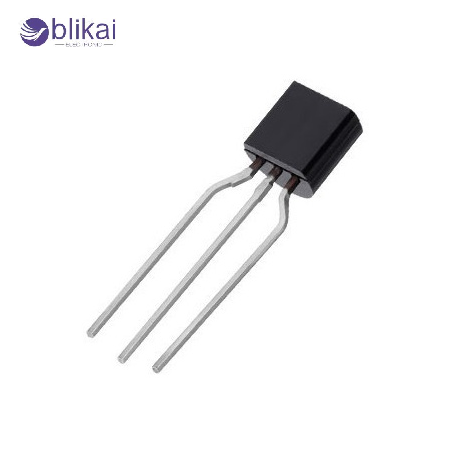
Key Features and Technical Advantages of KSC1845
High Collector-Emitter Voltage Capability
The KSC1845 provides a maximum collector-emitter voltage rating of 120V, which allows it to operate safely in high-voltage audio circuits and multi-stage amplifier designs. This tolerance of high voltage gives the designers more flexibility, dynamic range and better headroom in analog amplification systems.
Low Noise Performance
The very low noise figure of the KSC1845, often 1-2 dB, is one of its most valuable features, making it suitable in microphone preamps, phono amplifiers, and sensor front-end circuits where noise can be very detrimental to signal quality.
High DC Current Gain (hFE)
Having an average DC gain of between 200 and 700, KSC1845 is optimal in amplifying signals efficiently, and thus, a designer can get high voltage gain with comparatively simple bias networks with stable operation points.
Excellent Linearity and Signal Fidelity
The transistor is also known to be very linear throughout the entire audio range, which brings minimum harmonic distortion and signal transparency that is required in high-fidelity audio plays.
KSC1845 Pinout and Package Information
Pin Configuration and Functions
The KSC1845 is typically housed in a TO-92 package, and its pinout configuration, when the flat side is facing forward and leads point downward, is Emitter (E), Collector (C), and Base (B). Pin identification is essential, and reversing pins may cause instant damage to the device.
Package Types and Mechanical Dimensions
The small TO-92 package has very high mechanical stability and parasitic capacitance, and is ideal in the circuit layout of high frequencies and low noise, and can fit easily into a standard through-hole PCB layout.
PCB Footprint and Layout Guidelines
For optimal noise performance, designers should minimize trace lengths at the base terminal, avoid routing high-current paths near sensitive signal traces, and implement proper grounding strategies to reduce electromagnetic interference and oscillation risks.
Absolute Maximum Ratings and Electrical Specifications
Voltage Ratings
With a supporting voltage of 120 V, the transistor can be used in the medium-to-high voltage analog circuits with a collector-emitter voltage of 120 V, collector-base voltage of 120 V, and an emitter-base voltage of 5V.
Current Ratings
The top possible current is 50mA/maximum constant collector current that is adequate when working with low-power amplifier stages and high-precision analog designs.
Power Dissipation and Thermal Characteristics
The KSC1845 has a maximum power dissipation of 500mW with a wide operating temperature of -55 °C to +150degC which provides the KSC1845 with a stable long-term operation with a wider range in environmental conditions.
Frequency Response and Switching Characteristics
A high transition frequency of 100MHz ensures excellent AC performance and stable gain across the entire audio frequency range and beyond.
KSC1845 Electrical Characteristics and Performance Analysis
DC Characteristics
The transistor has a stable base-emitter voltage of about V=0.65V, low saturation voltage of about V=0.2V and low leakage current, which guarantees predictable biasing characteristics and stable signal amplification.
AC Characteristics
Its high gain-bandwidth product, low noise figure and constant small-signal response make it possible to amplify weak signals in a clean manner with only a small amount of distortion.
Temperature Stability and Reliability
The KSC1845 has a strong silicon platform and thermal design that ensures stable electrical performance under a wide range of temperature conditions, and thus can be used in industrial and professional audio applications.
How KSC1845 Works in Amplifier Circuits
Operating Principle of NPN Transistor
When a small base current is applied to the transistor, it turns on a much larger collector current, which enables weak input signals to be effectively amplified in terms of current gain and voltage amplification mechanisms.
Typical Biasing Configurations
The KSC1845 is commonly configured in common-emitter amplifier topologies using voltage-divider biasing and emitter degeneration resistors to achieve stable operating points and predictable gain.
Signal Amplification Process
Small AC input signals are superimposed on the DC bias voltage at the base, causing proportional variations in collector current, which are converted into amplified voltage signals across the collector load resistor.
Typical KSC1845 Application Circuits
Audio Preamplifier Circuits
The KSC1845 is widely used in microphone preamps, guitar amplifier input stages, phono preamplifiers, and tone control circuits due to its excellent noise suppression and linear amplification properties.
Low Noise Signal Amplifiers
It is extensively applied in sensor signal conditioning circuits and instrumentation amplifiers, where precise amplification of weak analog signals is required.
Differential Amplifier Input Stages
In front-end designs of differential audio processing and measurement systems, the transistor is common in the design of the front-end of a differential amplifier.
Voltage Amplifier Stage (VAS) in Power Amplifiers
In multi-stage audio power amplifiers, the KSC1845 serves as a voltage amplifier stage, providing high gain and low distortion for driving output transistor stages.
KSC1845 vs Common Equivalent Transistors
KSC1845 vs 2N5551
|
Parameter |
KSC1845 |
2N5551 |
|
Vceo |
120V |
160V |
|
Noise |
Very Low |
Medium |
|
Gain |
High |
Medium |
|
Best Use |
Audio Amplification |
General Purpose |
KSC1845 vs BC547 / BC550
|
Parameter |
KSC1845 |
BC547 |
BC550 |
|
Voltage |
120V |
45V |
45V |
|
Noise |
Very Low |
Medium |
Low |
|
Audio Suitability |
Excellent |
Moderate |
Good |
KSC1845 vs 2SC1815
Although both are low-noise devices, the KSC1845 has much higher voltage operating capabilities and better thermal stability, and would be more suited to the high-performance audio circuit.
KSC1845 Equivalent Replacement Guide
Direct Replacement Options
Popular substitutes are 2SC2240, BC550C and 2N5551 with different values of voltage tolerance, noise behavior, and gain stability.
Cross-Reference Table
|
Replacement |
Voltage |
Noise |
Audio Suitability |
|
KSC1845 |
120V |
Very Low |
Excellent |
|
2N5551 |
160V |
Medium |
Good |
|
BC550C |
45V |
Low |
Good |
Selection Tips for Substitutes
In choosing replacements, the designer should pay great attention to voltage rating, noise properties, gain range, and pin configuration to guarantee safe and successful operation of a circuit with great reliability.
Practical Design Tips Using KSC1845
Bias Stability Optimization
Proper resistor selection and emitter degeneration techniques are essential to maintain stable operating points and prevent thermal runaway.
Noise Reduction Techniques
Reducing noise pickup and electromagnetic interference is done with the help of short signal paths, good grounding techniques, shielding, and decoupling capacitors.
Thermal Management Guidelines
Adequate copper area around transistor pads improves heat dissipation and enhances long-term reliability.
Common Design Mistakes and Troubleshooting
Incorrect Pin Orientation
The pinout may be misinterpreted, resulting in the instant failure of the device, and it is necessary to make sure that all pinout details are checked both during PCB assembly and PCB design.
Overvoltage and Overcurrent Failures
Operating beyond rated voltage or current limits can permanently damage the transistor, emphasizing the need for conservative design margins.
Noise and Oscillation Issues
Oscillation and noise are usually caused by improper PCB layout, inadequate bypassing and poor grounding.
Typical Applications of KSC1845 in Real Products
The KSC1845 is widely used in professional audio amplifiers, guitar effect pedals, mixing consoles, microphone preamplifiers, sensor interface modules, and various analog signal processing systems.
KSC1845 Datasheet Summary Table
|
Parameter |
Value |
|
Transistor Type |
NPN |
|
Vceo |
120V |
|
Ic |
50mA |
|
Pd |
500mW |
|
hFE |
200 – 700 |
|
fT |
100MHz |
|
Package |
TO-92 |
FAQ
What is the best replacement for KSC1845?
2SC2240 and BC550C offer the most similar electrical performance, with 2N5551 being used when a better voltage margin is needed.
Can KSC1845 replace 2N5551?
In many audio circuits, KSC1845 offers lower noise and better linearity than 2N5551.
What is the noise figure of KSC1845?
Typically around 1–2 dB.
Conclusion
KSC1845 High Voltage NPN Transistor is a high voltage transistor with ultra-low noise, high-quality linearity, and stable gain. It is one of the best transistors in audio amplification and a precise analog. Its versatility, reliability, and outstanding electrical performance ensure its continued popularity in both professional and DIY electronics projects.
Some images are sourced online. Please contact us for removal if any copyright concerns arise.





