


MAX3232 RS-232 Level Converter: Specs, Pinout & Applications
 827
827Introduction to the MAX3232 RS-232 Level Converter
The most typical RS-232 level converter device is the MAX3232 to bridge the gap between equipment at different logic levels in the communication process. It converts the TTL/CMOS voltages on those levels to RS-232 levels, and the reverse. In the absence of this chip, microcontrollers, e.g. arduino/stm32, are unable to communicate with RS-232-compatible devices, e.g. the computer, GPS module or modem. The MAX 3232 is more versatile in the input and can be operated effectively between 3.0V and 5.5V, suitable to both 3.3V and 5V systems blending it to the older MAX232.
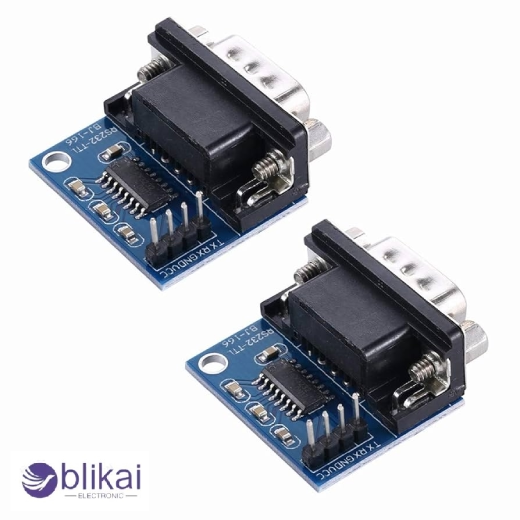
Key Technical Specifications of the MAX3232
MAX3232 is a level converter that provides good performance even with the small designs. It has an option of dual drivers and dual receivers, so there is a full-duplex communication. The chip has one power supply of 3.0V to 5.5V which fits well in the current low-voltage systems. It provides the highest data rates these days at 250 kbps, adequate for most refined serial communications. Auto-generated on-chip charge pump and use of just four mini capacitors, the MAX3232 does away with large external components. To cover different applications it comes in a variety of packages, which include SOIC, SSOP, and DIP.
MAX3232 Pinout and Function Description
The MAX3232 is a standard 16 pin package. It is very important to understand the work of all the pins in order to have a good integration:
|
Pin |
Name |
Function |
|
1 |
C1+ |
Capacitor for charge pump |
|
2 |
V+ |
Generated positive voltage |
|
3 |
C1− |
Capacitor for charge pump |
|
4 |
C2+ |
Capacitor for charge pump |
|
5 |
C2− |
Capacitor for charge pump |
|
6 |
V− |
Generated negative voltage |
|
7 |
T2OUT |
RS-232 Output |
|
8 |
R2IN |
RS-232 Input |
|
9 |
R2OUT |
TTL Output |
|
10 |
T2IN |
TTL Input |
|
11 |
T1IN |
TTL Input |
|
12 |
R1OUT |
TTL Output |
|
13 |
R1IN |
RS-232 Input |
|
14 |
T1OUT |
RS-232 Output |
|
15 |
GND |
Ground |
|
16 |
VCC |
Power Supply |
Both transceivers, (T1/T2 and R1/R2) are serial input to output converters. The charge pump pin (C1+, C1-, C2+, C2-) is connected with the external capacitor that also assists in creation of the required level of voltages.
Typical Applications of the MAX3232 Chip
The MAX3232 is an industry standard in designs that need RS-232 communication. Typical applications entail:
1. Microcontroller to PC Communication
Among the most popular applications of MAX3232 is in connecting microcontrollers (such as Arduino, STM32, or ESP32) to the desktop or laptop computers using RS-232 ports. Modern PCs have mostly switched to using USB interfaces, although industrial (aka engineering) applications continue to make use of RS-232 ports. Developers should be able to upload firmware, debug the system or can log data out of the microcontroller to the computer using the MAX3232 and a DB9 connector or USB-to-serial adapter.
2. Interfacing with GSM, GPS, and Modem Modules
Most communication modules, particularly legacy GSM, GPS and GPRS modules, use RS-232 signaling. The MAX3232 is a well-proven interface device that allows linking of these modules to low-voltage digital systems. As an example, when implementing an IoT project that needs the SMS feature or the GPS tracking, the MAX3232 will make sure of the correct voltage-level translation of the microcontroller UART and the serial port of the module.
3. Embedded System Integration
MAX3232 chips are common in embedded system designs with which RS-232 is employed in configuration, diagnostics, or serial data transfer. Such cases are smart meters, automotive diagnostics systems, vending machines, and security systems. In these applications, MAX3232 enables the host processor to interface the RS-232-based buried peripheral devices or off-board controllers.
4. Point-of-Sale (POS) and Retail Equipment
POS terminals, receipt printers, barcode scanners, and card readers may use RS-232 in retail environments when the exchange of data between them needs to be reliable and has a low latency. These components can simply be added to a centralized POS system with the MAX3232, providing you with the flexibility of pin functionality with the RS-232 signal range.
5. Industrial Automation and Control
In industrial automation RS-232 is still predominant because of its simplicity and tolerance to noise in short distances. Industrial environment devices such as PLCs (Programmable Logic Controllers), HMIs (Human-Machine Interfaces), and industrial sensors frequently have RS-232 interface support. MAX3232 is designed to construct interface boards or signal converters which enable low-voltage control units to transmit and receive data dependably in such environments.
6. Medical and Scientific Instruments
RS-232 has been used as the interface to medical devices, laboratory instruments and scientific analyzers to output data, or to calibration data, or to control data. That is just the MAX3232 to give you the needed level shifting to interface these instruments with newer data acquisition systems or embedded processors, to conduct safe and stable communication without redesigning the historical hardware.
7. Educational and Prototyping Projects
MAX3232 is another popular choice in the educational setting and hobby electronics. In development boards, serial terminal, projects or hobby One way to use the chip is in development boards, serial terminal, or in a robotics project, when students or hobbyists are the users. The ease of use, cheapness and prevalence of availability make it an ideal means of teaching and experimentation into the principle of serial communications.
Comparison with MAX232 and Other RS-232 Level Shifters
|
Feature |
MAX232 |
MAX3232 |
Other RS-232 Shifters (e.g., SP3232, ICL3232) |
|
Operating Voltage |
5V only |
3.0V to 5.5V |
Varies (often 3.0V–5.5V) |
|
Capacitor Size |
1μF to 10μF |
0.1μF to 1μF |
Typically 0.1μF |
|
Logic Compatibility |
5V TTL only |
3.3V/5V TTL/CMOS |
3.3V/5V compatible |
|
Power Consumption |
Higher |
Lower |
Low to medium |
|
Package Types |
DIP, SOIC |
DIP, SOIC, SSOP |
Varies (TSSOP, QFN, etc.) |
|
Application Suitability |
Legacy 5V systems |
Modern low-power systems |
Depends on model |
|
Charge Pump |
Yes (requires large caps) |
Yes (small caps) |
Yes (small caps) |
MAX3232 is basically a more advanced version of MAX232. It consumes less power and requires low voltages, hence it is suited to the modern microcontrollers operating at 3.3V. It also needs lower capacitors decreasing the PCB space and the cost of a component.
How to Use the MAX3232 in a Circuit
To use MAX3232 you just connect the TTL side (T1IN, T2IN, R1OUT, R2OUT) to your microcontroller, and the RS-232 side (T1OUT, T2OUT, R1IN, R2IN) to your RS-232 device. The VCC connects to your system power 3.3V or 5V and GND connects to ground. include four 0.1uF capacitors on the internal charge pump and connect them with the C1 and C2 pins as in datasheets.
A typical connection might look like:
Microcontroller TX → T1IN
T1OUT → RS-232 RX (e.g., DB9 pin 2)
RS-232 TX (DB9 pin 3) → R1IN
R1OUT → Microcontroller RX
Frequently Asked Questions (FAQ)
Q1: Can MAX3232 work with 3.3V systems?
It is reliable with 3.0 to 5.5V, yes, and it comes in handy with 3.3V microcontrollers.
Q2: What is the difference between MAX232 and MAX3232?
MAX3232 is able to handle lower and also it needs smaller capacitors which are one of the reasons why it can fit in contemporary systems.
Q3: How fast can MAX3232 transmit data?
It is capable of supporting speeds up to 250 kbps and it can fit most normal RS-232 communications.
Q4: Do I need external capacitors for MAX3232?
Yes, on its internal charge pump four large external capacitors (usually 0.1uf) are required.
Conclusion
MAX 3232 RS-232 level converter is an effective as well as small RS-232 voltage breakage. It is low-voltage compatible, reliable, with little external components and well suited to current embedded applications. Whether connecting to a PC, a GSM module, or industrial equipment the MAX3232 offers clean and reliable interaction. It is more flexible than the older MAX232 guaranteeing its relevance in new and retrofit designs.





