


TDA2822 Amplifier IC: Pinout, Specs, Circuit & Applications
 559
559Introduction
The TDA2822 amplifier IC is a very common low-voltage dual audio power amplifier intended to be used in small, low-power sound systems. It has been used as a standard in DIY electronics, embedded audio systems and educational projects since it is easy, cheap and reliable to use, originally in the portable audio electronics industry. TDA2822 provides an outstanding compromise in efficiency, power output and circuit simplicity; thus, it can be utilized in battery-operated devices and small speakers. This manual has a full technical description, such as pinout, specifications, operating principle, circuit design, tips to design PCB, and applications.
What Is the TDA2822 Amplifier IC?
TDA2822 is a low-voltage audio power amplifier IC that is available in two channels, and it is utilized to boost the small signal audio up to the level capable of driving small speakers or headphones. It combines two independent amplifier channels within one 8-pin package, which enables it to work in either stereo or bridge-tied load (BTL) mode, requiring more output power. The IC has been designed to operate at low supply voltages, and is applicable in battery-operated machines such as radios, portable speakers and handheld audio devices.
Key Features of TDA2822
The TDA2822 also has a number of features that are appealing to low-power audio designs. It enables stereo or dual-channel amplification of the signal and a bridge mode of greater mono output power. The IC does not need a large supply voltage, usually between 1.8 V and 12 V, and so can use batteries and other low-voltage direct current supplies. It consumes low quiescent current, which also enhances the battery life in portables. The bare minimum requirement minimizes the PCB complexity and cost. Built-in thermal protection and short-circuit protection improve reliability, while its compact DIP-8 and SOP-8 packages allow easy PCB integration.
TDA2822 Pinout Configuration
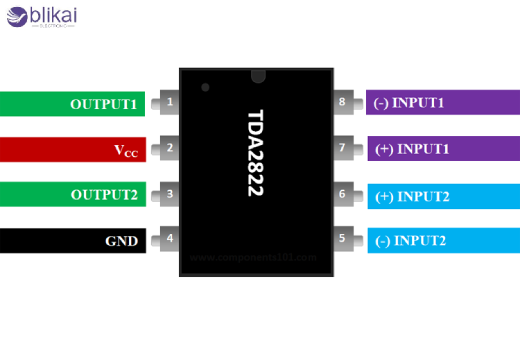
TDA2822 Pin Diagram Explanation
The TDA2822 is available in DIP-8 and SOP-8 packages, both with identical pin configurations. There are input and output channels to each channel, and shared power supply and ground pins are used to facilitate dual-channel operation.
TDA2822 Pin Description Table
- Pin 1 – Output 1: Output of amplifier channel 1
- Pin 2 – Input 1: Input of amplifier channel 1
- Pin 3 – GND: Ground reference
- Pin 4 – Input 2: Input of amplifier channel 2
- Pin 5 – Output 2: Output of amplifier channel 2
- Pin 6 – VCC: Positive power supply
- Pin 7 – Output 2 (BTL): Bridge output terminal
- Pin 8 – Output 1 (BTL): Bridge output terminal
TDA2822 Specifications and Electrical Characteristics
Absolute Maximum Ratings
The TDA2822 will normally supply up to 15 V and has a safe operating temperature of between -20 °C and +75 °C. Breach of these limits can cause irreparable damage to the IC.
Recommended Operating Conditions
A supply voltage range between 1.8 V and 12 V is recommended, and the usual load of the speakers is 4 O to 16 O with the supply voltage properly decoupled at all times.
Electrical Performance Parameters
The IC provides output power up to 0.65 W per channel in stereo mode and up to 1 W in bridge mode, depending on supply voltage and load impedance. Total harmonic distortion (THD) is typically below 1% at nominal output levels. The response of the frequency extends to a complete range of audio, normally between 40 Hz and 20 kHz. The input impedance is large, and the audio inputs, such as microphones, MP3 modules and Bluetooth receiver, are easily interconnected.
Internal Block Diagram and Working Principle
The TDA2822 contains inside it, differentials input stages, voltage gain amplifiers, and push-pull output stages. The signal goes through amplification processes that amplify the voltages and currents, but signal integrity is not compromised. Biasing networks stabilize operating points, as well as control the gain and reduce the distortion by feedback paths. Protection circuits check temperature and current and damage it in case of overload or short-circuit.
How Does the TDA2822 Work?
The TDA2822 boosts small audio signals both in current and voltage to directly drive speakers. When in stereo mode, both internal amplifiers are used to power left and right speakers. When in bridge mode (BTL), the two channels combine to create a single driver to a speaker, doubling the voltage swings and more than doubling the power output. This makes bridge mode the preferred mode of mono portable speakers. A single supply can be used with the IC, which allows easier power design when battery-powered electronics are needed.
Typical Application Circuits of TDA2822
Basic Stereo Audio Amplifier Circuit
In stereo, both channels have input coupling capacitors, feedback networks and output coupling capacitors. The circuit allows direct connection to audio sources such as MP3 players or Bluetooth modules, producing clean stereo sound with minimal components.
Bridge Amplifier Circuit (BTL Mode)
Bridge mode refers to a connection between the two outputs and one speaker. This design is efficient because it requires small capacitors to achieve high output power and does not need big output coupling capacitors, as is the case with this type of design.
Mono Amplifier Circuit
Simple systems such as intercoms and alarm sounders can use a single channel on their own and be mono-amplified.
PCB Layout Guidelines and Design Tips
Proper PCB layout significantly affects audio quality. Power decoupling capacitors should be placed close to the VCC pin to reduce noise. Ground traces should be short and thick to minimize impedance. Input signal traces should be isolated from output traces to prevent feedback noise. Thermal dissipation should be considered, especially in bridge mode operation, where output power is higher.
TDA2822 Applications
The TDA2822 is widely used in portable audio amplifiers, FM/AM radio receivers, walkie-talkies, intercom systems, DIY speaker projects, educational electronics kits, and embedded audio systems. The fact that it operates with low voltages makes it suitable in battery operated devices and small consumer electronics.
TDA2822 Advantages
TDA2822 is cheap, user-friendly, has low power consumption, and has very minimal external requirements. It is flexible in the sense that it supports both stereo and bridge formats.
TDA2822 Disadvantages
Its power output is lower than the Class-D amplifiers of that time, and the sound quality is not state of the art, so it can not be used in high-end audio.
TDA2822 vs Similar Audio Amplifier ICs
The TDA2822 has double-channel capability and bridge mode flexibility compared to the LM386. It has easier integration features, but worse output efficiency compared to the TDA7052. It is smaller in size than KA2209 but has lower output power. Each of the ICs is concerned with several design issues, such as power, size, and efficiency.
Common Problems and Troubleshooting
Problems that are frequent are that no sound can be heard because of wiring problems, low sound because of a lack of supply voltage, noise because of bad grounding, distortion because of the impedance mismatch of the speakers and overheating because of poor load setup.
Practical Design Tips for Best Audio Quality
Use proper power filtering capacitors, choose appropriate input coupling capacitors, match speaker impedance correctly, use short ground paths, and avoid long unshielded input wires. These practices significantly improve audio clarity and system stability.
FAQ
How much power can TDA2822 deliver?
It can deliver up to 0.65 W per channel in stereo mode and around 1 W in bridge mode, depending on supply voltage and load impedance.
Can TDA2822 drive an 8-ohm speaker?
Yes, the TDA2822 has the ability to power 8-ohm speakers in both a stereo and bridge setup.
Is TDA2822 better than LM386?
TDA2822 can be used in stereo, whereas LM386 can be used in a simple mono amplifier design.
Can TDA2822 work with 3.7V lithium batteries?
Yes, it works perfectly with Li-ion battery systems of 3.7 V so that it can be used in portable audio devices.
Conclusion
The TDA2822 amp IC is still a viable and useful product in audio amplification of low power. Its dual-channel architecture, low-voltage operation, and flexible configurations make it suitable for a wide range of applications from DIY electronics to embedded audio systems. Although it can not compete with the modern high-power audio amplifiers, it is excellent in simplicity, efficiency and cost- effectiveness. In the case of portable, compact, and education-oriented audio solutions, the TDA2822 is still a great choice for engineers, students and hobbyists alike.
Some images are sourced online. Please contact us for removal if any copyright concerns arise.





