


PTC Resettable Fuse: Working Principle, Types & Applications
 1407
1407Introduction to PTC Resettable Fuses
A PTC resettable fuse is an essential overcurrent protection device of modern electronics that is constructed to protect circuits against excessive current, to provide the convenient features of automatic reset. The name PTC is given by the Positive Temperature Coefficient characteristic, meaning that its resistance increases tremendously with an increase in temperature. As opposed to the physical replacement of traditional fuses that only occur once they blow open, the PTC fuse recovers to its high-conductive state by itself after the fault is cleared and the component cooled, and the circuit can then continue normal operation.
This property of independently resetting causes PTC fuses to be very useful in equipment that has limited or expensive (in terms of maintenance) access, e.g., embedded electronics, remote sensors, medical devices and consumer electronics. They are used to help limit the effects of inrush current, potentially reducing stress on sensitive parts, in addition to guarding against overcurrent due to short circuits/component failure. They are small and can fit into automated manufacturing processes, adding to their popularity within the mass production state of electronics.
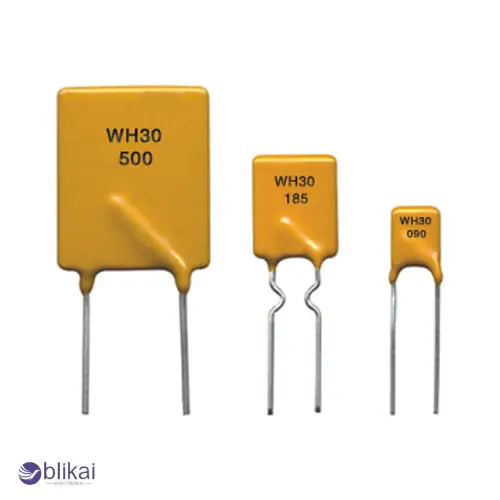
How a PTC Resettable Fuse Works
The Positive Temperature Coefficient Principle
The heart of a PTC resettable fuse consists of a polymer matrix filled with conductive particles of carbon. When operating under normal conditions, such conductive particles create unbroken connections that enable the flow of current with a low degree of resistance. Nevertheless, with the higher current passing through the circuit than the rated hold current, the electrical resistance heating makes the polymer expand. With the expansion of the polymer, the particles of carbon are separated, and many of the conductive paths are broken, leading to a drastic increase in resistance. This rush of resistance prevents a through flow of current at this point, essentially safeguarding downstream loads.
Self-Resetting Process
Upon removal of the overcurrent condition, such as short circuit repair or a faulty component removal, the fuse starts cooling off. When the temperature decreases, the polymer shrinks and the carbon particles are again put in contact, which recreates the conductivity channels. The fuse is then allowed to revert to its original value of low resistance so that it can be used normally. Such a thermal switching action can be repeated hundreds of times, but multiple trips can cause the base resistance of the fuse to rise during the lifetime of the fuse slowly.
Advantages Over Traditional Fuses
PTC resettable fuses have the advantage over conventional glass-tube or blade fuses:
- There is no replacement downtime, and this cuts the maintenance cost.
- Small size and packaging, particularly surface-mount versions of small-size PCBs of very high density.
- Automatic recovery, preferably designed to work on unattended (or sealed) systems.
- Soft current limiting rather than harsh open circuit is significant in some battery-powered or signal-determined applications.
Types of PTC Resettable Fuses
There are several forms of PTC resettable fuses, each designed to suit various mounting techniques, currents and environmental contexts. The most common are indicated in the table below:
|
Type |
Features |
Typical Applications |
|
Radial Leaded PTC |
Through-hole mounting, high current handling, robust design |
Power supplies, industrial controls, large consumer electronics |
|
Surface-Mount (SMD) PTC |
Compact, automated PCB assembly compatible, lower profile |
Smartphones, tablets, portable devices |
|
Telecom PTC |
High surge resistance, meets telecom safety standards |
Telephone lines, modems, DSL equipment |
|
High-Voltage PTC |
Handles high voltage and energy pulses |
Industrial machinery, motor drives, power grids |
All the types are designed to maintain a balance between the size, propulsion speed of the trip, current capacity, and sustainability to the environment. As an example of this, telecom PTCs can be encapsulated with extra protection against lightning-caused errors, and high-voltage types are made of thicker material to avoid arcing.
Key Applications of PTC Resettable Fuses
Consumer Electronics: PTC fuses in chargers, handheld devices, and game consoles, laptop computers, protect charging ports, battery trails and fragile ICs against short-circuit or against malfunctioning peripherals. They are self-reset and, therefore, users do not have to take them to service after they develop minor faults.
Automotive Systems: PTC fuses have been used in infotainment units, dash electronics, LED lighting circuits and sensor networks to prevent costly failures due to wiring harness faults and moisture-related shorts, and PTC fuses can withstand extremes of the automotive temperature range.
Industrial Automation: Industrial Automation offers protection of PLCs, motor controllers, and sensor networks against overcurrent events that can prove expensive to a manufacturing facility in terms of downtime. The speed at which they recover prevents the business from stopping production lines because of long maintenance periods.
Telecommunications: Signal protection against both overcurrent and surge voltages (Such protection is often combined, in combination with surge arresters, to protect network switches, modems, and base stations).
Medical Devices: PTC fuses deliver very important protection in portable diagnostic equipment, infusion pumps and patient monitoring systems so that the equipment can stay operational without physical servicing even in emergency conditions.
Advantages of PTC Resettable Fuse:
- Reusable protection reduces cost over the product’s lifetime.
- Minimal downtime for devices in hard-to-access locations.
- Compact designs suit modern electronics with limited PCB space.
- Safe operation in both AC and DC systems.
Disadvantages of PTC Resettable Fuse:
- Slower trip times than fast-blow fuses, so not suited to highly sensitive semiconductor protection.
- Voltage and current limitations — unsuitable in cases of very high power or high energy faults.
- Aging effects — periodic trips will result in a buildup of residual resistance, which will have a marginal effect on performance over time.
In numerous applications, designers may actually use PTC fuses in conjunction with other protection devices, either TVS diodes or MOVs, to have full protection against overcurrent and transient voltages.
How to Choose the Right PTC Resettable Fuse
The appropriate PTC fuse has to be chosen between electrical ratings and environmental and application-specific requirements:
- Hold Current (I_hold): The maximum continuous current the fuse can carry without tripping.
- Trip Current (I_trip): The current at which the fuse will switch to high resistance.
- Voltage Rating: Must exceed the circuit’s maximum operating voltage.
- Initial Resistance: Lower is better to minimize voltage drop in normal operation.
- Time-to-Trip: The response speed at different overload levels.
- Operating Temperature Range: Critical for applications in harsh environments.
Example: For a USB-powered device operating at 5V with a maximum draw of 1A, a fuse with I_hold of 1.1–1.5A and I_trip around 2A would be appropriate, with at least a 6V voltage rating to ensure reliability under transient conditions.
Installation and Testing Guidelines
Installation Tips:
Position the fuse near the power source for optimal protection coverage.
For SMD types, use reflow profiles recommended by the manufacturer to prevent damage during soldering.
Isolate the fuse thermally from nearby heat-generating components to avoid nuisance tripping.
Testing Steps with a Multimeter:
Measure initial resistance in normal state (should be under a few ohms depending on type).
Simulate an overcurrent condition briefly, observing the resistance rise sharply.
Allow cooling, then confirm resistance returns close to the original value.
Conclusion
Modern electronic systems cannot be complete without the use of PTC resettable fuses to provide overcurrent protection. The fact that they can reset themselves, are small in size and have a broad application makes them a favorite of engineers creating products that are dependable and not exposed to frequent repairs. Although they cannot universally be used as a replacement for all fuses, especially those with ultra-fast protection requirements, they prove very useful as an improved solution in applications where automatic recovery and uniform protection over a number of cycles are required. With both shrinking and integrating of electronics, PTC fuse technology will still be core in creating the safety of operation and serviceability.
Frequently Asked Questions (FAQ)
What is the difference between a PTC resettable fuse and a thermistor?
A thermistor is most often used to measure or compensate for temperature changes, whereas a PTC fuse is intended to limit current on overheat, based on the same temperature-resistance relationship.
How many times can a PTC fuse be reset?
Typically, hundreds of times, though repeated tripping can slightly increase base resistance and affect long-term performance.
Can PTC fuses fail permanently?
Yes — if exposed to extreme overcurrent or environmental stress beyond specifications, they can fail in a high-resistance or open state.
Are PTC fuses polarity sensitive?
No, they can be installed in any orientation in both AC and DC circuits.
Some images are sourced online. Please contact us for removal if any copyright concerns arise.





