


What Is Direct Memory Access (DMA)? Full Guide
 454
454Introduction
Direct Memory Access (DMA) is a key computer architecture and embedded system technology that enables peripherals to share data with system memory without involving the CPU itself at all, with great effect on system performance, processor burden and bandwidth, and is the key to high-performance data processing in current electronics. In modern microcontrollers, industrial controllers, communication modules, and high-performance computing systems, DMA is important in offloading data movement activities that are common in repetitive tasks to the CPU so that the processors can concentrate on the computational, control, and real-time decision-making processes. In data acquisition systems, multimedia streaming, storage interfaces or IoT devices, the engineers of embedded systems that require high motivation and low power consumption should understand direct memory access.
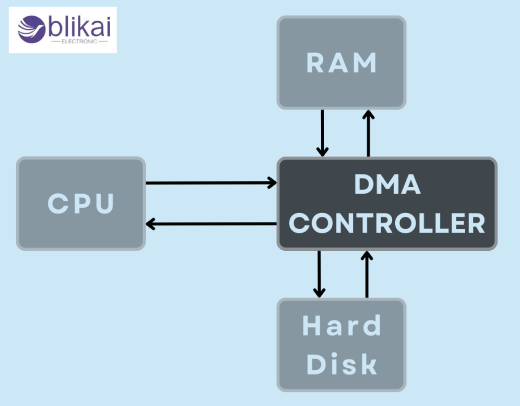
What Is Direct Memory Access (DMA)?
Direct Memory Access (DMA) is a hardware-based data transfer mechanism that enables peripheral devices such as ADCs, UARTs, SPI controllers, network interfaces, and storage controllers to move data directly to and from system RAM without requiring the CPU to manage every transfer step. A dedicated DMA controller handles the whole transfer process independently without requiring the processor to repeatedly read data off a peripheral register and write it into memory, instead of the other way around. This architecture greatly decreases the overhead of interrupts, enhances the data throughput and system responsiveness, especially where the systems have continuous or high-speed data streams.
How Direct Memory Access (DMA) Works
The DMA process starts when the CPU sets the DMA controller with the source address, destination address, transfer size, transfer direction, and operating mode, and then the peripheral device makes a DMA request signal when the data is available to transfer. Bus arbitration by the DMA controller is then executed to obtain control of the system bus. The data transfer is then done directly between the peripheral and memory, internal counters are then updated, and an interrupt is generated to signal the CPU on completion or error, and thus the processor is able to resume control or process the transferred data.
Role of the DMA Controller
The DMA controller is a dedicated hardware part of the microcontrollers, system-on-chip devices, or chipsets that manages various channels of transfer, address generation, the counts of data moved, controlling transfer modes, and the synchronization of interrupt systems. It is a sort of temporary bus master, and it is seen to make sure that memory operations are performed effectively and yet the system is stable, hence an essential architecture block of performance-oriented embedded systems.
DMA Transfer Cycle Step-by-Step
A typical DMA transfer cycle begins with the completion of a peripheral data ready, then a DMA request signal is sent to the controller, then bus arbitration is performed to provide a transfer, upon which the peripheral and RAM is accessed by the DMA controller either by reading or writing data, memory addresses and memory counters are automatically updated, and the cycle continues till the transfer count reaches zero, when the controller releases the bus and signals completion by sending an interrupt.
DMA vs CPU-Based Data Transfer
In CPU-based programmed I/O, the processor has to read the data in one of the peripheral registers and write the data to memory per unit of data, which uses precious processing cycles and creates a huge latency gap, which is replaced by DMA doing data transfer in bulk, and the processor does not have to offer help, which contributes immensely to throughput and efficiency.
|
Feature |
DMA Transfer |
CPU-Based Transfer |
|
CPU Involvement |
Minimal after setup |
Continuous involvement |
|
Throughput |
High, block-level transfer |
Limited by CPU speed |
|
Power Efficiency |
Higher |
Lower |
|
Interrupt Load |
Reduced |
Frequent interrupts |
|
Best Use Case |
High-speed data streaming |
Low-volume control data |
Types of DMA Transfer Modes
The DMA controllers usually have a variety of transfer modes, which define how the memory bus is accessed in comparison to the way the CPU is used, and can be used by system designers to trade performance and responsiveness as required by the application.
Burst Mode DMA
The DMA controller is operated in burst mode, where it transfers a complete data block in one continuous operation after taking bus control, temporarily preventing access by the CPU to memory, but achieving maximum throughput is good in high-speed applications, like multimedia buffering and data logging.
Cycle Stealing Mode
In cycle-stealing mode, the DMA controller transfers one data unit at a time while intermittently releasing bus control back to the CPU, effectively sharing memory access and minimizing CPU disruption, which is beneficial in multitasking embedded systems.
Transparent Mode
In transparent mode, DMA transfers are only made when the CPU is not accessing the system bus and cause minimal interference with processor access, but usually have a lower global transfer rate.
DMA in Microcontrollers and Embedded Systems
DMA is especially critical in microcontrollers and embedded systems, where limited processing resources and strict timing requirements demand efficient data movement mechanisms that do not overload the CPU.
DMA in ARM-Based Microcontrollers
Processors based on the Arm Ltd. architecture commonly integrate DMA controllers to support efficient peripheral communication, particularly in Cortex-M series microcontrollers, where DMA reduces interrupt frequency and enhances real-time performance in applications such as motor control, industrial automation, and IoT sensing platforms.
DMA in STM32 and Other MCUs
Multi-channel DMA controllers are also found on microcontrollers of STMicroelectronics, and more so within the STM32 family, which supports memory-to-memory, peripheral-to-memory and memory-to-peripheral transfers, and so is useful in applications that require ADC sampling, UART communication, streaming data over the SPI, and circular buffering of continuous data acquisition systems.
DMA for ADC, UART, SPI, and I2C
DMA is used for automatic conversion of ADC conversion results into memory buffers, continuous UART reception without loss of data, streaming of SPI sensor data at high speed and I2C-based memory transfer, which is essential in high-performance embedded firmware design.
Advantages of Direct Memory Access
There are several benefits of DMA, such as decreased CPU load, increased throughput, reduced interrupt overhead, increased real-time performance, and reduced power consumption, which help in more scalable and high-performance electronic processes.
Reduced CPU Load
By offloading repetitive data movement tasks to dedicated hardware, DMA frees processor resources for computation, control algorithms, and communication stack management.
Higher Data Throughput
Block-level data transfers allow DMA to achieve significantly higher bandwidth compared to CPU-driven I/O, particularly in applications requiring continuous data streams.
Improved Power Efficiency
Reducing CPU power during data transfers reduces the total power consumption and increases the battery life of portable and IoT devices.
Disadvantages and Design Considerations of DMA
Despite its advantages, DMA introduces design considerations such as bus contention, memory alignment requirements, buffer management complexity, and potential cache coherency issues in advanced systems with data caching mechanisms.
Bus Contention and Arbitration
Because both the CPU and the DMA controller need to access the memory, the arbitration logic has to be used to address the issue of bus ownership to avoid performance degradation.
Memory Alignment and Buffer Management
The efficient working of the DMA usually demands appropriate data alignment, circular buffers and double-buffering methods to maintain uninterrupted, reliable data flow.
Cache Coherency Issues
Whenever the data caches are present, the developers should make sure that memory buffers accessed by DMA are synchronized to the CPU cache to avoid the presence of stale or inconsistent data.
DMA vs Interrupt-Driven I/O
Interrupt-driven I/O is adequate in the tasks related to low-frequency control data and simple communication tasks, whereas DMA is better in high-data transfer volume or continuous data transfer and provides lower latency, less CPU load, and improved scaling in performance-sensitive systems.
Common Applications of Direct Memory Access
DMA is widely used in audio streaming, video processing, storage controllers, networking devices, data acquisition systems, and industrial automation platforms where efficient data movement is essential for maintaining system responsiveness and reliability.
FAQ
Is DMA faster than CPU transfer?
Yes, DMA is generally faster for bulk data transfers because it reduces processor overhead and enables block-level memory operations.
What is a DMA controller?
A DMA controller is a hardware component that controls autonomous data communications between peripherals and memory, including addressing, number of transfers, and interrupts.
What is the difference between DMA and interrupt-driven I/O?
DMA does block data transfers involving little CPU activity, whereas interrupt-based I/O has the CPU address one data event at a time.
Conclusion
Direct Memory Access (DMA) is an important technology in contemporary computing and embedded systems. It facilitates high-speed, efficient, and low-power movement of data between peripherals and memory. By offloading repetitive transfer tasks from the CPU, DMA enhances system performance, improves real-time responsiveness, and supports scalable electronic designs across industrial, consumer, and IoT applications, making it an essential architectural feature in today’s microcontrollers and processors.
Some images are sourced online. Please contact us for removal if any copyright concerns arise.





