


ATmega328 vs ATmega328P: Specs, Differences & Applications
 413
413Introduction to ATmega328 and ATmega328P
The ATmega328 and ATmega328P are widely used 8-bit AVR microcontrollers designed for embedded control systems, hobby electronics, and development boards. Both the chips belong to the AVR series of microcontrollers, which were first manufactured by Atmel and are currently manufactured by Microchip Technology. The microcontrollers have almost similar architectures, memory capacities, and peripherals, and this aspect adds more confusion when engineers, students and makers have to select between two microcontrollers. Despite the minor difference in the specifications, the ATmega328P has picoPower technology, which is more efficient in power consumption, hence more convenient in battery-operated and power-sensitive circuits. Due to this advantage, the ATmega328P is the choice of the current development platforms and embedded systems.
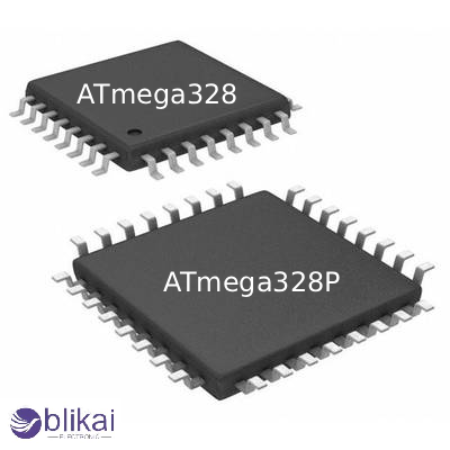
What Is the ATmega328 Microcontroller?
ATmega328 is an 8-bit AVR RISC microcontroller that is used in general embedded applications that need moderate processing power and built-in peripherals. It has a CPU that has the ability to execute the instructions within a single clock cycle, and this enables it to effectively perform real-time control tasks. The microcontroller has flash memory to store programs, SRAM memory to store runtime data and EEPROM to store non-volatile configuration. It has also been incorporated with a number of peripherals like timers, analog to digital converters, communication devices, and interrupt controllers, and this enables designers to design an entire control system on a single chip.
Key Features of ATmega328
The ATmega328 has 32 KB of program memory and 2 KB and 1 KB of SRAM and EEPROM data storage, respectively. It can operate at clock frequencies up to 20 MHz under different operating voltages and configurations. The microcontroller has several timers and counters, including an 8-bit timer and a 16-bit timer, that can be utilized in PWM generation and timing functions. The capabilities of the communication are UART, SPI and I2C (TWI) communication, which enables the chip to communicate with sensors, displays, memory modules and other microcontrollers. The device also has a 10-bit analog to digital converter having several input channels, which allows it to sense analog signals of various sensors like temperature sensors, potentiometers and light detectors.
What Is the ATmega328P Microcontroller?
The ATmega328P is an enhanced low-power version of the ATmega328, which adds picoPower technology to make it more energy efficient. While maintaining nearly identical architecture and peripheral features, the ATmega328P introduces optimized sleep modes and reduced power consumption during both active and standby operation. This makes it ideal for portable electronics, battery-powered devices, and energy-efficient embedded systems.
Key Features of ATmega328P
ATmega328P shares the same memory set up with ATmega328, which has 32 KB of flash memory, 2 KB of SRAM and 1 KB of EEPROM. It also supports clock speeds up to 20 MHz and shares the same communication interfaces such as SPI, UART and I2C. Its major strength is that it has an advanced power management system that enables very low current consumption in sleep modes and low operating current in active mode. This renders the microcontroller exceptionally suitable for applications with long battery life.
ATmega328 vs ATmega328P: Key Differences
Although the architecture and facilities of the two chips are similar, the ATmega328 and the ATmega328P differ a little in the technical aspects.
Power Consumption Differences
Power efficiency is the biggest distinction between the two microcontrollers. The ATmega328P is based on picoPower technology that reduces the amount of current consumed during operation as well as when asleep. This will be especially useful in battery-powered devices and energy-constrained IoT systems.
Device Signature and Programming Differences
The other difference is in the device signature that is applied in programming. A device ID is a representation of a chip in memory, and the programmer uses it to distinguish the microcontroller. The signing tools and bootloaders must be used to support each chip due to the differences in the device signatures.
Electrical Characteristics
Despite the similarity in the way in which these two microcontrollers operate, the ATmega328P is designed with lower current consumption at different voltages and clock speeds.
Availability and Production Status
A new design in modern electronics production would more readily use the ATmega328P. Many development tools and software platforms also prioritize support for the ATmega328P.
ATmega328 vs ATmega328P Specifications Comparison
|
Feature |
ATmega328 |
ATmega328P |
|
CPU Architecture |
8-bit AVR RISC |
8-bit AVR RISC |
|
Flash Memory |
32 KB |
32 KB |
|
SRAM |
2 KB |
2 KB |
|
EEPROM |
1 KB |
1 KB |
|
Maximum Clock Speed |
20 MHz |
20 MHz |
|
ADC Resolution |
10-bit |
10-bit |
|
Communication Interfaces |
SPI, UART, I²C |
SPI, UART, I²C |
|
Power Efficiency |
Standard |
picoPower low-power technology |
|
Device Signature |
Different |
Different |
|
Pin Compatibility |
Yes |
Yes |
ATmega328 vs ATmega328P Pinout and Architecture
Pin Compatibility
Among the major benefits of the two microcontrollers is the fact that the pin layout is similar in most packages. This implies that the ATmega328P can normally substitute the ATmega328 in the current circuit board designs without necessarily altering the hardware.
Internal Architecture Overview
Both chips are based on the AVR Harvard architecture, which isolates program memory and data memory to operate at higher speeds. The RISC instruction set has difficulties in processing embedded control since it provides a sizable number of instructions to be executed by a single clock cycle.
Use in Development Boards and Embedded Projects
Use in Arduino Boards
The ATmega328P is the main microcontroller in the development boards of the Arduino Uno and the Arduino Nano. These boards provide USB connectivity, voltage regulation, and simplified programming interfaces, allowing developers to quickly prototype electronic systems.
DIY Electronics and IoT Projects
In maker communities and IoT development, the ATmega328P is commonly used for sensor data acquisition, motor control, home automation systems, and robotics projects.
Which One Should You Choose?
When to Use ATmega328
The ATmega328 may still appear in legacy hardware designs or older development boards. As long as an original system had been constructed on this chip, without necessarily being very low-power-consuming, it could still be operable.
When to Use ATmega328P
In a majority of the current electronics projects, the ATmega328P would be the superior option due to its reduced power consumption and its greater compatibility with development tools and community resources.
Common Applications of ATmega328 and ATmega328P
Embedded Control Systems
The two microcontrollers also find extensive applications in embedded control systems to control sensors, actuators and user interfaces.
Robotics and Automation
These chips are used to control the robots and automation platforms with small size, sensor processing, and communication.
Consumer Electronics
They also occur in consumer electronics, including smart appliances, lighting controllers and portable electronic devices.
IoT Devices
Due to its low power consumption, the ATmega328P is specifically applicable in the IoT nodes that will need to be powered by batteries over long durations.
FAQ
Is ATmega328 the same as ATmega328P?
No, the ATmega328P is an enhanced low-power version of the ATmega328 with improved power management features.
Why does Arduino use ATmega328P instead of ATmega328?
The ATmega328P has improved power consumption and would suit battery-powered development boards better.
What does the “P” mean in ATmega328P?
The letter P is used to represent picoPower technology, which means the low-power design of the microcontroller.
Conclusion
The ATmega328 and ATmega328P are related AVR microcontrollers that are based on the same architecture, memory layout and peripheral support features. Nevertheless, the ATmega328P has better power efficiency, picoPower technology and is the choice today in regard to embedded systems and battery-powered electronics. In the majority of new designs and development projects, including those using platforms like the Arduino Uno, the ATmega328P is the most convenient and supported platform.
Some images are sourced online. Please contact us for removal if any copyright concerns arise.





