


What Is an RF Spectrum Analyzer? Key Features & Applications
 138
138What Is an RF Spectrum Analyzer?
An RF spectrum analyzer is a measurement instrument used to observe, analyze, and measure radio frequency signals in the frequency domain. In contrast to time domain instruments, it shows signal power as a function of frequency, which allows one to view harmonics, spurious emissions, noise floors, and bandwidth properties.
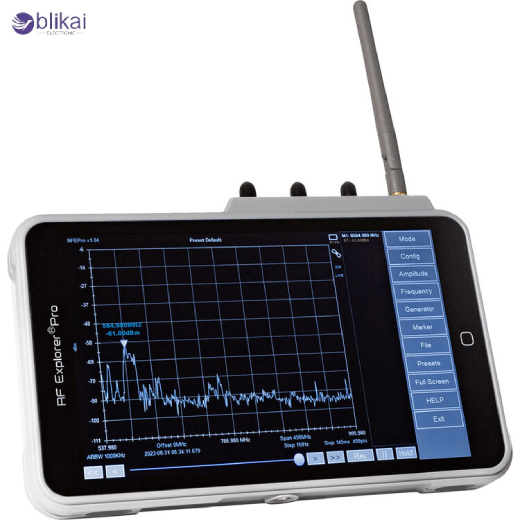
RF Spectrum Analyzer vs Signal Analyzer
Although the traditional spectrum analyzers emphasized the frequency-domain amplitudes, the new signal analyzers have added the capability to analyze the modulation, display the vectors and also analyze the digital demodulation. Practically, most current instruments have both functions, although classic RF spectrum analyzers are still suitable in fast spectral display and hunting interference.
How an RF Spectrum Analyzer Works
The knowledge of the working principle of an RF spectrum analyzer can be used to interpret the measurements in the accurate way and prevent the typical mistakes.
Frequency Domain Measurement Explained
RF spectrum analyzer transforms the incident RF signal into a frequency domain representation, which is a display that defines the power distribution of the signal with respect to frequency. It is also easier to distinguish various signals, harmonics and noise components, which otherwise would be hard to discern in the time domain.
Superheterodyne Architecture
The majority of the classical RF spectrum analyzers are based on a superheterodyne design, in which the input signal is multiplied with a local oscillator to create an intermediate frequency (IF). This IF is filtered, amplified, and detected, enabling high sensitivity and selectivity over a wide frequency range.
FFT-Based Spectrum Analysis
FFT-based spectrum analyzers use digital signal processing to transform time-domain samples into frequency-domain data. These analyzers have higher sweep rates, higher resolution to narrowband signals and are also particularly applicable in software-defined RF systems and real-time.
Key Features of an RF Spectrum Analyzer
There are specifications that are important in the actual performance of an RF spectrum analyzer during measurements.
Frequency Range
Frequency range defines both lowest and highest frequencies that can be measured using an analyzer. Entry-level models may cover a few gigahertz, while advanced analyzers extend into millimeter-wave frequencies for 5G and radar applications.
Resolution Bandwidth (RBW)
The resolution bandwidth is used to identify how the analyzer can differentiate narrowly spaced signals. Narrow RBW is better in frequency resolution and noise performance and wider RBW can use faster sweeps and full band signals.
Video Bandwidth (VBW)
Video bandwidth filters the detected signal after RBW filtering to smooth trace noise. Lower VBW settings reduce display fluctuations but slow measurement response, making VBW a trade-off between clarity and speed.
Dynamic Range and Sensitivity
Dynamic range determines the ability of an analyzer to measure weak signals when strong ones are present in the analyzer. RF detection and low noise floors are necessary to detect low level RF emissions and sources of interference.
Display and Trace Modes
Contemporary RF spectrum analyzers are able to display a variety of trace modes such as clear/write mode and maxhold mode, average mode and waterfall mode. These modes can be used to visualize intermittent signals, frequency hopping behavior and the spectrum occupancy in the long term.
Types of RF Spectrum Analyzers
RF spectrum analyzers are available in several form factors to suit different applications.
Benchtop RF Spectrum Analyzers
Benchtop spectrum analyzers are laboratory instruments of R&D, manufacturing and compliance tests. They offer wide frequency coverage, excellent accuracy, and advanced measurement functions.
Portable and Handheld Spectrum Analyzers
Portable spectrum analyzers are intended to be used in the field, have battery operation and tough enclosures. They are suited in RF site surveys, hunting of interference and maintenance.
Real-Time Spectrum Analyzers (RTSA)
Real-time spectrum analyzers detect and analyze signals in real-time with no gaps allowing them to detect transient, burst and frequency-happing signals that traditional swept spectrum analyzers can overlook.
Common Applications of RF Spectrum Analyzers
RF spectrum analysers have found application in most industries and technologies.
Wireless Communication Testing
Spectrum analyzers are critical in the testing of Wi-Fi, Bluetooth, LTE, 5G and IoT systems. They are utilized to test carrier frequency errors, channel bandwidth, spectral masks and spurious emissions.
EMI and EMC Testing
Spectrum analyzers are used in electromagnetic testing of electromagnetic interference (EMI) and electromagnetic compatibility (EMC). Spectrum analyzers are used to determine the sources of noise and the emissions that may cause interference with other electronics.
RF Component and Circuit Testing
Spectrum analyzers are used to test RF amplifiers, RF oscillators, mixers, RF filters, and antennas. Harmonic distortion, phase noise, and gain compression are examples of measurements that are needed in the optimization of RF circuits.
Broadcast and Signal Monitoring
RF spectrum analyzers are used to monitor spectrum occupancy, detect illegal activities and to quality signals in radio, television and satellite communications in broadcasting and signal surveillance.
How to Choose the Right RF Spectrum Analyzer
The choice of an appropriate analyzer is based on the needs of applications and financial limits.
Application-Based Selection
Application specifications vary according to different applications. As an example, EMI testing can focus on sensitivity and dynamic range, whereas wireless testing can need a wide frequency range and rapid sweep rates.
Key Specifications to Consider
Among the significant specifications that should be considered are: Some of the key specifications are frequency range, RBW, phase noise, dynamic range, accuracy of measurements and analysis capabilities available. Knowing these parameters prevents excessive spending or minimal specification of equipment.
Budget and Performance Trade-Offs
Spectrum analyzers of higher performance are more expensive. The deployment of entry-level or software-defined software can be adequate at education, hobbyist projects, or to a simple trouble-shooting need, whereas more advanced software applications may need high-quality tools.
Advantages of RF Spectrum Analyzers
High Sensitivity and Wide Dynamic Range
RF spectrum analyzers can detect very weak signals even in the presence of strong neighboring signals, making them ideal for identifying interference sources and low-power emissions.
Accurate Frequency-Domain Analysis
They give accurate signal amplitude versus frequency measurements enabling engineers to visualize harmonics and spurious signals as well as spectral occupancy.
Versatile Applications
Spectrum analyzers are used in a myriad of engineering activities, such as testing of wireless communication, EMI/EMC compliance and RF component testing.
Real-Time Monitoring (for RTSA models)
Real-time spectrum analyzers record transient and burst signals which swept analyzers can miss, and are irreplaceable in kind by swept spectrum analyzers in advanced RF debugging and spectrum management.
Disadvantages of RF Spectrum Analyzers
High Cost for Advanced Models
Widespec display Premium spectrum analyzers have wide frequency response, sensitivity, and can be real time, which are usually costly, making them accessible only to hobbyists or small laboratories.
Limited Time-Domain Visibility
Older spectrum analyzers are capable of showing frequency-domain information, and in many cases cannot provide detailed time-domain waveform information, so they might need to be supplemented with instruments such as oscilloscopes.
Sweep Speed Constraints
Swept spectrum analyzers may miss very short-duration or intermittent signals if the sweep speed is not fast enough, especially in dynamic RF environments.
Complexity of Operation
High-end functionality and options may not be user-friendly among novice users as it may need training to become an accurate interpreter of measurements and prevent some common pitfalls.
RF Spectrum Analyzer vs Oscilloscope
A spectrum analyzer is an instrument that is appropriate in frequency domain analysis and an oscilloscope is appropriate in time domain analysis. In RF systems, both tools are often used together to fully characterize signal behavior.
FAQs
What frequency range does an RF spectrum analyzer cover?
The frequency range varies by model, from a few kilohertz up to tens of gigahertz, depending on the intended application.
Can an RF spectrum analyzer measure modulation?
Simple spectrum analyzers display spectral behavior, whereas more complex models and signal analyzers facilitate modulation analysis and also in the form of a vector analysis.
Is a real-time spectrum analyzer necessary for RF debugging?
Capturing transient and intermittent signals that are not recorded by swept analyzers require real-time analyzers.
What is the difference between RBW and VBW?
The frequency resolution of RBW is altered, whereas VBW filters signal display by removing extra noise after being detected.
Conclusion
RF spectrum analyzers form an essential part of electronics and wireless engineering in modern times. From RF component testing to wireless communication validation and EMI troubleshooting, they provide critical insights into signal behavior across the frequency domain. Knowing the mechanism of RF spectrum analyzers, their important characteristics and the most appropriate model to purchase, engineers and technicians can greatly enhance the performance and reliability of RF systems.
Some images are sourced online. Please contact us for removal if any copyright concerns arise.





