


SAW Filter: Types, Working Principle & RF Applications Guide
 531
531Introduction to SAW Filters
In contemporary communication systems, effective signal filtering is necessary to ensure quality work. The Surface Acoustic Wave (SAW) filter is one of the most popular filter technologies among the different available filter technologies. SAW filter is a small and inexpensive electronic device that is highly essential in radio frequency (RF) signal processing, particularly in mobile phones, wireless LAN, GPS receivers and broadcasting.
SAW filters are able to utilize acoustic wave-based frequency filtering on surfaces of a piezoelectric material to achieve high levels of selectivity in frequency filtering in a relatively small size and low cost. This renders them invaluable in billions of consumer electronic devices that are shipped annually.
Here we shall discuss the working principles of SAW filters, the types of filters, specifications, benefits, drawbacks, as well as applications of these filters, a comparison with Bulk Acoustic Wave (BAW) filters and a discussion of future trends.
How SAW Filters Work: The Working Principle
The principal idea of the SAW filter operation consists of the transformation of electrical energy into mechanical (acoustic) energy and vice versa. This is done on a piezoelectric substrate like quartz or lithium tantalate.
Structure of a SAW Filter
A typical SAW filter consists of:
Piezoelectric substrate: This is a material that has the capacity to transduce electrical signals into mechanical vibrations and the versa.
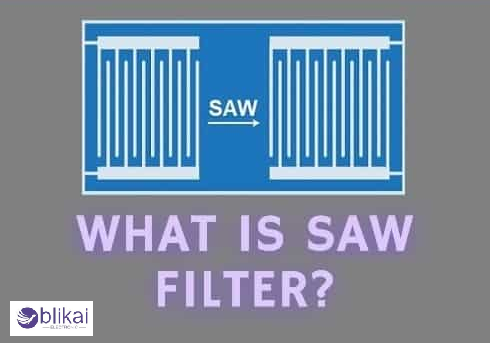
Interdigital transducers (IDTs): Fine metal electrodes were patterned on the substrate. The input IDT transforms an electric signal into surface acoustic waves, and the output IDT transforms the acoustic waves into an electrical signal.
Acoustic propagation path: This is the area of the substrate through which the surface waves propagate and interact, and defines the frequency response of the filter.
Step-by-Step Operation
- An electrical RF signal is applied to the input IDT.
- The signal is then converted to surface acoustic waves by the piezoelectric effect at the input IDT.
- These acoustic waves propagate over the substrate surface, and certain wavelengths are allowed to propagate, depending on the geometry of the IDT.
- Reconversion of the acoustic waves into an electrical signal is done at the output IDT.
- The frequency components that are desired are passed efficiently, and the rest are attenuated.
This process allows SAW filters to become highly useful band-pass filters, which select the desirable signals and reject the undesirable interference.
Types of SAW Filters
SAW filters come in different designs tailored for specific applications. The three main categories include:
1. Resonator-type SAW Filters
Built using acoustic resonators arranged in a ladder or lattice configuration.
Provide sharp frequency selectivity.
Commonly used in mobile communication systems where precise channel separation is needed.
2. Delay-line SAW Filters
Based on the principle of time delay in surface wave propagation.
Simpler construction, but less selective than resonator-based filters.
Historically used in analog television and early communication systems.
3. Band-pass SAW Filters
Created to permit a given frequency band and suppress others.
The most prevalent one in smartphones, Wi-Fi modules and GPS receivers.
Provides the best size to cost to performance ratio.
4. SAW vs. BAW (Bulk Acoustic Wave) Filters
Whereas the SAW filters perform well at lower frequencies, the BAW filters suit higher frequency RF applications.
Key Specifications of SAW Filters
Some of the important parameters that an engineer takes into consideration when choosing or designing a SAW filter are:
- Center Frequency (Fc): The target frequency around which the filter operates.
- Bandwidth (BW): The range of frequencies that the filter allows.
- Insertion Loss: The amount of signal power lost while passing through the filter. Lower insertion loss is desirable.
- Group Delay: Indicates phase distortion; important in communication systems where timing matters.
- Temperature Stability: SAW filters can drift with temperature changes; some designs minimize this effect.
- Package Size: Compact packages are critical for integration into smartphones and IoT devices.
- Q Factor (Quality Factor): A Higher Q means sharper filtering and better selectivity.
These values are usually supplied by manufacturers as datasheets, and engineers are able to use them to decide which filter to use in their system.
Applications of SAW Filters in Electronics & RF Systems
Mobile Communication (3G, 4G, 5G)
SAW filters are essential in smartphones for channel selection and interference suppression. Each phone contains multiple SAW filters to separate signals from different frequency bands and carriers.
Wi-Fi and Bluetooth Modules
SAW filters in wireless networking and short-range communication assist in interfering with other signals and providing a clean frequency channel to enhance connectivity and performance.
Television and Broadcasting Systems
SAW filters are used in TV tuners to filter the channels, and only the desired broadcast frequency is used. They played a crucial role, particularly in the analog television system, and they will still be useful in digital broadcasting.
Satellite and GPS Receivers
GPS modules are based on the use of SAW filters to filter undesired signals and enhance the accuracy of the location. In their absence, the weak satellite signals are easily overwhelmed by noise.
Automotive Electronics
Cars use SAW filters in radar systems, infotainment, and wireless communication modules. As vehicles become more connected, demand for RF filtering grows.
IoT Devices and Wireless Connectivity
The SAW filters offer cheap, small-scale filtering products to sensors, smart home gadgets, and industrial IoT applications with billions of connected IoT devices.
Advantages of SAW Filters
- Small size and lightweight, suitable for portable devices.
- Low cost, and hence can be used by the mass market.
- Stable operation in low-to-mid frequency.
- Well-established technology that is fully backed by manufacturers across the globe.
Disadvantages of SAW Filters
- Frequency limitation (generally up to ~3 GHz). For higher bands, BAW filters are more effective.
- Lower power handling, unsuitable for high-power RF applications.
- Temperature sensitivity can cause slight frequency drift in extreme conditions.
When to Use SAW vs. BAW Filters
- Use SAW filters for applications below 3 GHz where cost and size are critical.
- Use BAW filters for higher frequency ranges (e.g., Wi-Fi 6E, 5G mid-to-high bands) and where power handling is more demanding.
Design & Selection Guide for SAW Filters
When selecting a SAW filter, engineers should consider:
Frequency requirements: Does the filter support the desired band?
Bandwidth: Narrow or wide band, depending on the application.
Insertion loss: Lower is better for preserving signal strength.
Size: Important for integration into compact devices like smartphones or IoT modules.
Compatibility: Ensure the filter matches other RF components such as amplifiers, antennas, and mixers.
Supplier support: Availability, lead time, and datasheet clarity can affect project timelines.
Practical tip: For prototyping, start with off-the-shelf SAW filters from leading manufacturers, then refine selection based on test results.
Future Trends in SAW Filter Technology
With the development of communication technologies, SAW filters are also developing:
5G and Beyond: Although BAW dominates higher frequencies, SAW filters are applied in the lower 5G frequencies, and they will be applicable in the coming years.
Integration in SiP (System-in-Package): SAW filters are increasingly embedded alongside RF amplifiers and switches in compact modules.
Automotive and IoT Growth: It is gaining momentum with an increase in demand as more gadgets need a wireless connection.
Competition with MEMS Filters: Micro-Electro-Mechanical Systems (MEMS) filters are a possible competition, but SAW is older.
SAW vs. BAW Filters: Comparison Table
|
Feature |
SAW Filter |
BAW Filter |
|
Frequency Range |
Up to ~3 GHz |
Up to ~6 GHz+ |
|
Power Handling |
Lower |
Higher |
|
Size |
Very compact |
Slightly larger |
|
Cost |
Lower (mass production friendly) |
Higher |
|
Temperature Stability |
Moderate |
Better |
|
Common Applications |
Smartphones, Wi-Fi, GPS, TV |
4G/5G base stations, Wi-Fi 6E, radar |
Conclusion
Modern RF design utilizes SAW filters to provide compact, efficient, and low-cost frequency filtering, found in billions of devices all over the world. Since smartphones and GPS receivers are included, as well as automotive systems and IoT modules, they cannot be compared in terms of reliability in communication.
Although at higher frequencies, BAW filters are becoming the solution, at frequencies below 3 GHz, SAW filters are still necessary. As IoT and automotive electronics continue to develop, integrate, and gain new applications, SAW filters will continue to be an important technology even in the future.
Frequently Asked Questions (FAQ)
What is the working principle of a SAW filter?
To provide frequency filtering, a SAW filter is an electrical RF signal converter that transforms electrical RF signals into surface acoustic waves in a piezoelectric substrate, processes them, and transforms them into an electrical signal.
What frequency range do SAW filters cover?
Typically up to 3 GHz. For higher frequencies, Bulk Acoustic Wave (BAW) filters are more suitable.
Where are SAW filters used?
In personal computers, Wi-Fi/Bluetooth, GPS receivers, televisions, car electronics, and the Internet of Things.
What are the advantages of SAW filters over BAW filters?
They are small, inexpensive, and work well in low-to-mid frequencies, and are suitable for consumer electronics of the mass market.
Are SAW filters still relevant in 5G?
Yes. Lower-band 5G frequencies 5G bands with frequencies below several hundred GHz continue to use SAW filters, but BAW filters take over the higher frequencies.
How do I select the right SAW filter for my project?
Consider frequency band, bandwidth, insertion loss, size, and compatibility with other RF components. Always consult the datasheet for performance details.
Some images are sourced online. Please contact us for removal if any copyright concerns arise.





