


JRC4558 Op Amp IC: Specs, Pinout & Applications Guide
 1012
1012Introduction to the JRC4558 Op Amp IC
The JRC4558 is one of the most common operation amplifier integrated circuits in analog electronics, or more specifically, in audio signal processing. This is a dual op amp, which was initially developed by Japan Radio Company (JRC) and was popular due to its stable operation, low priced and general amplification uses. Even in an era dominated by modern low-noise and rail-to-rail op amps, the JRC4558 remains relevant in legacy designs, audio equipment repair, guitar effects, and educational electronics because of its predictable behavior and broad availability.
What Is the JRC4558?
The JRC4558 is a dual operational amplifier IC, i.e., it has two independent op amps in a single 8-pin package. The amplifiers have a common power supply, with each amplifier having independent input and output pins. It has a functional design of amplifying voltage, buffering signals, filtering, and shaping waveforms in analog circuits. Compared with single op amp devices, the dual configuration allows designers to save PCB space and cost while implementing stereo or multi-stage amplification circuits.
JRC4558 Electrical Specifications
From an electrical standpoint, the JRC4558 is a bipolar-input op amp optimized for low-frequency and audio-band applications. It typically operates with a dual power supply, commonly ±12 V or ±15 V, although lower voltages are possible with performance trade-offs. The machine has a medium input offset voltage, quite low input bias current in bipolar mode and a product of gain and bandwidth which is suitable for audio amplification. Its slew rate is modest by modern standards, but sufficient for clean audio reproduction without noticeable distortion in most consumer applications.
JRC4558 Pinout and Package Information
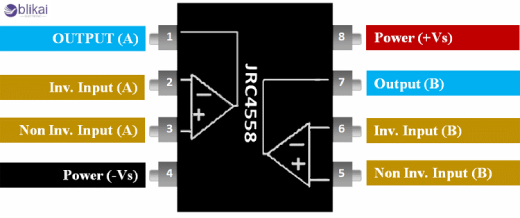
JRC4558 Pin Configuration Diagram
The JRC4558 follows the standard dual op amp pinout found in many classic ICs. Pins 1 and 7 contain the outputs of the two internal amplifiers, and the inverting/non-inverting inputs are contained on pins 2, 3, 5 and 6. Pin 4 is connected to the negative supply voltage, and pin 8 is connected to the positive supply voltage. This familiar layout allows easy replacement or comparison with similar dual op amps.
Package Types
Most popular uses of the JRC4558 include through-hole mounting in DIP-8 packages and are used in electronics prototyping, repairs and hobbies. Surface-mount variants such as SOP-8 are also available for compact PCB designs and mass production.
Internal Architecture and Working Principle
On the inside, every amplifier in the JRC4558 is based on the standard bipolar differential input stage, amplification of voltages and an output buffer stage. Differential input stage: A comparison occurs between the voltage difference between the inverting and non-inverting input and the amplification of the amplifier is as per the external feedback network. The output stage is geared towards driving moderate loads but with a wide frequency range, ensuring stability over this very wide frequency range, a requirement in audio and signal-conditioning applications.
Typical JRC4558 Application Circuits
Audio Preamplifier Circuits
The JRC4558 is used in audio preamplifiers, which is one of the most prevalent applications. It is frequently found in guitar pedals, mixers, and consumer audio equipment where moderate gain and tonal coloration are acceptable or even desirable. The op amp’s frequency response and harmonic behavior contribute to the characteristic sound many musicians associate with classic analog audio gear.
Signal Conditioning and Amplification
Beyond audio, the JRC4558 is widely used for signal conditioning. It can amplify low-level sensor signals, act as a buffer to isolate stages, or scale voltages for analog-to-digital conversion. Its predictable input and output behavior make it suitable for educational circuits and basic industrial electronics.
Active Filters and Oscillator Circuits
The JRC4558 is effective in active filter applications, including low-pass, high-pass and band-pass filters in the audio and low-frequency range. It may also be applied in simple oscillator circuits where stability is more significant than ultra-high frequency operation.
JRC4558 in Audio Electronics
The balance between performance and simplicity of the JRC4558 is the key factor that has ensured its popularity in audio electronics. While it does not match modern low-noise op amps in specifications, it delivers acceptable noise levels and distortion for most consumer applications. Several traditional audio designs have deliberately been built around its properties and have been changed by the replacement of a newer op amp, the signature of the circuit's sound.
JRC4558 vs Popular Alternatives
These distinctions are clearly seen when the JRC4558 is contrasted with the other alternatives, such as NE5532, TL072 or even LM358. NE5532 is less noisy and can drive higher, hence more fit to the high-fidelity audio. The TL072 has JFET inputs and reduced input bias current, useful for high-impedance circuits. Although the LM358 can be operated on a single supply, it is not audio optimized. JRC4558 is placed in the middle, which provides equal performance on general-purpose designs.
Advantages and Disadvantages of the JRC4558
The principal pluses of the JRC4558 are low price, extensive distribution and convenience. It is stable in most of the common settings and tolerant of PCB layout. Some disadvantages that come with it are that its slew rate is quite low, it has more noise than a modern audio op amp, and it has limited output swing that is close to supply rails.
Design Tips for Using the JRC4558
Right decoupling of the power supply is critical in the usage of JRC4558. Bypass capacitors placed close to the supply pins help reduce noise and prevent oscillation. Grounding and PCB layout should minimize loop areas and avoid routing sensitive input traces near high-current paths. The proper values of the feedback resistor are also useful in stabilizing and predictable gain.
How to Test and Troubleshoot a JRC4558 IC
The test of a JRC4558 usually begins with confirming the power supply voltages. The proper supply connections can be checked using a multimeter, and the input and output waveforms can be observed with the help of an oscilloscope. Common failure symptoms include distorted output, excessive noise, or complete loss of signal, often caused by overvoltage, overheating, or improper wiring.
Common JRC4558 Datasheet Parameters Explained
Understanding the datasheet parameters is critical for effective design. Input offset voltage affects DC accuracy, while the gain-bandwidth product determines the usable frequency range at a given gain. Noise density provides insight into audio performance, and output current limits indicate the types of loads the op amp can drive safely.
FAQs
Is the JRC4558 good for audio applications?
Yes. The JRC4558 is widely used in audio preamps, guitar pedals, and mixers because it provides stable gain and acceptable noise performance for consumer and musical applications.
Can the JRC4558 run on a single power supply?
The JRC4558 has been developed mainly to operate on dual supply. Single-supply operation can be done, but biasing methods are needed, and the output swing is low.
Is the JRC4558 still manufactured?
Yes. Various other manufacturers are still manufacturing the JRC4558 and other versions, and are still available in large quantities.
What are drop-in replacements for the JRC4558?
Ordinarily, the NE5532 and TL072 are used as drop-in replacements, but there may be variations in the circuit performance and sound characteristics.
Conclusion
The JRC4558 op amp IC remains a cornerstone of analog electronics, particularly in audio and general-purpose signal processing. It has become popular because of its simplicity, reliability and understood behaviour that has made it endure. Although its performance might be outperformed by the modern op amps in pure terms, JRC4558 remains an effective and instructive design and teaching and learning tool to designers, technicians, and hobbyists dealing with analog circuits.
Some images are sourced online. Please contact us for removal if any copyright concerns arise.





