


AMD Graphics Card Architecture, Specs & Performance Guide
 567
567Introduction to AMD Graphics Cards
AMD graphics cards have transformed into more traditional raster-oriented GPUs to a highly parallel, multi-purpose processor used in gaming, professional visualization and workloads that can be driven by computing. The frame rates cease to define modern AMD GPUs, but rather architectural efficiency, optimization of data movements, and the silicon-level power-conscious design.
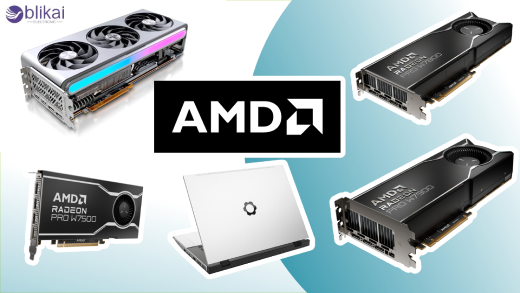
Overview of AMD GPU Architecture
AMD GPU architecture, at the very core of it, is constructed on the principle of massive parallelism in which thousands of lightweight threads are running simultaneously and processing graphics and computational duties. In contrast to CPU-centric designs, which are optimized to execute serial data at a low latency, AMD graphics cards emphasize throughput by spreading workloads on Compute Units linked by a high-bandwidth internal fabric. This architectural philosophy allows AMD GPUs to be scaled throughout the product range, including the entry-level graphics cards, all the way to the high-end accelerators, without a significant rethink of the model of execution.
RDNA Architecture Explained
The RDNA architecture is a significant change in AMD GPG design paradigm, which is more about the number of instructions per clock, lower latency, and better performance per watt than the earlier designs. RDNA reorganizes execution resources into Workgroup Processors, allowing paired Compute Units to share instruction scheduling and data paths more efficiently. The design is also similar to modern graphics APIs like DirectX 12 and Vulkan, which are focused on hardware access at a low-level and allow asynchronous compute, allowing AMD graphics cards to perform better in real-world performance without scaling in the number of transistors correspondingly.
Compute Units and Shader Design
The Compute Unit is the fundamental building block of AMD graphics cards, integrating vector execution units, scalar processors, texture units, and local memory resources into a modular structure. Each Compute Unit processes wavefronts of threads in parallel, enabling high throughput for shading, geometry processing, and compute operations. The efficiency of this design allows AMD GPUs to maintain strong performance even when raw shader counts appear lower than competing designs, as utilization and scheduling efficiency play a more significant role than theoretical peak numbers.
Wavefront Execution and Parallelism
AMD graphics cards employ a wavefront-based execution model that groups threads for simultaneous execution, optimizing data locality and reducing control overhead. New implementations provide more flexibility on the wavefront size, which can be more adjusted to divergent workloads typical of advanced game engines. This will reduce the amount of unused execution units and result in a more efficient process, especially in the scenes that have intricate lighting, physics and post-processing.
Ray Tracing Architecture in AMD GPUs
Ray tracing in AMD graphics cards hardware is executed using Ray Accelerators embedded in each Compute Unit, and is used by calculating intersections necessary to do real-world lighting and reflections. Instead of using big individual blocks of ray tracing, AMD has built ray tracing directly into the current execution infrastructure trade-off of silicon and power.
AI and Compute Acceleration Capabilities
Although the AMD graphics cards are not generally used as AI accelerators, their compute architecture can run a wide variety of AI-assisted workloads using matrix operations, vector processing, and compute shaders. There are open standards like the OpenCL and Vulkan Compute, which enable developers to utilize AMD GPUs in inference, image processing, and data analysis. This flexibility ensures that AMD graphics cards can be used in hybrid workloads, which involve graphics rendering in addition to compute-intensive processing.
Memory Architecture and Bandwidth
One of the characteristics of AMD graphics card performance is memory design, with the current workloads becoming limited more often by data movement than raw compute power. AMD GPUs typically use high-speed GDDR6 memory paired with carefully optimized memory controllers to balance bandwidth, latency, and power consumption. AMD does not just focus on increasing the memory bus bandwidth indefinitely, but aims to increase the data reuse and efficiency of caches to get higher effective bandwidth.
Infinity Cache Explained
Infinity Cache is a huge on- die cache, which is intended to minimize the dependency on off-die memory accesses by keeping most commonly accessed information near the compute cores. Infinity Cache reduces the off-chip memory traffic in order to reduce latency and power usage and enhance performance at high resolutions of 1440p and 4K. This strategy enables AMD graphics cards to provide competitive performance without the use of overboard complexity or memory subsystem cost.
Infinity Fabric and Internal Interconnects
Infinity Fabric serves as the internal communication backbone of AMD graphics cards, linking Compute Units, cache slices, and memory controllers with high bandwidth and low latency. Being scalable ensures efficient data sharing across the GPU and enables future architectural designs, such as multi-chip and chiplet-based GPUs. By abstracting communication at the fabric level, AMD can evolve GPU layouts without disrupting the core execution model.
AMD Graphics Card Specifications Breakdown
The most significant specifications that can be considered to determine what an AMD graphics card can accomplish are core clock, boost clock and Compute Unit count, which must be taken into account in relation to the rest of the architecture. Dynamic frequency scaling allows GPUs to adjust clock speeds based on workload, thermals, and power limits, ensuring optimal performance under varying conditions. Compute throughput measured in TFLOPS reflects raw arithmetic capacity but does not fully capture real-world performance, which depends heavily on memory and cache behavior.
Power Consumption and Thermal Design
Among AMD graphics cards, power efficiency is a key design objective that has been used across the silicon layout, board-level power delivery, and more. The power management characteristics, such as fine-grained voltage control and power gating, allow idle components of the GPU to idle, hence conserving energy. Thermal solutions such as reference solutions and bespoke partner coolers are important in ensuring sustained performance, reduced noise and prolonged component life.
Gaming Performance Characteristics
AMD graphics cards are also very effective in the performance of rasterization in gaming loads, at high frame rates, and with predictable frame pacing, over a large range of resolutions. The scaling of performance at 1080p, 1440p and 4K is based on a total of compute throughput, memory bandwidth and driver optimization. Multi-threaded rendering Game engines that are asynchronous compute and multi-threaded in game creation are more beneficial to the architectural capabilities of AMD, which have made them work well in practice.
Professional and Content Creation Workloads
AMD graphics cards are widely used in content creation applications such as video editing, 3D rendering, and CAD, where parallel compute and memory efficiency are critical. Support for industry-standard APIs ensures compatibility with professional software, while stable drivers contribute to predictable performance under long-duration workloads. Those features precondition the appropriateness of AMD GPUs to workstation-type tasks as well as hybrid systems of game creation and creation.
Software Ecosystem and Drivers
The AMD software ecosystem, centered around Adrenalin drivers, provides essential tools for performance tuning, monitoring, and feature enablement. Driver-level technologies such as resolution scaling, latency reduction, and performance profiling directly influence user experience and application behavior. Constant upgrading and continuous optimization are essential in keeping up with new games and new graphics technologies.
AMD vs Competing Graphics Card Architectures
Compared to other graphics cards, AMD GPUs focus on performance, efficiency and value as opposed to ultimate specialization. The architectural variety affects the capabilities in the rasterization, power consumption, and open compute jobs, and the trade-off can manifest itself in cases where the strong dependency on the special acceleration devices is advanced.
Choosing the Right AMD Graphics Card
The choice of an AMD graphics card requires a match of architectural features to the desired application, e.g., game resolution, content creation requirement or compute needs. The constraints of budgets, compatibility of the systems and power availability are all significant factors in the decision-making process. Users are able to make better decisions by looking at real-world performance rather than just looking at headline specifications.
Future Trends in AMD GPU Architecture
The future graphical design of AMD is set to be based on chapterlet scalability, enhanced memory technologies, and more integration of computational and interconnects. Further advancement of the production processes will make them more efficient and dense in terms of performance. These trends make AMD GPUs one of the major building blocks of the heterogeneous computing systems, which are based on the integration of CPUs, GPUs, and accelerators.
Conclusion
The AMD graphics cards are a progressive and visionary approach to the design of the GPUs that integrate efficient design, clever memory, and scalable interconnections to provide competitive performance in a very broad application spectrum. AMD has maintained its focus on balanced implementation and real-world performance to deliver graphics solutions within the changing requirements of gaming, professional visualization and compute-intensive workloads.
FAQ
What architecture do AMD graphics cards use?
AMD graphics cards of the modern era are based on the RDNA architecture, which is aimed at enhancing the performance per watt, minimizing latency, and increasing the efficiency of executions via the redesigned Compute Unit, as well as the memory systems built on a cache basis.
What makes AMD graphics card architecture different?
The architecture of AMD graphics cards focuses on opting to depend on open compute standards and a balanced rasterization and efficient memory utilization instead of overusing specialised fixed-function accelerators.
How does ray tracing work on AMD graphics cards?
On AMD graphics cards, Ray tracing is performed by Ray Accelerators incorporated with each Compute Unit, and allows the calculation of ray intersection in hardware with overall architectural efficiency.
Some images are sourced online. Please contact us for removal if any copyright concerns arise.





