


Electromagnetic Levitation: Key Electronic Components Explained
 748
748Introduction
Electromagnetic levitation (EML) is a technique to enable an object to suspend itself in air with the assistance of magnetic fields, which are regulated with the help of accuracy electronics. It allows friction-free movement, noise-free operation and precision positioning of consumer goods, industrial automation and state-of-the-art transportation. This article breaks down how EML works, the key components involved, and the engineering principles behind stable levitation—organized in a clear, question-driven format.
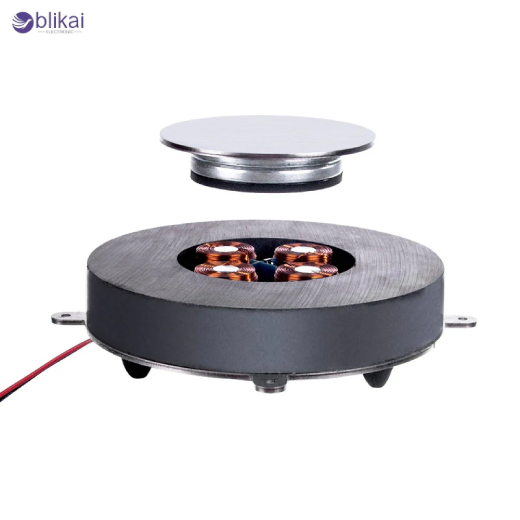
What Is Electromagnetic Levitation?
In electromagnetic levitation, objects are suspended without physical contact by matching magnetic repelling forces with the repelling forces of gravity with very controlled electronic feedback to allow wear-free operation, high-speed motion, and precise positioning in a wide range of applications such as maglev transport, levitating displays and cleanroom robotics.
How Does Electromagnetic Levitation Work?
Electromagnetic levitation operates through interactions between magnetic fields, induced currents, and Lorentz forces governed by Faraday’s Law, where coil-generated magnetic flux counters gravity, and dynamic modulation of current allows precise force control; because the interaction is inherently unstable, continuous electronic correction is mandatory.
Why Is Feedback Control Required?
The control of feedback is needed, since any variation of the position quickly leads to instabilities in the levitating object and the height is constantly monitored with the controller adapting the coil current in real-time to overcome the disturbance before it grows to enormous proportions, making it a closed-loop system.
How Do Attractive, Repulsive, and Inductive Levitation Systems Differ?
The attractive levitation Attractive levitation is the attraction of an object by an electromagnet, repulsive levitation is the expulsion of an object by magnetic opposition, and inductive levitation is the creation of lift by eddy currents induced in conductive materials; the design of coils, the control speed needed, and the stability properties in general are all affected by these levitation methods.
Which Electronic Components Make Electromagnetic Levitation Possible?
The creation of lifting force through the use of electromagnetic coils has been based on current, turns, and the type of core making the coils, low resistance, manageable inductance and sufficient thermal performance are crucial to stable levitation lifted coils, more turns enhance field strength, thinner wire reduces heating and air-core coils have short response times that are important in real time control.
Coil Selection Table
|
Parameter |
Importance |
Recommended Range |
|
Wire Gauge |
Heat & resistance |
20–28 AWG |
|
Inductance |
Response speed |
Low–medium |
|
Core Type |
Field strength |
Air core (fast), Iron core (strong) |
|
Temperature Rating |
Operation safety |
≥150°C |
What Is the Role of Hall Effect Sensors?
Hall Effect sensors keep track of vertical position by sensing changes in the magnetic flux and provide continuous height information to the controller, with which quick corrective action can be taken; fast responding linear Hall sensors minimize vibration, counteract disturbances and make the levitation far more stable.
Why Are MOSFETs and Power Drivers Required?
MOSFETs are required to provide the high current, short, rapidly changing current required by levitation, and driver ICs are required to provide good control of the gate, protect against voltage spikes and provide high-frequency PWM operation. And low Rds(on), sufficient current margin, and good thermal design of MOSFETs are chosen to provide efficient, stable magnetic field generation.
How Do Microcontrollers Stabilize the Levitation System?
The microcontroller performs real-time PID calculations, processes sensor input, and generates PWM signals for the coil driver, acting as the core stabilizing element; higher-performance MCUs lower control latency, increase loop frequency, and provide tighter position regulation essential for smooth levitation.
What Do Amplifiers and Conditioning Circuits Do?
Amplifier circuits boost weak Hall sensor outputs, filter electrical noise, and shift voltages so the MCU receives clean, accurate position data; proper signal conditioning is critical because even small noise spikes can trigger overcorrection, causing jitter, instability, or sudden loss of levitation.
Why Is a Stable Power Supply Essential?
A good DC power supply prevents voltage sag, ripple, and heat-induced drift and is used to provide the coil with clean and adequate current and power sources with low noise. Thermal protection and current overhead provide a stable magnetic force and enhance long-term system stability.
What Control Techniques Keep Levitation Stable?
Closed-loop control constantly compares the position of the object with the target height and changes coil current to maintain a balanced condition of the object in the presence of perturbations like vibration, changes of loads or changes in the environment where the object is operating.
Why Is PID Control the Standard Method?
PID control offers the most suitable degree of reactivity and steadiness since it involves proportional action to provide instant correction, integral action to provide drift removal, and derivative action to provide overshoot reduction and appropriately balanced PID parameters allow vibration-free levitation even in dynamic circumstances.
How Is Magnetic Field Strength Regulated?
The strength of the magnetic field is regulated by varying coil current by using PWM, varying duty cycles using sensor feedback and thermal limits, and more sophisticated devices have current sensing and a temperature sensor to ensure that the lift remains constant without overheating the coils or becoming magnetically saturated.
Where Is Electromagnetic Levitation Used?
Maglev trains use electromagnetic levitation to eliminate mechanical friction to give them very high speeds, low noise, and low maintenance. and high power coils and control systems ensure that the level of lift remains constant at different loads and track conditions.
How Do Contactless Bearings Improve Machines?
Contactless magnetic bearings are designed to hold rotating shafts in suspension with no physical contact and cause minimal wear, which allows very high-speed operation, making them the best when used in turbines, compressors, and other sensitive industrial machinery that need smooth, frictionless motion.
Why Are Levitation Displays Popular?
Consumer levitation applications incorporate the use of simple coils, Hall sensors and microcontrollers to levitate small objects like globes or decorations to produce aesthetically pleasing effects, based on simplified implementations of industrial levitation control methods.
How Is EML Used in Semiconductor Manufacturing?
Particle-free handling of wafer, high precision motion levels, and sensitive measurement systems. Semiconductor tools employ electromagnetic levitation to handle particles without contact, providing high-accuracy positioning at the micron level by avoiding contamination and improving the positioning of particles and materials at the micron level.
What Are the Advantages of EML?
- No mechanical contact
- Near-zero maintenance
- Silent operation
- High precision
- Cleanroom-friendly
What Are the Disadvantages of EML?
- High power consumption
- Heat generation in coils
- Complex circuitry
- Requires fast sensors and MCUs
How Do You Select Components for a Levitation Project?
How Do You Choose the Right Coil?
The choice of a coil is determined by the lifting force needed, response rate, and thermal constraints, and the engineers will balance the number of coils, the wire gauge and the inductance to produce a coil that can produce strong magnetic fields without overheating or slowing the control response.
What MOSFET Specs Matter Most?
Selecting MOSFETs requires focusing on low Rds(on), high current rating, robust thermal characteristics, and fast switching performance, ensuring the device handles continuous coil current without excessive heat or switching losses.
What Type of Hall Sensor Provides the Best Stability?
Linear analog Hall sensors with high sensitivity, fast response, and low noise provide the most stable position feedback, allowing the control loop to react quickly to small movements and maintain smooth levitation.
How Do You Size the Power Supply?
The power supply should be 1.5-2 times the maximum current requirement of the coil, have low ripple, and thermal and short-circuit protection to have a safe and stable operation under conditions of continuous high load.
What Does a Typical EML Circuit Look Like?
A typical levitation circuit consists of a Hall sensor connecting to an op-amp conditioning stage, which feeds the coil position information to the microcontroller, which processes the information by PID feedback to output PWM to a MOSFET driver to amplify current to the coil to create a high-speed feedback loop that maintains a constant levitation state.
Typical Specifications
- 12 V power supply
- 1–3 A coil current
- 20–50 kHz PWM
- 500–2000 Hz PID loop update rate
FAQs
Why Does the Levitating Object Shake?
Shaking usually results from noise in the sensor signal, incorrect PID tuning, or insufficient coil response speed, all of which cause delayed or exaggerated corrections in the control loop.
Can Permanent Magnets Reduce Power Consumption?
Hybrid systems employ permanent magnets to carry most of the load and the electromagnets to stabilize the load to a great extent, which conserves a lot of power and minimizes the coil heat.
How Do You Prevent Coil Overheating?
Overheating is controlled through thicker wire, optimized PWM duty cycles, forced-air cooling, and ensuring the power supply does not exceed the coil’s thermal rating during continuous operation.
Which MCU Gives the Best Stability?
MCUs like STM32 and ESP32 offer fast ADCs, high-resolution PWM, and low-latency processing, making them far more stable for levitation systems than basic 8-bit controllers.
Conclusion
Electromagnetic levitation is based on the principle of coils, hall sensors, MOSFETs, drivers, microcontrollers and fine feedback control to sustain the suspension and friction-free movement without contact. With knowledge about the stability of each electronic component, engineers are able to develop levitation systems that are efficient, responsive, and reliable to serve the needs of consumer displays to high-speed maglev transportation.
Some images are sourced online. Please contact us for removal if any copyright concerns arise.





