


How an Electromagnetic Field Detector Works in Electronics
 869
869Introduction
An electromagnetic field (EMF) detector is an essential device in electronics today, and it assists engineers, technicians and hobbyists to measure and comprehend the invisible fields around electrical equipment. Such detectors are cursory, as well as troubleshooting, electromagnetic compatibility (EMC) and shielding efficiency, and safe operating conditions. This paper gives the principle of operation, components, application, and trends of EMF detectors as an electronics perspective.
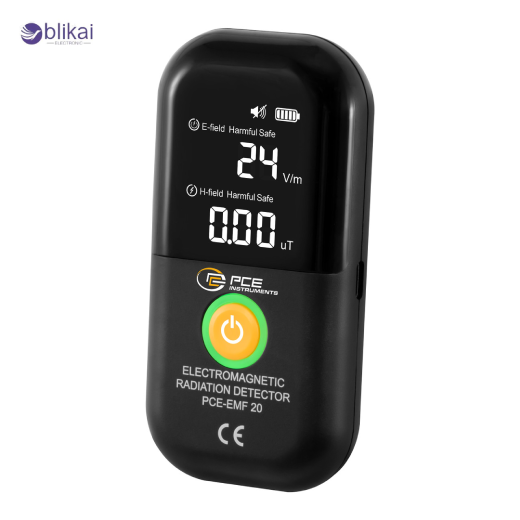
What is an Electromagnetic Field Detector?
An electromagnetic field (EMF) detector is a measuring instrument, a metering device, that measures variations in electric and magnetic fields, both low-frequency variations caused by power lines and appliances, and high-frequency variations caused by wireless communication devices. Volts per meter (V/m) is commonly used to measure electric fields and microtesla (uT) or milligauss (mG) is commonly used to measure magnetic fields. EMF systems and detectors find extensive application in electronics and electrical systems to identify the location of high-field areas, check wiring integrity, and find interference as well as verify compliance with safety and EMC standards.
How Does an Electromagnetic Field Detector Work?
What sensor technologies enable field detection?
Coils are used in magnetic field detectors, plates are used in electric field detectors, precision in Hall-effect sensors and high-sensitivity in optical sensors. All the sensors convert the physical field into an electrical field, which should be processed and represented.
What is the detection principle inside the device?
The theory is straightforward: the detector will detect a change in the field, but will convert this change into voltage/current, then amplify it, and record/present the outcome. Many devices include op-amps or microcontrollers for signal conditioning.
What measurement modes are common?
EMF detectors offer broadband measurement for wide frequencies and frequency-selective modes for targeted analysis. Some include peak-hold or continuous logging functions for analyzing intermittent interference.
What are tri-axial probes?
Tri-axial probes measure fields in three orthogonal axes (X, Y, Z), ensuring accurate representation and preventing directional bias. They are needed to make dependable measurements in problematic conditions.
What Are the Applications of Electromagnetic Field Detectors?
EMF sensors are extensively used in industry, various automation, and electronics, where engineers and technicians can get useful information about the existence of electromagnetic fields. Key applications include:
PCB Debugging: The engineers can trace the unwanted electromagnetic emissions in printed circuit boards using EMF detectors. They will be in a position to remove EMI issues that may cause circuit operation to fail or cause it to be non-regulatory because of monitoring of hotspots. The field anomalies are also useful in the optimization of the trace layouts and the positioning of the components, in addition to enhancing the overall performance of the device. This will ensure enhanced consumer and industrial electronic stability.
Shielding Verification: EMF detectors help ensure enclosures, cabinets, and housing materials effectively block electromagnetic interference. Proper shielding is essential for sensitive electronics such as medical devices, communication modules, and high-frequency instrumentation. Having measured the fields inside and outside the enclosure systematically is a way for engineers to isolate the weak points of the shielding and reinforce the vulnerable spots. The procedure enhances the dependability of the equipment, and it reduces the unintended failure that is brought about by EMI.
Power Distribution Inspection: In industrial and commercial setups, stray magnetic fields can arise from transformers, busbars, or high-current cables. EMF sensors enable technicians to detect these stray fields and make proper adjustments so as not to disrupt other electronics around. Monitoring power distribution systems' magnetic fields also aids in preventive maintenance as it helps to reduce downtime and promote safety. The inspections are especially useful in plants with complicated electrical systems.
Automation & IoT Systems: IoT networks and smart factories are based on sensors and wireless communication, which are both vulnerable to electromagnetic radiation. EMF devices assist in controlling the fields in the environment by ensuring that essential equipment does not fail to perform its functions due to a lack of signal. Eliminating undesirable EMF within automation systems will help improve data accuracy, minimize system errors, and ensure efficiency in the use of systems among devices linked together.
Wireless Communication Devices: Detecting EMF around Wi-Fi routers, cellular modules, or RF transmitters helps engineers optimize device placement and reduce interference. Through field analysis, in terms of field strengths and field distribution, the technicians are able to avoid overlapping signals and degraded signals. This provides stable and quality communication, which is crucial to both industrial and consumer wireless networks. The accurate mapping of EMF will also inform shielding and filtering.
Industrial Machinery: Motors, robotic arms, conveyor systems and welding equipment produce powerful electromagnetic fields which can potentially interfere with other electronics around them. EMF detectors assist engineers in tracing where interference may occur, and a shielding or rerouting solution can be done. Another area in which the monitoring of machinery fields can help is in predictive maintenance to avoid any malfunctioning of equipment or sudden failures. This is needed in a safety-critical setting, like a medical or automation plant, to provide a smooth and continuous operation.
Laboratory & Research Applications: Researchers employ EMF detectors to measure fields for EMC testing, signal integrity validation, and experimental analysis. Reproducible experiments and verification of standards of electromagnetic compliance make accurate field measurements possible. The design and testing of new devices is also supported by EMF detection to guarantee that the devices are of high-quality performance before they are launched. The use of this application is essential in the fields of academic and industrial research.
Consumer Electronics Safety Checks: EMF detectors enable one to test the level of exposure of routine appliances, including microwaves, laptops, and portable chargers, among others. Engineers are able to measure fields in other locations and orientations to determine that devices are used safely and do not exceed the exposure regulations. This also assists manufacturers in designing products that have minimal unnecessary emissions, and therefore, enhance the safety of the user and the reliability of the product.
Key Design Considerations & Sensor Performance
What factors influence detector sensitivity and accuracy?
The accuracy is determined by sensor type, frequency range, number of axes to be measured, calibration, shielding of the probe and environmental factors. As an example, the method of proximity to large metallic objects may influence the readings through reflection or coupling. Measurements require proper calibration and proper placement of the probe in order to achieve reliable measurements.
How do engineers select or optimize a detector?
It has been chosen based on both the required frequency range and maximum field strength, directional sensitivity, and environmental considerations, as well as data logging, bandwidth and dynamic range. To illustrate, EMI sensors at higher frequencies are required in IoT systems than in lower frequency fields of power lines.
What limitations or pitfalls exist?
The AC-coupled meters may be insensitive to circuit ground fields (static or DC), whereas the cheap detectors can be of low quality or poorly calibrated. Unless the operator knows about the misleading readings, the electronic equipment around them may interfere with the surroundings.
EMF Detector Sensor Types & Key Features
|
Circuit Block |
Typical Component |
Function / Description |
|
E-field sensing probe |
Metal plate, capacitive antenna |
Picks up electric field variations. |
|
H-field sensor |
Inductive coil, Hall effect IC |
Converts magnetic flux changes into voltage/current. |
|
Amplifier stage |
Op-amp (e.g., LM358, TL072) |
Boosts weak signals from sensors. |
|
Filter network |
RC/LC filters |
Removes unwanted noise and defines frequency response. |
|
Rectifier & detector |
Diodes, capacitors |
Converts AC signals to DC level for display. |
|
ADC & microcontroller |
MCU with ADC (e.g., Arduino, STM32) |
Digitizes signals and calculates EMF strength. |
|
Display unit |
LCD/OLED screen |
Shows field strength and mode selection. |
|
Power supply |
Battery, regulated DC source |
Powers sensor and processing circuitry. |
How Is Ai Influencing Electromagnetic Field Detection?
The AI and machine learning models can also forecast EMF exposure, identify the anomalies, and streamline the field analysis, which does not involve only hardware measurements. This method is especially effective in the urban and industrial setting, where interference is complex.
What Sensor Innovations Are on the Horizon?
New technologies are ultra-sensitive Hall-effect variants, optical sensors, and fiber-optic photonic EMF sensors. These innovations allow higher accuracy, lower noise, and real-time monitoring in compact devices.
How Will This Affect Electronics and Automation System Design?
With compact multi-axis detectors, real-time logging, and AI-based prediction, engineers can integrate EMF monitoring into IoT systems, predictive maintenance, and automated compliance checks, improving both safety and system reliability.
Practical Tips
How to establish baseline readings?
Start in a low-field area, record minimum, maximum, and average readings, and identify spikes to detect interference or wiring faults.
Good practices for industrial or electronics use?
Avoid contact of probes with metal, read all three axes, record data at different times, and eliminate sources of interference.
How to act on high field or anomaly readings?
Trace the source (wiring fault, unshielded cable, coupling), mitigate (shield, reroute, repair), and re-measure to confirm improvement.
Conclusion
Detection, measurement and control of electric and magnetic fields EE and automation detectors cannot be done without electromagnetic field detectors, which help engineers detect, measure and control electric and magnetic fields. It is important to know how they operate, sensor technologies, measurement principles and applications as key to the successful design and compliance of a system and its safety. With the development of AI and sensor technologies, the EMF detection is going to be more interconnected with the IoT, predictive maintenance, and automated electronic monitoring.
Some images are sourced online. Please contact us for removal if any copyright concerns arise.





