


Linear Voltage Regulator vs Switching: Key Differences Guide
 195
195Introduction to Voltage Regulation Technologies
A basic requirement of a modern electronic system is voltage regulation, to provide the circuits with a steady and predictable voltage independent of changes in the input supply or load conditions, and this is a fundamental requirement in all modern electronic systems, and the differences between the two should be well understood by the engineers and designers of modern electronic systems to select the best solution to a given application.
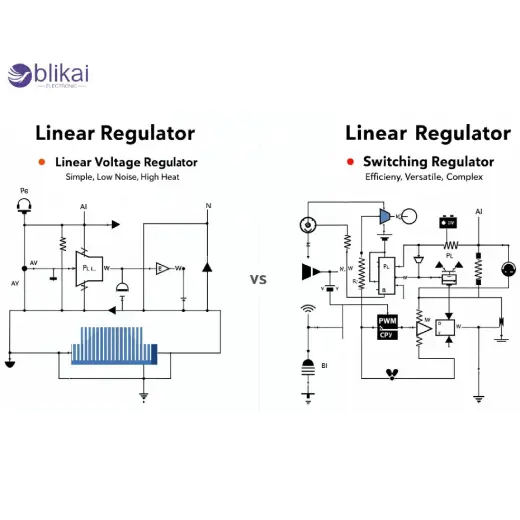
What Is a Linear Voltage Regulator?
A linear voltage regulator is a power management device that maintains a constant output voltage by operating a pass transistor in its linear region, effectively acting as a variable resistor that drops excess voltage as heat to keep the output stable, and unlike switching regulators, linear regulators do not rely on high-frequency switching or energy storage components such as inductors, which makes them inherently simple, low-noise, and easy to design into circuits where precision and signal integrity are more important than efficiency.
Working Principle of Linear Regulators
A linear regulator operates around a feedback control loop, constantly comparing the output voltage to an internal reference and error amplifier, adjusting the conduction of the pass element in real time, to keep the output voltage constant with a small ripple and rapid transient response, and is particularly useful in any application where voltage stability is an important factor.
Key Advantages of Linear Regulators
Linear regulators have a number of useful characteristics, such as the lowest possible output noise, low electromagnetic interference, rapid response to load variation and an extremely simple circuit design, often consisting of only a few capacitors, so they are applicable to analog circuits, RF systems, sound equipment, and precision measurement devices, where clean power is a major factor.
Limitations of Linear Regulators
Linear regulators have the disadvantages of low efficiency with large input-output voltage differences, where the extra energy is lost to heat and may cause thermal management problems and shortened life in portable devices, thus being less suitable in high-power or energy-sensitive applications.
What Is a Switching Regulator?
A switched-mode power supply (sometimes known as a switching regulator, often shortened to SMPS) is a highly efficient type of power conversion device that operates by quickly switching a transistor on and off and inductive to capacitive energy transfer to regulate the output voltage, enabling it to step up and step down or invert voltages with significantly greater efficiency than a linear regulator, especially where high voltage drop or high current requirements are involved.
Working Principle of Switching Regulators
Switching regulators operate on high-frequency switching, pulse-width modulation (PWM) or pulse-frequency modulation (PFM) in which the switching signal duty cycle determines the voltage across the output, and the energy is stored and released by inductors and capacitors, allowing efficient conversion of power with a low power loss.
Key Advantages of Switching Regulators
The main advantage of changing regulators is that they are highly efficient (typically more than 90 percent) and therefore generate less heat and less battery life in portables, and that a wide range of input voltages can feed them and can provide a wide output configuration, including buck, boost, and buck-boost conversion.
Limitations of Switching Regulators
High-frequency operation, more complex design and layout considerations, and usually additional components such as inductors and diodes make switching regulators noisy and electromagnetically interfere with the output and are more expensive and complicated to design than linear regulators.
Linear Voltage Regulator vs Switching: Core Differences
The key distinction between linear and switching regulators is their manner of handling excess energy, where a linear regulator turns it into heat, and a switching regulator turns it into energy storage devices, leading to large variations in efficiency, noise, complexity, and suitability to application.
Efficiency Comparison
Linear regulators are generally efficient in terms of the ratio of control output voltage to input voltage, which can be poor when these voltages are large, whereas switching regulators are high-efficiency over a large operating range, and are thus the regulator of choice in designs sensitive to power.
Noise and Ripple Performance
Linear regulators provide exceptionally clean output with very low ripple and noise, making them ideal for sensitive analog and RF applications, while switching regulators generate switching noise that may require additional filtering or post-regulation to meet strict noise requirements.
Size and Component Requirements
Linear regulators also consume fewer external parts and can be designed in small packages, whereas switching regulators also have an inductor, capacitors, and, in some cases, external MOSFETs that can consume more board area than improvements in integration.
Thermal Management Considerations
Linear regulators are a significant consideration because of power dissipation, so the heat sink is often needed, or PCB design must be considered, whereas switching regulators produce lower heat because they are more efficient, but might still need thermal considerations when operating at higher currents.
Cost and Design Complexity
Linear regulators tend to be less expensive, simpler to design, and suited to simple applications, whereas switching regulators are more complex to design, have more components, and require more engineering work, but can be less expensive overall by offering higher efficiency and lower thermal needs.
Application-Based Comparison
The selection between linear and switching regulators is immensely dependent on the particular application demands, such as the efficiency of power, tolerance to noise, space usage, and cost factors.
When to Use a Linear Voltage Regulator
Linear regulators are most applicable in low-power, noise-sensitive applications like audio amplifiers, RF circuits, sensors, and precision analog systems, where clean voltage is of greater importance than efficiency.
When to Use a Switching Regulator
Best suited are switching regulators in high efficiency power conversion in battery-powered equipment, embedded systems, industrial equipment and those needs of high voltage conversion or high output current.
Hybrid Power Design Approaches
In many modern designs, engineers combine switching regulators with linear regulators by using a switching stage for efficient voltage conversion followed by a linear regulator for noise filtering, achieving an optimal balance between efficiency and performance.
Popular Linear and Switching Regulator IC Examples
Real-world integrated circuits illustrate how these technologies are implemented in practical designs, with linear regulators often appearing as low-dropout (LDO) devices and switching regulators available in highly integrated buck converter ICs.
Common Linear Regulator ICs
Popular linear regulator ICs include LDO devices designed for low dropout voltage and low noise, widely used in portable electronics and sensitive analog circuits.
Common Switching Regulator ICs
Switching regulator ICs include buck converters such as RT6338CGQUF, RT6338BGQUF, and RT7290AGQUF, which are designed for high-efficiency step-down conversion in modern electronic systems.
Specification Comparison Table
|
Parameter |
|||
|
Type |
Buck Converter |
Buck Converter |
Buck Converter |
|
Input Voltage Range |
Wide |
Wide |
Wide |
|
Output Current |
High |
High |
Medium-High |
|
Efficiency |
Up to ~95% |
Up to ~95% |
Up to ~90%+ |
|
Switching Frequency |
High |
High |
Moderate |
|
Package |
Compact QFN |
Compact QFN |
Compact |
|
Application |
High-performance systems |
General-purpose power |
Cost-sensitive designs |
Design Considerations for Engineers
To choose the appropriate regulator, it is important to consider electrical and environmental parameters to achieve optimal performance and reliability.
Input Voltage and Output Requirements
Engineers must consider the difference between input and output voltage, as this directly impacts efficiency and determines whether a linear or switching regulator is more appropriate.
Load Current and Power Dissipation
The greater the load currents, the higher the power dissipation in linear regulators, so switching regulators are more appropriate in high-current applications, where efficiency is of primary concern.
EMI Compliance and Filtering
Switching regulators require careful PCB layout and filtering to meet electromagnetic compatibility standards, while linear regulators inherently produce minimal EMI.
Advantages and Disadvantages Summary
Linear regulators are simple, low noise, and easy to use, whereas switching regulators are high efficiency and flexible at the expense of complexity and noise, so each technology is applicable in different applications to suit system needs.
Future Trends in Voltage Regulation
The development of semiconductor technology is contributing to the development of lower quiescent current and better dropout characteristics in linear regulators and a higher switching frequency, better integration, and lower EMI in switching regulators, making both linear and switching regulators and power sources more compact and efficient in next-generation electronic products.
Conclusion
It is necessary to understand the differences between a linear voltage regulator and a switching regulator to design efficient and reliable electronic systems because the technologies have their own advantages and trade-offs, which should be well-considered depending on the requirements of the application, and in most cases, a hybrid solution that involves both technologies is the most effective in terms of overall performance.
FAQ
Why are linear regulators still used despite low efficiency?
Linear regulators are better suited to applications where noise, simplicity and rapid response are needed, e.g., analog and RF circuits.
Do switching regulators always produce noise?
Yes, high-frequency switching causes noise when switching regulators, but with sound filtering and design, it can be reduced to a minimum.
Can I replace a linear regulator with a switching one?
Yes, in most instances, but before the substitution is made, a consideration of noise sensitivity and complexity of design is necessary.
What is the main disadvantage of switching regulators?
The major disadvantages include increased design complexity, more components and possible EMI problems over linear regulators.
Some images are sourced online. Please contact us for removal if any copyright concerns arise.





