


Linear Amplifier Guide: Types, Working & Applications
 185
185What Is a Linear Amplifier?
A Linear amplifier is a circuit built in analog electronics to amplify the amplitude of an electrical signal without any distortion in the relationship between the waveforms of input and output. A linear amplifier uses active semiconductor devices in the continuous conduction regime as opposed to switching amplification methods, which use rapid on-off transfers, and enables the amplified output to truthfully recapitulate the original signal shape. This characteristic causes linear amplifiers to be essential components in analog electronics where signal integrity is essential, such as audio systems, communication equipment, instrumentation electronics, and sensor interfaces.
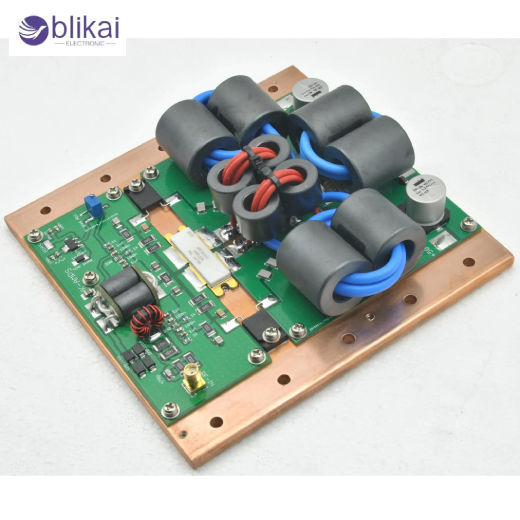
Linear Amplifier vs Switching Amplifier
The main distinction between a linear and a switching amplifier is the trade-off between efficiency and the work of the devices. Linear amplifiers are used to control the current flow continuously, and the unused energy is converted to heat to keep the signal accurate, whereas switching amplifiers use transistors as digital switches, allowing large efficiency but with more complexity in signal processing. Designs that switch, like Class D amplifiers, are power efficient, but need filtering stages to replicate analog signals, whereas linear amplifiers generate smooth analog signals naturally, which is why they are more desirable when signal purity is more important than power efficiency.
How a Linear Amplifier Works
A linear amplifier is an amplifier that operates based on an active component, e.g., a bipolar transistor, MOSFET or operational amplifier, designed in such a way that a small change in the input voltage triggers a larger amount of energy to flow out of a power source. This device is operated at a fixed operating point within the linear region of operation, and fluctuations in input signals at a fixed operating point cause the output current to vary proportionately. Feedback networks have frequently been used to stabilize gain, minimize distortion, and broaden bandwidth, providing predictable amplification under operating conditions. Since the amplification is a continuous process, but not discrete, the output waveform is closely related to the input waveform, which is a good reproducer of analog signals.
Signal Amplification Process
In operation, a small input signal to the control terminal of the amplifier changes the level of conduction of the active device, resulting in proportional changes in output voltage or current. Amplification is performed without excessive loading of the source of the signal by using the energy of a power supply, not the signal itself, and so amplification is achieved. Proper matching of impedance between stages is to guarantee a good signal transfer, whereas coupling components will make sure that undesired DC offsets do not propagate through the circuit.
Gain, Biasing, and Operating Regions
Biasing establishes the operating point that allows symmetrical amplification of positive and negative signal swings without clipping. Resistor networks or active bias circuits are chosen with great care by engineers in order to be stable to temperature variations and device tolerances. Using too much gain near cutoff or saturation causes distortion, and therefore, it is necessary to maintain sufficient headroom to maintain linearity, particularly in high-fidelity or measurement applications.
Main Types of Linear Amplifiers
Class A Linear Amplifier
Class A amplifiers carry current over all the signal cycles, offering the best linearity and smallest distortion since the active device is never switched off. This non-stop conduction can remove crossover distortion, but incurs low efficiency, since much power is wasted as heat even when no input signal is present, so Class A designs are found in high-end audio design and in high precision analog designs.
Class B Linear Amplifier
In class B amplifiers, the amplification of the signal is split between two complementary devices that conduct half the cycle of the signal. This design is more efficient than Class A designs, but contains crossover distortion around the zero-crossing point, which must be well controlled by bias or by feedback compensation to achieve acceptable signal quality.
Class AB Linear Amplifier
Class AB amplifiers are designed to combine the benefits of Class A and Class B operation by slightly biasing both of the devices to allow conduction to overlap around the crossover region. This has gone a long way in minimizing distortion and enhancing efficiency, and Class AB is the most common topology in the design of real-world audio amplification and analog power stages.
Class C Linear Amplifier
Class C amplifiers conduct for less than half of the signal cycle and are typically used in RF applications where resonant circuits reconstruct the waveform. Although highly efficient, they are unsuitable for audio amplification due to inherent distortion without tuned filtering networks.
Key Components Used in Linear Amplifier Circuits
Active Semiconductor Devices
High transconductance in transistors is available with bipolar junction transistors, and high input impedance and thermal stability in transistors are available with MOSFETs. Operational Amplifier ICs combine the functionality of differential input stages, gain blocks, and compensation networks into small packages, allowing designers to achieve accurate amplification using only a few external components.
Passive Supporting Components
Resistors establish biasing and feedback ratios, capacitors shape frequency response and coupling behavior, and inductors may appear in RF linear amplifier designs to control impedance matching. The correct choice of components provides stability of operation with temperature and frequency changes.
Linear Amplifier IC Comparison: RT9118GQW vs RT9114BGQV vs RT9146ZQW
Although some older implementations of the linear amplifier use integrated operational amplifiers optimized to be low-power and to perform precision analog processing, recent applications use the RT9118GQW, RT9114BGQV, and RT9146ZQW to show how various amplifier ICs are tailored to particular system needs. Despite similarities in the amplification of linear signals, the voltage range, quiescent current, and noise optimization of each device are important factors in their suitability in portable electronics, sensor conditioning circuits, or general analog amplification stages, where power efficiency and signal accuracy must be carefully considered.
Specification Comparison Table
|
Parameter |
|||
|
Device Type |
Operational Amplifier |
Operational Amplifier |
Operational Amplifier |
|
Supply Voltage Range |
2.5V – 5.5V |
2.1V – 5.5V |
1.8V – 5.5V |
|
Input Offset Voltage |
Low |
Very Low |
Ultra-Low |
|
Quiescent Current |
Low Power |
Ultra Low Power |
Extremely Low Power |
|
Gain Bandwidth Product |
Medium |
Low–Medium |
Optimized Low Power |
|
Output Capability |
Rail-to-Rail Output |
Rail-to-Rail I/O |
Rail-to-Rail I/O |
|
Noise Performance |
Good |
Very Good |
Sensor Optimized |
|
Typical Applications |
Audio & Signal Amplification |
Portable Devices |
Sensor Interfaces |
|
Package Type |
WDFN/QFN |
QFN |
WDFN |
|
Design Focus |
Balanced Performance |
Power Efficiency |
Precision Low Voltage |
Application Differences in Linear Amplifier Design
In general designs, the RT9118GQW is normally used where balanced amplification of moderate bandwidth and constant output drive are needed, whereas the RT9114BGQV focuses on ultra-low power consumption needed in battery-operated electronics. The RT9146ZQW achieves high performance at reduced voltages and is well suited in precision sensor front-end systems where signal accuracy at very low power budgets is essential, making it a good choice in modern IoT and embedded measurement systems.
Linear Amplifier Circuit Design Basics
The gain, impedance, bandwidth and thermal behavior of a linear amplifier must be carefully considered to design an amplifier that can be operated stably and predictably.
Voltage Gain and Impedance Considerations
Voltage gain is calculated mainly based on feedback network ratios or transistor parameters, and input and output impedance should be optimised to avoid signal loss and compatibility between stages. High input impedance minimizes loading effects, whereas low output impedance improves driving capability for subsequent circuitry.
Frequency Response and Stability
Capacitances of devices and compensation networks can cause bandwidth constraints, which necessitate a trade-off between gain and frequency response. Stability analysis is to ensure that feedback does not cause oscillations, especially in high-gain operational amplifier circuits.
Advantages of Linear Amplifiers
Linear amplifiers are important because of their high linearity, so that most waveforms can be reproduced, distortion is reduced, and the performance of the analogue product is predictable. The quality of the signal is paramount in audio, instrumentation, and communication systems.
Disadvantages of Linear Amplifiers
Since unnecessary energy is turned into heat, thermal management methods like heat sinks or optimized PCB layouts are necessary with linear amplifiers, particularly in more powerful implementations.
Common Applications of Linear Amplifiers
Audio and Communication Systems
High-fidelity audio amplifiers rely on linear operation to maintain tonal accuracy, while RF transmitters use linear amplification to avoid spectral distortion.
Instrumentation and Sensor Electronics
To make measurements precise, precision measurement instruments employ linear amplifiers to condition low-level sensor signals before converting them into digital form, to guarantee the accuracy of measurements.
Linear Amplifier vs Switching Amplifier Technologies
The decision to use linear or switching amplification will be based on the efficiency requirements and the acceptable level of distortion.
Efficiency vs Signal Fidelity
Switching amplifiers are more efficient, but they add switching noise, and must be filtered; linear amplifiers provide clean analogue outputs by design that can be used in sensitive applications.
Design Challenges and Optimization Techniques
To ensure the best linear amplifier performance, engineers have to control the noise, thermal drift, and stability of the power supply.
Noise Reduction and Layout Practices
High-gain circuits are characterized by short signal paths, good grounding and decoupling capacitors in order to reduce interference and preserve signal integrity.
FAQ
What is the difference between a linear amplifier and a power amplifier?
A linear amplifier is an amplification behavior that maintains proportional relationships of signals, whereas a power amplifier is an amplifier whose main purpose is to provide increased output power, such that a power amplifier may be linear or switching, depending on topology.
Which linear amplifier class is most commonly used?
Class AB amplifiers are the most common as they provide a compromise between efficiency and low distortion, and can thus be used in the majority of practical analog amplification needs.
Some images are sourced online. Please contact us for removal if any copyright concerns arise.





