


Rotary Encoder Explained: Types, Applications & How It Works
 179
179What Is a Rotary Encoder?
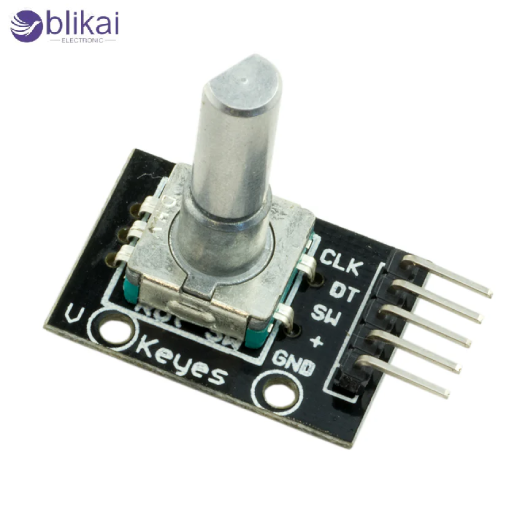
A rotary encoder is a sensor that converts the angular movement of a rotating shaft into electrical signals that a control system can interpret. Rotary encoders give a position, speed or direction of rotation representation in the form of digital or coded outputs, unlike simple variable resistors or mechanical switches.
How Does a Rotary Encoder Work?
Basic Working Principle
Rotation is sensed and converted to digital codes or electrical pulses. The rotation of the encoder shaft will cause an internal sensing device to detect and provide an output signal that is indicative of the angle or steps of rotation. The sensing technique can be optical, magnetic, or mechanical.
Signal Output and Resolution
The number of separate positions that the encoder can identify during one revolution is called resolution and is usually described as the number of pulses/revolution (PPR) or counts/revolution (CPR). Higher resolution encoders generate more pulses per rotation, allowing finer position tracking and smoother motion control in precision systems.
Direction and Speed Detection
The majority of rotary encoders have two channels of output with an offset to indicate the direction of rotation. The control system will be able to estimate the direction of rotation and the rotational speed on-the-fly by knowing the order of the pulses and the frequency of pulses.
Types of Rotary Encoders
Incremental Rotary Encoders
Incremental rotary encoders produce a train of pulses with each rotation of the shaft, giving information about the relative position but not the absolute position of the shaft. They normally have 2 outlets (A and B) and, in some cases, a third reference channel (Z).
Absolute Rotary Encoders
Absolute rotary encoders ensure that a unique digital code is associated with each shaft position, so the system can be aware of the exact position as soon as power is turned on. They are available in single-turn and multi-turn versions and are commonly used in safety-critical applications where position data must be retained even after power loss.
Optical vs Magnetic vs Mechanical Rotary Encoders
Optical Rotary Encoders
In optical rotary encoders, a light source, a coded disk and photodetectors are used to detect rotation. They are very precise, have high resolution, and are therefore suitable for precision motion control needs. Nevertheless, they can be dust-sensitive, oil-sensitive and vibration-sensitive.
Magnetic Rotary Encoders
Magnetic rotary encoders are based on magnetic fields and Hall effect sensors to detect rotation. They are very tough and can withstand extreme environmental conditions like dirt, moisture and extreme temperatures, hence they are applicable in the industrial and automotive settings.
Mechanical Rotary Encoders
Mechanical encoders rely on the physical contacts in order to produce signals as the rotation is done. Although generally cheaper and less complicated, their life expectancy is low because of contact wear, and they are generally used in low-cost consumer equipment and control knobs.
Key Specifications of Rotary Encoders
Resolution and Accuracy
Resolution is the quality of the encoder to measure rotation finely, whereas accuracy is the quality of the result that is compared to the real shaft position. When there is a strong need to have precise positioning and not suffer from jerking, high-resolution encoders are necessary.
Output Signal Types
There are open collector, push-pull, line driver and analog voltage common output types. Choosing the correct output format ensures compatibility with microcontrollers, PLCs, and motor drivers.
Operating Voltage and Current
Rotary encoders come in different voltages, including 3.3 V, 5 V, and 12-24 V, depending on the use. Power is another factor of concern when it comes to battery-powered systems and embedded systems.
Environmental Ratings
Ecological conditions like IP rating, operating temperature, and mechanical life depend on the type of encoder that can be used in the industrial, outdoor or consumer application.
Rotary Encoder vs Potentiometer
While potentiometers measure position by varying resistance, rotary encoders generate digital signals that are immune to electrical noise and wear-related inaccuracies. Rotary encoders have a longer life, are more accurate and are more appropriate to be used in digital control, so they are chosen to be used in modern designs.
Applications of Rotary Encoders
Industrial Automation and Motion Control
Rotary encoders find a broad and extensive application in CNC machines, robotic arms, conveyor systems and servo motors; they are used to give feedback to close loop control and accurate positioning.
Consumer Electronics
Rotary encoders are also being used in consumer devices as volume controls, menu navigation knobs and user interface panels because they are durable and provide tactile feedback.
Automotive and Transportation Systems
Steering angle sensors, throttle position sensing, and motor feedback in electric and hybrid vehicles are used in automotive applications since reliability and accuracy are highly valued.
Medical and Measurement Equipment
Rotary encoders are utilized in medical machines that require high accuracy and repeatability of motion feedback in the operation of imaging devices, pumps, and diagnostic tools.
How to Choose the Right Rotary Encoder
The appropriate choice of rotary encoder entails consideration of application needs, including resolution, environmental factors, mechanical dimensions, installation procedure and electrical interface. The combination of these factors guarantees maximum performance and high reliability in the long term.
Advantages of Rotary Encoders
High Positioning Accuracy and Resolution
Rotary encoders offer high-resolution feedback, which can be used to measure angular position and movement precisely. Rotary encoders are very well suited when there is any application requirement to apply fine movement control, positioning to within a tolerance of precision and smooth speed control with a resolution of a few pulses/revolution to a number of thousands of counts/revolution.
Digital Output with Strong Noise Immunity
Rotary encoders, as compared to the analog sensors, produce digital signals that are less prone to the effects of electrical disturbances, voltage drift, and signal degradation. This renders them well-suited in industrial settings that are characterized by the presence of electromagnetic interference (EMI) and long cable trails.
Long Service Life and Low Wear
The non-contact rotary encoders, like the optical rotary encoder and magnetic rotary encoder, are not affected by mechanical wear. This greatly increases their operation life over potentiometers or mechanical switches and saves on maintenance and replacement expenses.
Simultaneous Speed and Direction Measurement
Rotary encoders can measure rotational speed and direction at the same time by analyzing pulse frequency and phase relationships between output channels. This is needed in closed-loop motor control and real-time motion feedback.
Wide Compatibility with Control Systems
Rotary encoders are compatible with microcontrollers, PLCs, motor drivers, and industrial controllers through standard output interfaces such as TTL, HTL, and differential line drivers. Such flexibility enables the integration of systems over a large scale of electronic and automation systems.
Disadvantages of Rotary Encoders
Higher Cost for High-Resolution and Absolute Models
Designed rotary encoders are particularly the high-resolution optical encoder and multi-turn absolute encoder, which are more costly than simpler position sensors. This is able to add-up on the cost of the entire system in sensitive budget or high volume applications.
Sensitivity to Mechanical Alignment
The correct direction of the shaft and a firm fixation are the keys to effective encoder operation. Misalignment, excessive shaft load, or vibration can lead to inaccurate readings, increased wear, or premature failure, particularly in precision motion systems.
Environmental Limitations of Optical Encoders
Optical rotary encoders can be sensitive to dust, oil, moisture and condensation that can disrupt the transmission of light and detection of a signal. In harsh industrial environments, additional sealing or alternative encoder technologies may be required.
Power Loss Considerations for Incremental Encoders
Incremental rotary encoders do not store absolute position data during power outages. Lacking a homing routine and reference position, the system cannot know the exact shaft position when it starts again, and this is not appropriate in safety-critical applications.
Signal Processing and Counting Requirements
Fast speed or high-resolution rotary encoders produce a high rate of pulses that cannot be counted by slow counters and need appropriate signal conditioning. Weak processing power or improper wiring standards may lead to lost counts and a decrease in the accuracy of measurement.
Installation and Wiring Basics
Proper installation includes secure shaft coupling, correct alignment, and appropriate wiring practices. The use of shielded cables and the adequate grounding of cables are contributing factors to the reduction of electrical noise and the stability of signal transmission.
FAQs
What Is the Difference Between Incremental and Absolute Rotary Encoders?
Relative position data is given by incremental rotary encoders, and these encoders need a homing procedure at start-up, but absolute rotary encoders give a unique digital coded data that represents the shaft location, so that the position is immediately identified even when power is switched off.
Do Rotary Encoders Lose Position Data When Power Is Off?
Incremental rotary encoders lose position information when power is shut off, whereas in absolute rotary encoders, position information is stored in a position register and can be reported to indicate the shaft position of the shaft exactly when power is reconnected.
What Output Signals Do Rotary Encoders Commonly Use?
Popular types of rotary encoder output signals are open collector, push-pull and differential line driver. The appropriate signal type depends on system voltage, cable length, and noise immunity requirements.
Conclusion
Rotary encoders are essential in modern electronic and automation systems because they offer precise and dependable motion responses. The knowledge of the working principles, types, specifications, and uses is used to assist engineers and designers in choosing the appropriate encoder to optimize the performance of the system.
Some images are sourced online. Please contact us for removal if any copyright concerns arise.





