


SiC MOSFET Technology: Specs, Advantages & Applications Guide
 556
556Introduction to SiC MOSFET Technology
Silicon Carbide (SiC) MOSFets are existing wide bandgap (WBG) semiconductor MOSFETs that have replaced the previous silicon MOSFETs, although in high voltage, high temperature and high frequency applications. The silicon devices are power-related devices in comparison to the SiC MOSFET which are used at higher voltages, current and with much lower switching losses and can be utilized in power electronics in electric vehicles (EVs), renewable energy systems and industrial automation.
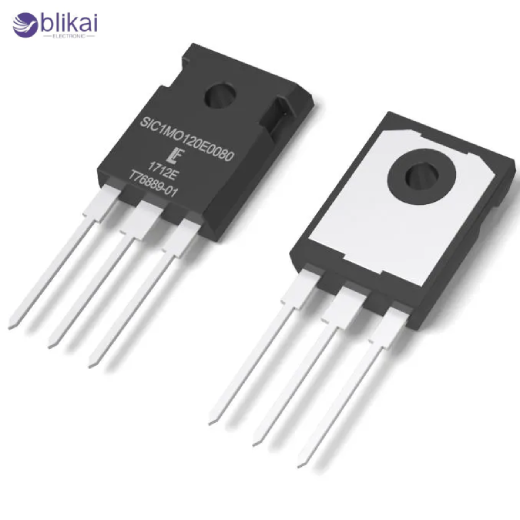
How SiC MOSFETs Work
SiC MOSFETs operate in a similar manner to conventional MOSFETs but use a silicon carbide semiconductor which has a larger bandgap which permits higher temperatures and voltages to be used. They possess a gate, a source and a drain with the voltage of the gate corresponding to the conductance between the source and the drain. With the material properties, the SiC MOSFETs have very high switching speed, reduced on-resistance (Rds(on)) and reverse scatter. They allow them to operate at high frequencies with less energy loss and higher system efficiency; thus, in comparison to silicon MOSFETs and IGBTs, they are best suited for highly stressful power electronics.
Key Electrical Specifications of SiC MOSFETs
Voltage Ratings (600V–1700V and Above)
SiC MOSFETs typically range from 600V to 1700V and beyond, suitable for high-voltage applications such as EV traction inverters, industrial drives, and grid-tied solar inverters. The high-voltage ratings also decrease the number of parallel devices required in the system design, making the system easier to design and more reliable.
On-Resistance (Rds(on)) and Temperature Effects
Low Rds(on) ensures minimal conduction losses. SiC devices maintain stable Rds(on) at high temperatures, unlike silicon MOSFETs, which suffer significant performance degradation, enhancing efficiency in harsh environments.
Switching Speed, Rise/Fall Time, Miller Capacitance
SiC MOSFETs operate in high frequencies (nanosecond switching) and allow high frequencies. Short rise and fall times minimize losses in energy and low Miller capacitance minimizes losses in gate drive which is vital in compact designs with high efficiency.
Gate Threshold Voltage & Gate Charge
It is necessary that the right value of the gate voltage is required to enable the full functionality of the device on and off. The SiC MOSFETs require approximately 15- 20V to conduct. Frugal gate charge ensures a power efficient switching that uses less power.
Reverse Recovery & Body Diode Performance
SiC MOSFETs feature low reverse recovery loss in the body diode, unlike silicon counterparts. This reduces heat generation and increases efficiency in synchronous rectification applications.
Thermal Parameters (Junction Temperature, Thermal Resistance)
SiC devices can also work at junction temperatures reaching 175- 200 degC and the thermal resistance is less than silicon MOSFETs. This enables smaller heat sinks hence the system is smaller and cheaper.
Package Options (TO-247, TO-220, SMD, Modules)
Available in multiple packages, including TO-247, TO-220, surface-mount, and power modules, SiC MOSFETs provide flexibility for various power electronics designs, from discrete devices to fully integrated modules.
Advantages of SiC MOSFETs Over Silicon Devices
Higher Efficiency & Lower Switching Losses
SiC MOSFETs can greatly decrease switching and conduction losses allowing easier conversion of power and reduced power usage, which is essential to EVs and renewable systems.
High Temperature Operation (up to 175–200°C)
The characteristics of wide bandgap enable work at high temperatures, and less cooling is needed due to the characteristics, which enhance reliability in adverse conditions such as automotive and industry.
Higher Breakdown Voltage & Reliability
SiC MOSFETs have higher voltages, and they are more reliable in stress situations. This eliminates the use of several devices in series and eases the circuit design.
Smaller Size & Higher Power Density
Reduced size and weight, increased power density and temperature capability of lower-power electronics allow smaller, lighter power electronics, which also makes designs smaller and provides increased power density, such as EV traction inverters and aerospace electronics.
Faster Switching for High-Frequency Power Designs
SiC devices are also faster in switching than silicon MOSFETs, and can be used with high-frequency converters. This enables smaller passive components and more compact system designs.
Reduced Cooling Requirements & Overall System Cost
SiC MOSFETs have reduced losses and greater thermal tolerance, and this makes them less dependent on cooling infrastructure to reduce the cost of the system, and also enables them to perform better and have increased reliability.
Design Considerations for Using SiC MOSFETs
Gate Driver Selection & Gate Voltage Levels
SiC MOSFETs require precise gate voltage control and fast gate drivers to optimize switching performance and prevent oscillations or overvoltage stress.
PCB Layout for High-Speed Switching
Inductive coupling in PCB design is an important consideration in the SiC MOSFET because of its high switching rates. Proper layout reduces EMI and ringing, enhancing efficiency and reliability.
Parasitic Inductance Control
Low parasitic inductance in traces and connections prevents voltage overshoot and energy loss, improving device longevity and performance.
Thermal Management & Heat Sinking
Although thermal tolerance is high, thermal design and heat sinking are requisite to sustain efficiency and ensure that a device is not degraded in the long run.
EMI Mitigation Techniques
Electromagnetic interference can be brought about by high-speed switching. Methods such as snubbers, ferrites, and shielding enhance adherence to EMC standards.
Safe Operating Area (SOA) & Protection Circuits
The designers should make sure they work with SOA and employ protections that can ensure that devices do not fail by use of TVS diodes, gate resistors, and current sensing.
Common Applications of SiC MOSFETs
EV Chargers & On-Board Chargers (OBC)
SiC MOSFETs enhance the efficiency and size reduction of the EV charging systems, while also allowing the charging of power and power density to be higher.
Solar Inverters & Energy Storage Systems
High-voltage, high-frequency SiC MOSFETs allow efficient DC–AC conversion in solar and battery storage systems, minimizing energy loss and heat.
High-Frequency SMPS & Server Power Supplies
SiC devices enhance efficiency in switch-mode power supplies, supporting high-frequency operation and compact design in data centers and industrial power systems.
Motor Drives & Industrial Automation
SiC MOSFETs have been used to offer efficient and swift switching to motor controllers in robotics, automation, and industrial drives to lower energy consumption and enhance reliability.
Telecom Power Modules & Data Centers
The technologies of SiC MOSFETs are to enhance energy efficiency and ease cooling demands in power modules of telecoms and servers to facilitate high-density power distribution.
UPS Systems & High-Voltage Converters
SiC MOSFETs in uninterruptible power supply have the advantage of high efficiency, high-voltage conversion with low loss and minimal heat.
Aerospace, Defense & Harsh Environment Electronics
SiC technology is capable of operating under extreme temperature and high voltages and therefore can be applied in the aerospace, military and other extreme environments.
How to Select the Right SiC MOSFET
Selecting the right SiC MOSFET involves balancing voltage class, current rating, switching frequency, thermal requirements, and package type. Designers must consider gate drive voltage, Rds(on), thermal resistance, and reverse recovery performance. The comparison of the devices of leading manufacturers, Infineon, Wolfspeed, ROHM, STMicroelectronics and Microchip, assists in tuning the price performance. High-power electronics can be reliably and efficiently selected and stabilized in the long term.
SiC MOSFET Industry Trends & Future Outlook
The demand for SiC MOSFETs is rapidly growing due to EV adoption, renewable energy expansion, and high-efficiency power electronics. Wafer sizes are also growing from 6-inch to 8-inch, reducing prices and providing better access. SiC-based modules make design easier and minimize parasitic effects, and continued evolution of Rds(on), switching speed, and reliability will be used in more applications in industrial, automotive and aerospace fields. SiC will soon rise to become the technology of next-generation high-power electronics.
Conclusion
SiC MOSFETs are one of the significant developments in power electronics that provide high efficiency, high voltage, thermal resiliency and compact system design. They are very fast, have low losses, and are very reliable and would be considered ideal in EVs, renewable energy, industrial drives, and high-frequency converters. With the development of technology and reduction of costs, the future of energy-efficient high-power electronic systems will be dominated by SiC MOSFETs replacing silicon devices.
FAQ
What are the reliability concerns for SiC MOSFETs under stress conditions?
SiC MOSFETs are robust but have short-circuit and UIS limits (~3 µs). Fast detection, proper cooling, and protection circuits are needed to prevent damage. Gate oxide and chip defects can affect long-term reliability.
What are the gate-drive and layout requirements for SiC MOSFETs?
SiC MOSFETs require high gate voltage (18–20 V) and fast gate drivers. PCB layout must minimize parasitic inductance and separate power and gate traces to reduce EMI and switching losses.
Why do SiC MOSFETs maintain stable performance at high temperatures?
SiC MOSFETs have low increment Rds(on) at high temperature (e.g. 50% vs. 160-250% with Si). This will ensure increased efficiency and predictability of EVs and industrial drives.
What are the drawbacks of SiC MOSFETs compared to silicon?
SiC MOSFETs are more expensive and require careful gate driving and layout. Protection circuits are necessary, and the stability of interfaces and chips is still a matter of long-term reliability.
Some images are sourced online. Please contact us for removal if any copyright concerns arise.





