


What Is a Buck Regulator? Efficiency, Specs & Applications
 324
324What Is a Buck Regulator?
A buck regulator is a high efficiency DC-DC step-down converter that is used to convert a larger input voltage to a smaller, constant-valued output voltage through variable switching and storage of energy. A buck converter transfers energy with the minimum loss as compared to linear regulators, which transform refuse to dissipate the voltage as heat through a MOSFET, inductor, diode, or synchronous MOSFET, and capacitors. With this switching behavior, the regulator enables the regulator to have tight load regulation, low thermal stress and high efficiency in compact electronic designs and is a fundamental power-management solution among the modern devices.
Why Do Electronics Use Buck Regulators?
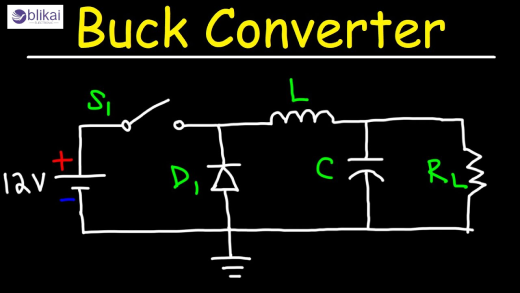
A buck regulator reduces voltage across a load by turning a MOSFET on and off very rapidly to regulate the amount of energy that is transferred into the load by the inductor, which stores the energy and releases it in a smooth way to the load. Their switching-based architecture provides stable power presentation even to varying loads, which is important in dense electronics such as smartphones, embedded controllers, and computing processors. Buck regulators prevent wastage of heat and energy, thereby increasing the life of the device and eliminating the use of large thermal solutions.
How Does a Buck Regulator Step Down Voltage?
A buck regulator achieves the reduction of voltage by swiftly switching a MOSFET on and off to regulate the amount of energy entering an inductor that stores this energy and releases it gradually to load. It is connected to an inductor where the switch is turned on to induce current in the inductor and turned off to induce current in the inductor into a diode or synchronous MOSFET. The average output voltage is directly proportional to the duty cycle: the ratio between ON time and OFF time. This method allows the converter to stabilize at high efficiency voltage reduction at minimal heat.
What Are the Key Efficiency Factors in a Buck Regulator?
Conduction losses, switching losses, magnetic components, ESR values, and thermal layout decisions shape the efficiency of a buck regulator. All these factors control the extent of the amount of energy that is transferred to the load rather than being lost as heat. The control of MOSFET performance, choice of an inductor and trade-off of switching frequency are all important in realizing the optimum performance of battery or thermally limited systems.
Which Components Have the Biggest Impact on Efficiency?
Component characteristics such as MOSFET Rds(on), diode forward voltage, inductor DCR, and capacitor ESR all strongly influence efficiency. Low Rds(on) MOSFETs reduce conduction losses, Schottky diodes lower voltage drops, and low-DCR inductors improve current handling. Likewise, capacitors with low ESR minimize ripple and wasted heat. The combination of these factors defines the efficiency with which the regulator is able to work with high currents and high switching rates.
Why Are Buck Regulators More Efficient Than Linear Regulators?
Buck regulators are better than linear regulators as they use switching by the use of an inductor to convert energy; they do not dissipate the voltage difference as heat. The efficiency of a linear regulator depends on the ratio of Vout/Vin, and this is often only 40-60% efficiency compared to buck converters, which are usually more than 90%. This theatrical benefit cools down the heat, increases the battery life and enables designers to create smaller, cooler and more power-efficient gadgets.
What Are the Important Electrical Specifications of a Buck Regulator?
The key parameters that should be factored in during the selection of a buck regulator are input voltage range, output current capability, switching frequency, ripple performance and transient response. These parameters specify the stability of the performance of the device, besides the variation of the actual input variability, in addition to the variation of loads, and also the variation of environmental conditions under actual usage.
What Is the Input Voltage Range?
The safe operating region of the regulator is determined by the range of input voltages allowed to flow through it so that the item can continue to properly switch even when the power supplies vary. Since a buck regulator only reduces voltage, VIN must always stay above VOUT by a required margin. A properly chosen input range prevents dropout issues, supports battery discharge curves, and maintains regulation during transient spikes.
How to Understand Output Current Rating?
The output current rating of a regulator relies on such parameters as the saturation current of the inductors, the current limiting capabilities of the MOSFETs, the peak inductor ripple, and the thermal dissipation power. Higher currents require low-resistance inductors, efficient MOSFETs, and robust thermal management. Selecting a regulator with adequate headroom ensures long-term reliability and prevents thermal throttling or component stress during peak loads.
What Are Switching Frequency and Ripple Specifications?
The compromise between efficiency, component size and electromagnetic noise is controlled by switching frequency. A higher frequency needs smaller inductors and capacitors, but high switching losses and EMI. The output stability and noise-sensitive loads are dependent on Ripple performance, which is dictated by the inductor value and capacitor ESR. Adjusting frequency and ripple is problem-free, clean, and reliable output even in precision electronics.
What Types of Buck Regulators Are Commonly Used Today?
Modern electronics use several types of buck regulators—synchronous, non-synchronous, and integrated module-based designs—each offering different trade-offs between cost, efficiency, complexity, and PCB footprint. The choice of the right type varies according to design objectives, including thermal limits, load current and EMI performance.
What Is a Synchronous Buck Regulator?
One of the ways to lower the conduction losses and efficiency is to use a synchronous buck regulator with a low-side MOSFET instead of a diode, and especially at low output voltages a low-side MOSFET-based buck regulator is more efficient. It is common in CPU VRMs, GPUs and digital electronics in which high current and low heat is important.
What Is a Non-Synchronous Buck Regulator?
A non-synchronous buck regulator uses a diode instead of a MOSFET, which simplifies design and reduces cost but lowers efficiency, particularly at higher currents. It is suitable for low-power or budget-focused designs where simplicity matters more than peak performance.
What Is a Buck Converter IC Module?
Buck converter modules integrate the controller, MOSFETs, and sometimes the inductor into a compact package. This reduces EMI challenges, shortens design time, and improves reliability. They are ideal for IoT devices, wearables, and rapid prototyping environments.
Where Are Buck Regulators Used in Modern Electronics?
Buck regulators are found across consumer electronics, automotive systems, industrial controls, and IoT devices, where they supply stable, efficient power to processors, sensors, radios, LEDs, and control circuitry. Their capability to provide cooler, cleaner as well and efficiently stepped-down voltages is fundamental in almost all power architectures.
Why Are Buck Regulators Essential in Consumer Electronics?
Consumer devices use buck regulators to supply processors, memory, communication devices, and LED backlights with low heat production. This efficiency supports longer battery life, reduces thermal throttling, and enables thinner device designs.
How Are Buck Regulators Used in Automotive and Industrial Systems?
Automotive ECUs, sensors, actuators, and infotainment systems use buck regulators to convert 12V or 24V power into lower voltages while enduring noise, temperature extremes, and load dumps. In industrial equipment, buck converters ensure stable power delivery for PLCs, motors, sensors, and communication modules.
Why Are Buck Regulators Critical in IoT and Battery-Powered Devices?
Buck regulators can be used to control the power draw of IoT devices during quiescent conditions to prolong their battery life and make optimal use of conversion efficiency. They facilitate the smallest form factors, stable wireless operation, and extended (unattended) wearable, sensor and beacon and portable tools performance.
FAQ
Is a Buck Regulator the Same As a Step-Down Converter?
Yes. Other terms used to denote the same device, which employs efficient switching methods in order to reduce DC voltage, include buck regulator, buck converter, and step-down converter.
Can a Buck Regulator Increase Voltage?
No, a buck regulator can only step the voltage down. To increase voltage, a boost or buck-boost converter is required.
Why Does My Buck Converter Overheat?
Overheating may be caused by switching losses, insufficient cooling, high ripple current, diode forward loss in non-synchronous designs, or an undersized inductor. Ensuring proper MOSFET selection and thermal layout usually resolves this.
How to Choose the Right Inductor and Capacitor?
Choose an inductor whose saturation current exceeds peak load and a capacitor with low ESR for minimal ripple. Following the datasheet-recommended values ensures stability and prevents unwanted oscillation.
Conclusion
Buck regulators are indispensable power-management components that provide efficient, stable voltage reduction across a wide range of modern electronic applications. Their efficiency, small size, and powerful features make them the right choice when it comes to consumer devices, automotive electronics, industrial devices, and IoT systems. Through their understanding of how they work, their specifications, their types, and real-life application, the engineer is able to make informed design choices, which increase the reliability, minimise heat and make use of power delivery most efficiently.
Some images are sourced online. Please contact us for removal if any copyright concerns arise.





