


What Is a Full Bridge Rectifier? Complete Beginner Guide
 33
33What Is a Full Bridge Rectifier?
A full bridge rectifier is an electronic circuit that converts alternating current into direct current using four diodes arranged in a bridge configuration, allowing both halves of an AC waveform to contribute to DC output generation. A bridge rectifier (as opposed to a half-wave rectifier) rectifies the entire AC cycle; that is, the output voltage does not go negative in response to both positive and negative input cycles, and thus, the power conversion efficiency is much greater, and the output voltage is more stable.
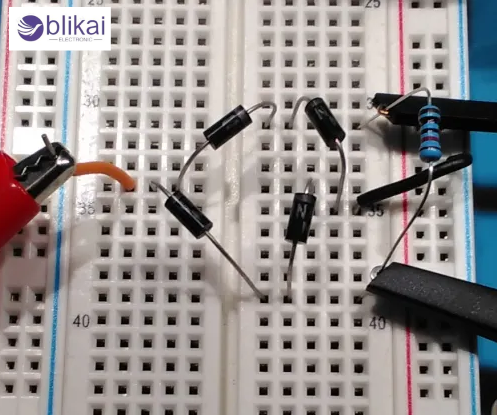
Key Components Used
A standard full bridge rectifier circuit is made up of four rectifier diodes comprising the bridge network, an AC input source which can be linked together usually via a transformer in an attempt to raise or lower the input and also isolate it, a load resistance representing the powered device, and a filter capacitor to minimize ripple and stabilize the output voltage following rectification.
Working Principle of a Full Bridge Rectifier
Positive Half Cycle Operation
The positive one/half cycle of the AC input signal causes the two opposite diodes to be forward biased, with the other two diodes being reverse biased, to permit the current to pass through the load in one direction. Even though the input voltage alternates, the diode arrangement ensures the load current maintains a consistent polarity, producing a positive output waveform.
Negative Half Cycle Operation
As the AC input polarity reverses in the negative half cycle, the diodes previously connected in the forward mode short out, and the new pair of diodes becomes connected in reverse mode, through which the current again flows in the same direction through the load resistor as in the forward mode. This automatic switching is possible because of the polarity of the diodes, and it does not need any control circuitry.
Output Waveform Explanation
The full bridge rectifier provides a pulsating DC signal with both sides of the AC waveform present as positive voltage pulses that, in effect, double the ripple frequency of the input AC waveform. Its increased ripple frequency is more easily filtered, and DC becomes more smooth than half-wave rectification after capacitor-based filtering.
Full Bridge Rectifier Circuit Diagram Explained
Standard Bridge Configuration
The standard bridge rectifier circuit is a diamond-shaped circuit with four diodes, whereby two opposite terminals receive AC input, and the two other terminals are DC output terminals. It can be efficiently used as the transformer winding is utilized symmetrically without the need to have a center-tapped transformer.
Step-by-Step Current Flow Analysis
In current flow, diodes in pairs alternate current flow based on the polarity of the input, yet since each conducting path always causes current to flow through the load in the same direction, the polarity of an output does not alternate. This ingenious construction is such that energy is delivered to the load throughout the AC cycle.
Role of Filter Capacitors
A filter capacitor across the output is charged on peaks of the voltage and discharged on the drops of the voltage, filling the gaps between the waveform peaks and minimizing ripple voltage. The higher the capacitance value, the more the smoothing effect of the resulting DC output and practical constraints, including size, cost and inrush current, should also be taken into consideration.
Full Bridge Rectifier vs Half Wave Rectifier
|
Feature |
Full Bridge Rectifier |
Half Wave Rectifier |
|
AC Utilization |
Uses both half cycles |
Uses one half cycle only |
|
Efficiency |
High |
Low |
|
Ripple Frequency |
2× input frequency |
Same as input frequency |
|
Output Voltage |
Higher average DC |
Lower DC output |
|
Number of Diodes |
4 |
1 |
|
Filtering Requirement |
Easier |
More difficult |
A full bridge rectifier provides significantly better performance because it converts the entire AC waveform into usable energy, reducing wasted power and improving overall power supply efficiency.
Full Bridge Rectifier vs Center-Tapped Rectifier
|
Feature |
Bridge Rectifier |
Center-Tapped Rectifier |
|
Transformer Type |
Standard transformer |
Center-tapped transformer required |
|
Number of Diodes |
4 |
2 |
|
Transformer Utilization |
Excellent |
Partial utilization |
|
Cost |
Lower overall system cost |
Higher transformer cost |
|
Circuit Complexity |
Moderate |
Higher wiring complexity |
The performance of a full bridge rectifier is much higher since it can convert the complete AC waveform into useful energy, thus less power is wasted, and power supply capability is enhanced.
Advantages of a Full Bridge Rectifier
Higher Efficiency
The full bridge rectifier greatly enhances the use of energy over half-wave rectifier designs, by processing a fraction of the AC waveform into usable power on both sides of the wave. It is therefore suitable in current electronics, which focuses on conserving energy.
Better Transformer Utilization
This is facilitated by the fact that the entire transformer secondary winding is engaged in power delivery by the absence of a center tap, which increases the efficiency of the transformer and minimizes the hardware requirements.
Higher Average Output Voltage
Since power is supplied at all points throughout both periods of the input waveform, the mean DC value of the output voltage is greater, thereby permitting improved control of downstream voltages.
Reduced Ripple Frequency Issues
The doubled ripple frequency simplifies filtering design since capacitors can smooth higher-frequency ripple more effectively than lower-frequency fluctuations.
Disadvantages of a Full Bridge Rectifier
Voltage Drop Across Two Diodes
Two diodes are simultaneously exposed to current, and a voltage drop of around 1.2-1.4 volts is generated across the silicon diodes, slightly lowering efficiency in low-voltage applications.
Heat Dissipation Considerations
The loss of power through conducting diodes produces heat, and this demands correct diode selection and, on some occasions, heat sinks in high current circuits.
Not Ideal for Very Low Voltage Circuits
In circuits operating at very low voltages, diode forward voltage drops may represent a significant percentage of total voltage, making alternative rectification methods preferable.
Applications of Full Bridge Rectifiers
AC-DC Power Supplies
Linear and switching power supply. Most linear and switching power supply systems start with a bridge rectifier stage, which rectifies the mains AC line, then filters and regulates it.
Battery Chargers
Bridge rectifiers allow chargers to safely convert AC power into DC suitable for charging rechargeable batteries across consumer and industrial applications.
LED Drivers
Many LED lighting systems rely on bridge rectifiers to provide constant polarity input for LED driver circuits operating from AC mains.
Motor Control Circuits
DC motors powered from AC sources use bridge rectification as the first conversion step before speed or torque control electronics.
Consumer Electronics Adapters
Bridge rectifiers have universal and wide use in Laptop chargers, phone adapters and home electronics as an internal architecture of power conversion.
Key Parameters and Specifications
Peak Inverse Voltage (PIV)
Peak inverse voltage is the highest reverse voltage a diode can withstand, and in bridge rectifiers, both diodes have to be capable of breaking down to about the highest value of the transformer secondary voltage.
Forward Current Rating
The forward current rating determines how much load current the rectifier can safely handle, directly influencing diode selection and thermal management requirements.
Output Voltage Calculation
The approximate DC output voltage equals the peak AC voltage minus the voltage drop across two conducting diodes, typically expressed as VDC ≈ VP − 2VD.
Ripple Factor
Ripple factor measures the remaining AC variation in the output and depends on load resistance, capacitance value, and input frequency.
How to Build a Simple Full Bridge Rectifier Circuit
Required Components
Basic circuit. The circuit needs four rectifier diodes, an AC voltaic source or transformer, a load resistor, connecting wires and an optional smoothing capacitor to enhance output stability.
Wiring Steps
The four diodes are connected in a bridge arrangement so that opposite corners accept AC input while the remaining terminals provide positive and negative DC output connections.
Testing the Output with a Multimeter
After assembly, a multimeter set to DC voltage mode can verify successful rectification by measuring a positive voltage across the load regardless of AC input polarity.
Safety Considerations
AC voltage should be insulated, grounded and handled carefully in order to avoid electrical shock or destruction of components.
Common Problems and Troubleshooting
No DC Output
Incorrect diode orientation or open diodes often prevent current flow and eliminate rectification.
Excessive Ripple Voltage
Insufficient filter capacitance or excessive load current commonly causes unstable output voltage.
Overheating Diodes
Diodes operating beyond rated current limits generate excessive heat and may fail prematurely.
Incorrect Polarity Connections
Miswired output terminals can damage connected electronic circuits instantly.
FAQ
Why are four diodes used in a bridge rectifier?
The four diodes enable the use of both halves of the waveform in the AC to be used without a center-tapped transformer.
What is the efficiency of a full bridge rectifier?
Efficiency is much greater than half-wave rectification since both cycles of AC are availed of energy.
Can a bridge rectifier charge batteries directly?
Yes, however, voltage regulation and filtering are normally demanded to provide safe conditions of charging.
Conclusion
The full bridge rectifier is considered to be one of the most significant circuits in electronics since it is able to make efficient conversion of alternating current to useful direct current with a simple but very effective combination of diodes. It is more efficient and has enhanced output stability and transformer utilization through the use of both halves of the AC waveform, as opposed to simpler rectifier designs. Since learning about novice projects to power systems in industrial applications, knowledge on how a full bridge rectifier operates is an important aspect that every individual who is studying electronics, power sources or embedded hardware design must understand.
Some images are sourced online. Please contact us for removal if any copyright concerns arise.





