


What is a Purge Valve? Working, and Applications
 237
237
Have you ever noticed how your car starts with a strange click? There may be a purge valve working there. There's nothing flashy about it. Doesn't roar like the engine or illuminate your dashboard like the engine does. There's no noise from it, but it's still working. The system keeps fuel vapors in check behind the scenes. By rerouting fumes back into the engine, it prevents them from escaping into the atmosphere. Burn them off. Less pollution, cleaner rides. Your vehicle's EVAP system includes a purge valve. Sounds fancy, huh? It's a pretty clever idea. ECUs control the opening and closing of doors. Like clockwork. In order to comply with strict emission laws and ensure a smooth running engine, all these steps must be taken. No purge valve? You’d smell it. Feel it, even. Not good.
What is Purge Valve?
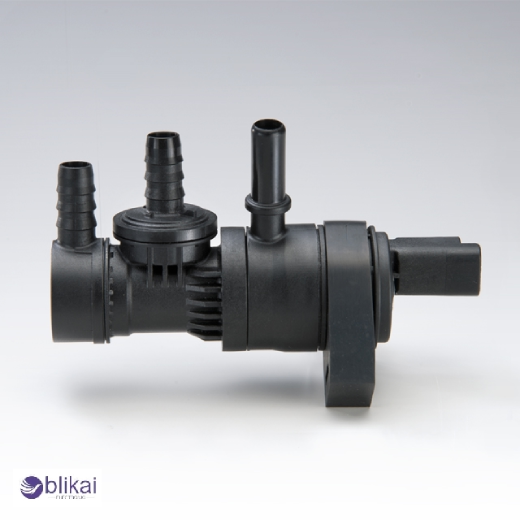
What's the purge valve for? This is one of those parts under your hood nobody talks about until something goes wrong. Think about this: your car sits idle with the engine off, and fuel vapors silently build up in the tank. There is no such thing as vanishing. Not at all. It is a charcoal canister that traps them. This is when the purge valve comes into play. As soon as the engine is ready, it opens up. So that the vapors can be burned off cleanly, let them flow back into the engine. Environmentally friendly and more efficient. This is a really smart little system.
In this case, the ECU is controlling the valve. Gas vapor traffic lights are like that. Whenever it should go or stop, tell it. Solenoid valves are most commonly used in newer cars. Fast and electric. However, if it fails, then things can get weird. There is a possibility that your engine will idle rough. It may also stutter when you hit the start button. There is a check engine light on the dashboard. There is a lot of annoying stuff going on. Do you want to know the real kicker? It is a very small item. Although it is only a small part of the equation, the consequences are huge. What a funny thing it is how the smallest things often cause the biggest mess when they are left unattended.
How Does A Purge Valve Work?
Alright, let's take a closer look at this. Purge valves serve as intermediaries between the fuel tank and the engine. The essentials aren't glamorous, but are absolutely necessary. In your fuel tank, liquid gas isn't the only thing you'll find - you'll also find vapor. We shouldn't let that vapor float around in the air (bad for the environment, bad for our cars). Consequently, it is stored in charcoal canisters. Similar to a sponge, it can be thought of as a container. When the vapor is given a command, it releases it. That command is given by whom? That's right, it's our guy, the purge valve.
Here's where things get a little more technical. When the car's Engine Control Unit (ECU) detects optimal operating conditions-as in warmed-up and steady running-the purge valve is triggered to open. Solenoid valves open and close electronically, and are usually solenoids. The trapped vapors are suctioned into the intake manifold once the charcoal canister is opened. Combustion chambers mix them with air and fuel before burning them off. This is a clean, efficient, neat environment. The ECU adjusts the valve's opening length and width based on various factors, such as engine load and temperature. A smart part of the emissions system, it never stops adapting. It's not just an on/off switch. I don't think there's much here. However, it is working. In the background, quietly.
Applications
A purge valve has many uses, so let's go over them one by one. Depending on how the system and the vehicle are configured, each one plays a different role.
Emissions Control
When it comes to purge valves, this is where they really shine. Its core responsibility is to reduce harmful emissions. During the evaporation of fuel, hydrocarbon-rich vapors are formed, which pollute the atmosphere. Charcoal canisters capture these vapors instead of allowing them to escape. However, they cannot stay there indefinitely. Purge valves provide that solution. In the process of burning these vapors, the car burns pollution that would have otherwise gone to waste. The air is cleaner, the fuel is more efficient. Everyone wins.
Improved Fuel Economy
You may not realize it, but a purge valve can actually increase your tank's mileage. What you need to do is as follows. By feeding the vaporized fuel back into the engine, the system prevents it from being wasted. It's not just air that is vaporized; it's fuel that has been converted into gas forms. This vapor is burned exactly like liquid gasoline when the purge valve opens and routes it into the intake. The effects are subtle, but they accumulate over time. Particularly in vehicles idling a lot or sitting in warm climates where fuel evaporates more quickly.
Maintaining Engine Performance
Purge valves that stick or malfunction can disrupt an engine's rhythm. A mixture of air and fuel that is too rich or too lean will mess up the air-fuel ratio. If every aspect of the engine is running correctly, then only ideal engine conditions will cause the purge valve to open. In the event that it leaks or sticks open, what should be done? A rough idle, stalling, or even a hard start may occur. Nevertheless, it contributes to smooth, consistent engine combustion when it works properly. By improving engine breathing, it improves performance.
Diagnostic Support via OBD Systems
The purge valve performs a variety of tasks behind the scenes. It's part of the EVAP system, and OBD-II can alert the driver to an issue with this system when it goes wrong. When the purge valve opens, for how long, and if vapor flows, the ECU continuously monitors the valve's behavior. When something goes wrong, such as a stuck valve or leak, a code is thrown. The check engine light is blinking, what's up? A lot of times he is referred to as this little guy. In a sense, it facilitates the diagnosis of problems under the hood for mechanics and scanners.
Environmental Compliance
Purge valves are popular with regulatory bodies. Why? Manufacturers can meet strict environmental laws like EPA or Euro emission standards with this technology. It would lead to a dramatic increase in evaporative emissions. The purge valve is essential to automakers' vapor emission control system, which is legally mandated. By reducing airborne toxins and smog, these components ensure vehicles remain road-legal.
Engine Idle Stabilization
Whenever you stop at a red light, does your engine randomly stutter? There may be a problem with the purge valve. A properly functioning system lets the engine burn fuel vapors gradually by releasing controlled amounts of fuel vapors. In what case will it leak too much vapor at idle if it malfunctions? There is an overload on the engine. Too rich. Too soon. The car can stall when this happens, causing the idle to be messed up. When the engine sits there, the purge valve keeps it calm and steady, but it seems unrelated.
Cold Start Emission Reduction
After parking your car overnight, do you start it? The behind-the-scenes work is incredibly busy. Initial startup is a challenge, especially when it comes to controlling emissions. A cold engine, not fully operational sensors, and inefficient combustion are all signs of a cold engine. Initially, the purge valve remains closed, giving the engine a chance to warm up before it releases fuel vapors. A gradual opening of the system allows the vapors to enter the system once it's ready. Those cold-start bursts are less likely to cause pollution as a result of all of this.
Turbocharged Engine Support
We're getting into a niche area now, but it's still important. When it comes to turbocharged engines, pressure control is vital. Is it possible to introduce too much vapor at the wrong time? If that happens, the air-fuel balance under boost may be upset. As a result, timing of the purge valve becomes even more crucial in these systems. If the pressure levels aren't right, then performance might suffer or detonation might occur. In some modern turbo engines, the purge system adjusts depending on the level of boost. Less guesswork, more precision.
EVAP System Integrity Testing
Purge valves are also used as test tools. An EVAP self-check occurs when the car's ECU monitors and pressurizes the sealed fuel system through its purge valve. A valve is opened, a bit of vacuum is let in, then the valve is closed to see if the pressure holds. If not? Perhaps a gas cap is loose or a hose is cracked, but there's a leak somewhere. The part plays a low-key but vital role in regulating all emissions. Is there a purge valve without it? No test. There is no diagnosis. Small problems cannot be caught before they grow.
Faqs
Question 1: What is the purpose of a purge valve?
Answer: It is a device that removes excess fuel vapor from the evaporative emission controls of a vehicle. This is typically located on the fuel tank and allows fuel vapor to enter the engine for burning instead of being released into the air.
Question 2: Can a car run without a purge valve?
Answer: When the purge valve fails or sticks open, you can still drive your vehicle, but it's not recommended. In these conditions, driving can result in higher emission levels, engine roughness, and, occasionally, stalling.
Final Thoughts
Despite its small size, the purge valve is a crucial part of the engine. There is a lot more to it than meets the eye. A fuel filter keeps your car running smoother, cleaner, smarter by controlling fuel vapors and preventing pollution. In turbo engines, the purge valve is responsible for managing boost during cold starts and idling at traffic lights. There is nothing flashy or loud about it. However, it is extremely important. What happens when it fails? Oh, you’ll know. The rough idle, the check engine light, perhaps even the smell of fuel that comes with it all. That's why I recommend that you take a look at that little valve the next time you pop the hood. You don't realize how much it's doing for you.
Some images are sourced online. Please contact us for removal if any copyright concerns arise.





