


What Is a TVS Suppressor Diode? Full Protection Guide
 303
303What Is a TVS Suppressor Diode?
A TVS suppressor diode is a semiconductor protection diode that is designed to limit high voltage transients and ensure they do not surpass the safe operating conditions of electronic components used in an electronic circuit. TVS is an acronym, meaning Transient Voltage Suppressor, which is designed to suppress short-lived voltage spikes, instead of continuously adjusting voltage as is the case with conventional diodes or voltage regulators. The TVS diode does not handle current flow in normal operating conditions and is essentially an open circuit, but at a given set point, once the voltage exceeds a preset value, the TVS diode will instantly conduct current and bypass the sensitive components with the excess energy.
How a TVS Suppressor Diode Works
The operation of a TVS suppressor diode is based on avalanche breakdown physics, allowing the device to transition from a high-impedance state to a low-impedance conduction path almost instantly when a voltage spike occurs. Under normal operating conditions, the applied voltage is less than the reverse stand-off voltage, and a small leakage current through the diode is therefore encountered. Once a transient drives the voltage past the breakdown level, the internal semiconductor junction switches to avalanche conduction, where the internal junction is now capable of conducting large currents as a result of the diode allowing a selected clamping voltage across the circuit being protected. This measure will divert surge energy to ground so that sensitive components are not subject to too much voltage. When the transient is gone, the diode will automatically revert to its non-conductive state and leave normal operation of the circuit unaltered.
Key Electrical Characteristics of TVS Diodes
Several electrical parameters characterize the performance of TVS suppressor diodes, and these should be well comprehended when selecting the component. The reverse stand-off voltage (VRWM) is the maximum operating voltage that the diode can sustain continuously without any current flowing through it, but the diode remains off. The breakdown voltage (VBR) is indicated as a point when avalanche conduction commences. One of the most important specifications is the clamping voltage (VC), which gives the highest voltage that is present across the circuit during a surge event. Peak pulse power rating: This defines the maximum transient power that the device can absorb safely, normally defined under standardized conditions of waveforms (e.g. 8/20 us pulses). Other parameters are leakage current, dynamic resistance and response time, which are usually in picoseconds and hence TVS diodes are among the fastest protection devices in the market.
Types of TVS Suppressor Diodes
TVS suppressor diodes are manufactured in several configurations to accommodate different electrical environments and application requirements. Unidirectional and bidirectional TVS diodes are the two major types of functional types that are designed to safeguard certain conditions of signals or power. Packaging can also be used as small-scale surface-mount devices in portable electronics or the larger through-hole components that are capable of handling higher power levels in an industrial system.
Unidirectional TVS Diodes
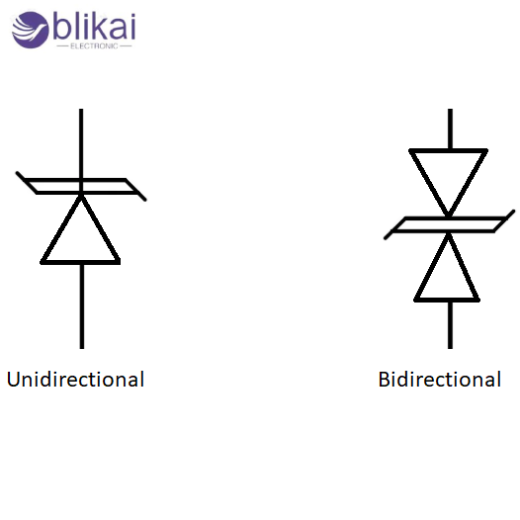
Unidirectional TVS diodes are used just like the normal rectifier diodes in the reverse bias, and these are mostly applied in DC circuits where transients are in one polarity direction. These devices offer very fine clamping operation and low capacitive value, thus suitable for protecting power supply rails, microcontroller inputs and in digital logic circuit protection. They act like conventional diodes when forward-biased, and surge protection is even offered by reverse avalanche conduction. Because of their predictable characteristics, unidirectional TVS diodes are widely used in automotive electronics, DC adapters, battery-powered equipment, and embedded control systems.
Bidirectional TVS Diodes
Bidirectional television sets' diodes are created such that they can withstand the voltage bursts of each direction, and are therefore ideal for AC signals and communication lines. Avalanche diodes that are built internally are wired in opposite directions so that positive and negative transients can be protected symmetrically. These devices are commonly used in data interfaces such as RS-485, CAN bus, audio lines, and other alternating or differential signals where surge events may occur in either direction. Bidirectional TVS diodes simplify circuit design because a single component can protect against dual-polarity transients without requiring additional devices.
TVS Diode Symbol and Circuit Placement
In circuit schematics, the TVS diode symbol resembles a Zener diode symbol with slight variations depending on whether the device is unidirectional or bidirectional. Effective protection depends on the proper location where the diode should be placed near the entry point of external signals or lines of power in order to capture the surges before they leak to sensitive circuitry. Typically, the TVS diode is connected in parallel with the protected line and ground so that excessive voltage is immediately diverted away from downstream components. Short PCB trace lengths and low-inductance grounding paths significantly improve protection performance by minimizing voltage overshoot during fast transient events.
TVS Diode vs Other Protection Devices
TVS suppressor diodes are often compared with other surge protection components such as Zener diodes, metal oxide varistors (MOVs), and gas discharge tubes (GDTs), each offering different advantages. Zener diodes can be used to control voltage, but do not have the large transient-suppressing current that transistors have. MOVs are able to operate at greater energy levels, though they react more slowly and deteriorate with repeated surges. Gas discharge tubes are used well with high lightning bursts; however, the response time is slower, which does not fit well with delicate electronics. TVS diodes find a middle ground between providing a very high response time and precision in clamping a voltage suitable choice as well as small size, making them a favourite in semiconductor-level protection.
Applications of TVS Suppressor Diodes
TVS suppressor diodes are used across nearly every electronics industry due to the universal need for transient protection. In power supply circuits, they protect regulators and converters from switching spikes and lightning surges. Automotive systems rely on TVS devices to withstand load dump events and ignition noise. Communication interfaces such as USB, Ethernet, HDMI, and serial ports use low-capacitance TVS arrays to prevent ESD damage. Consumer electronics integrate TVS protection to improve reliability and regulatory compliance, while industrial automation equipment uses high-power TVS diodes to protect sensors and control modules operating in electrically noisy environments. The rapid growth of IoT devices has further increased the demand for compact and efficient transient suppression solutions.
Advantages and Disadvantages of TVS Diodes
TVS suppressor diodes have numerous important benefits, such as a rapid response time, accurate voltage clamping, a very small size, and high reliability with a minimum maintenance needs. The construction of their semiconductor has uniform performance and can easily be integrated into automated processes in the manufacturing industry. They also have limits, however, as every device has a finite capacity to absorb energy and then start degrading, and they are not designed to operate under sustained overvoltage conditions. In high-energy surge applications with repeated surges, designers can use TVS diodes as well as other protection devices to share the load and increase the service life of the system.
Common TVS Diode Failure Modes
Like all electronic components, TVS suppressor diodes can fail if operated beyond their specified limits. Uncontrolled surge energy can permanently short-circuit the energized part, a failure mode that is usually regarded as a safe failure mode since it eliminates additional exposure to overvoltage. Thermal stress due to frequent transients may build up and cause increased leakage current or change the properties of the clamping. Failure to select the correct voltage can also cause premature conduction or a lack of adequate protection.
Installation and PCB Layout Tips
Effective transient protection cannot be achieved by just the use of the right TVS diode, but also extends into the PCB layout and installation activities. Placing the diode as close to the connectors or the external interfaces as possible should capture the surges at the point of entry. Earth connections should be short and broad to reduce the inductive impedance, so that high-speed transients can quickly divert current. Where possible, designers must not use long traces between the TVS diode and the components being offered protection, since even small inductances can generate spikes in voltages when current is changing rapidly. Good layout practices significantly improve real-world protection performance compared to theoretical designs.
FAQs
How fast does a TVS diode respond?
TVS diodes generally react in the picosecond range, so these diodes are used to protect high-speed semiconductor equipment against ESD events.
Where should a TVS diode be placed in a circuit?
It must be mounted near external connectors or power entry points and mounted in parallel between the line being protected and ground.
Conclusion
TVS suppressor diodes play a critical role in protecting modern electronic systems from transient voltage events that could otherwise cause catastrophic failure or long-term reliability issues. By rapidly clamping voltage spikes and safely diverting surge energy, these devices safeguard sensitive semiconductors across applications ranging from consumer electronics to industrial automation and automotive systems. Knowledge of the operation of TVS diodes, their electrical properties, and the appropriate methods of selecting them can help engineers and designers create a more robust and durable electronic system. The need and value of effective transient voltage suppression is set to only increase as electronic devices continue to grow smaller but more complex, and the TVS suppressor diode is becoming a crucial element in circuit protection design today.
Some images are sourced online. Please contact us for removal if any copyright concerns arise.





