


AD590 Temperature Sensor IC: Specs, Pinout & Applications
 554
554What Is the AD590 Temperature Sensor IC?
The AD590 is a two-terminal integrated circuit temperature sensor that produces an output current directly proportional to absolute temperature, typically scaled at 1 µA per Kelvin. This proportional-to-absolute-temperature (PTAT) output allows extremely linear and stable temperature measurement across a broad operating range. Internally, the AD590 uses matched transistor pairs and precision trimming techniques to maintain tight accuracy and long-term stability.
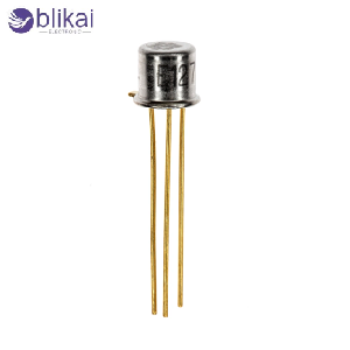
Key Features of AD590
The AD590 has excellent performance features that include great linearity, best repeatability, minimum power usage, and a large operating temperature of -55 °C to +150 °C. It has a high noise resistance and signal conditioning since its present output format is high. Other capabilities are low calibration error, stable long-term drift, single two-wire operation, broad supply voltage compatibility, and durable mechanical packaging.
AD590 Pinout and Package Types
AD590 Pin Configuration
The AD590 is a basic two-terminal device with a working principle similar to a current source that is temperature-controlled. One end would be connected to the positive supply voltage, and the other end would be the temperature-proportional output current. This two-wire design simplifies circuit layout, minimizes wiring complexity, and enables easy integration into current-loop measurement systems.
Available Package Options
AD590 comes in various packages, such as the TO-92, which is used in through-hole designs, the SOIC package, used in surface-mount assembly, and the metal can package, which is used in order to enhance thermal conductivity and mechanical strength. The various types of packages have varying benefits in thermal response, mechanical stability, and environmental protection that enable engineers to use the most appropriate form factor based on the needs of the application.
AD590 Electrical Specifications
Absolute Maximum Ratings
The AD590 supports a wide supply voltage range, typically up to 30 V, with a maximum operating current of approximately 1.5 mA. The rate of power dissipation varies depending on the package chosen and thermal conditions. This gadget is able to work without degrading its accuracy or reliability over an enormous temperature range of -55 °C to +150 °C.
Operating Electrical Characteristics
Under typical operating conditions, the AD590 produces an output current of 298.2 µA at 25°C (298.2 K), following a precise 1 µA/K scaling factor. This highly linear behavior is easily exposed to simple current-voltage conversion via a simple resistor, which makes it easy to calculate the temperature.
Temperature Measurement Range and Accuracy
AD590 can be used to measure the accurate temperature of -55 °C to +150 °C, and the usual accuracy is better than +-0.5 deg C at room temperature. With proper calibration and signal conditioning, measurement errors can be further minimized. Stability and low drift are guaranteed over a prolonged time of the years of continuous use.
How Does the AD590 Work?
PTAT Operating Principle
The AD590 operates on the proportional-to-absolute-temperature principle, using precisely matched semiconductor junctions to generate a current output linearly proportional to absolute temperature. As temperature increases, the internal transistor characteristics shift predictably, producing a proportional increase in output current.
Signal Conditioning and Current-to-Voltage Conversion
External signal conditioning is necessary, as the current signal is present at the AD590 and needs to be changed into a measurable voltage. This is typically achieved using a precision resistor, operational amplifier, or transimpedance amplifier configuration.
Typical AD590 Application Circuits
Basic Temperature Measurement Circuit
A standard AD590 circuit uses a precision resistor connected between the output terminal and ground to generate a voltage proportional to temperature. For example, using a 10 kΩ resistor produces 10 mV per Kelvin, simplifying direct interfacing with ADC inputs.
Precision Temperature Monitoring Circuit
High-accuracy designs often employ operational amplifiers to provide gain, offset compensation, and filtering. They are used in laboratory instruments, calibration systems, and temperature monitoring devices that are of medical grade, as these circuits can be precisely calibrated, reduce noise and improve stability.
Microcontroller Interface Circuit
No complications are present when the AD590 is used with microcontrollers (Arduino, STM32, ESP32, and PIC). A basic resistor to convert circuit enables the microcontroller to measure the voltage in the conversion circuit with a simple resistor circuit, and the firmware algorithms calculate the temperature values. This functionality of easy integration makes AD590 very appealing to the embedded and IoT-based sensing systems.
AD590 vs Common Temperature Sensors
AD590 vs LM35
LM35 gives out a voltage output that is proportional to the temperature, whereas the AD590 gives out a current output. The AD590 offers superior noise immunity, better long-distance transmission performance, and greater linearity, whereas the LM35 provides simpler direct voltage measurement and lower cost for short-distance applications.
AD590 vs DS18B20
DS18B20 is a digital temperature sensor that comes with direct digital communication and easier integration into the system. Nevertheless, the AD590 is used in severe industrial conditions, whereby analog current loops are more reliable, EMI, and system robust.
AD590 vs Thermistors
Thermistors are very sensitive, but have complicated linearization and calibration. AD590 has high linearity, easier signal processing and better long-term stability and hence, a better option regarding accuracy and industrial-grade temperature measurement.
Advantages of AD590
The AD590 provides outstanding accuracy, linearity, and immunity to noise and has low power consumption and a two-wire operation. It has the capability to operate at its present output to make long-distance measurements without the degradation of signals, making it suitable in the field of industrial automation, laboratory equipment and medical equipment.
Disadvantages of AD590
Although very strong, the AD590 needs external signal conditioning and calibration so that it can be used with maximum accuracy. Also, it tends to be more costly than simple temperature sensors, which can restrict its application to the cost-conscious consumer electronics.
Common Applications of the AD590 Temperature Sensor IC
Industrial Temperature Control Systems
The AD590 is extensively used in industrial process control systems for monitoring machinery temperature, chemical processing conditions, and automated manufacturing environments where accuracy and reliability are essential.
HVAC and Environmental Monitoring
Applications in heating, ventilation and air conditioning systems. The AD590 can be used in the measurement of ambient temperature to achieve precision in controlling the climate, optimization of energy use, and providing comfort for the occupants.
Medical and Laboratory Equipment
Medical diagnostics and diagnostic tools, incubators, and laboratory analyzers are based on the AD590 to monitor thermal parameters with high accuracy, which guarantees the correct test results, preservation of samples and patient safety.
Automotive Temperature Monitoring
The AD590 serves automotive systems like battery thermal control, engine temperature, and climate control systems with a high degree of reliability in operating in such extreme environmental conditions.
Embedded and IoT Temperature Sensing
IoT devices, smart home controllers, and industrial embedded systems utilize the AD590 for accurate and stable temperature sensing, enabling data logging, predictive maintenance, and automated environmental control.
PCB Layout and Design Guidelines for AD590
Noise Reduction Techniques
The designers should reduce signal paths, grounding, decoupling capacitors, and shielding to reduce noise interference. The reduction of noise and various signal routing operations, among others, is used to improve the accuracy of the measurements.
Thermal Coupling and Placement Tips
To achieve the desired temperature sense, the AD590 is to be put in proximity to the target heat source, and the exposure to outside airflow, thermal gradient and mechanical stress should be reduced. Proper thermal coupling improves response time and measurement precision.
Calibration and Error Minimization
The digital compensation algorithms, two-point calibration and offset trimming are the methods used to reduce measurement error. Periodic recalibration is used to guarantee long life in mission-critical systems.
Storage, Handling, and Reliability Considerations
The AD590 has great stability against the environment over a long period of time. Correct handling, ESD protection, moisture, and safe packaging will guarantee stable operation and long operation time. Packaging can also be provided in industrial grade, further increasing the ability to resist tough conditions.
FAQs
What voltage supply does AD590 require?
The AD590 can be powered between 4 V and 30 V, so it can be used with a great variety of industrial and embedded devices.
How does AD590 compare with digital temperature sensors?
AD590 has better noise resistance and industrial protection, whereas digital sensors are easy to integrate with the software.
Is AD590 suitable for high-temperature environments?
Yes, it can reliably work up to +150degC which makes it applicable to industrial and automotive use.
How do you calibrate an AD590 sensor?
Calibration is normally done by selecting two known temperature reference points and modifying gain and offset parameters.
Conclusion
The AD590 temperature sensor IC is possibly one of the most stable, precise and general-purpose temperature sensing ICs available today. Its linear current out feature, high noise resistance, large operational range, and strong performance characteristics are the perfect fit for industrial automation, lab instrumentation, automotive electronics and embedded system design. The AD590 has remained an important component in contemporary temperature measurement and control with its simplicity and precision, as well as in temperature control.
Some images are sourced online. Please contact us for removal if any copyright concerns arise.





