


DRV8825 Stepper Motor Driver Tutorial & Wiring Guide
 547
547What Is the DRV8825 Stepper Motor Driver?
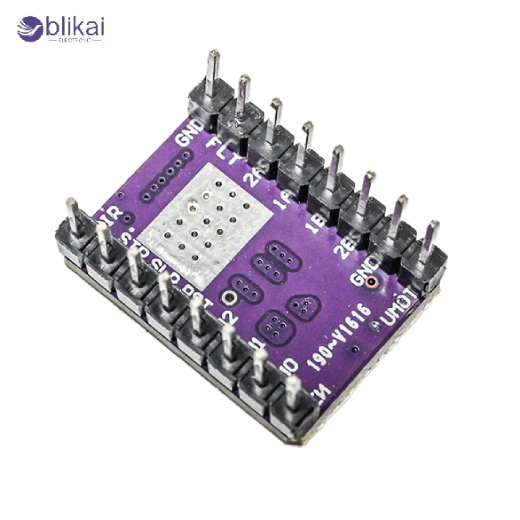
The DRV8825 is a high-current stepper motor driver IC that has been designed by Texas Instruments that has evolved to drive a single bipolar stepper motor using two complete H-bridges. It integrates advanced current control, internal PWM regulation, and microstepping logic into a compact form factor, allowing precise control of motor position, speed, and torque.
Key Features and Technical Advantages of DRV8825
High Current Drive Capability
The DRV8825 can deliver up to 2.2 A peak current per phase with proper cooling and around 1.5 A continuous current without additional heat sinking. This has a high current capability, which is capable of controlling larger stepper motors than several entry-level drivers (hence making more torque available to applications like CNC milling machines, robotic joints and automated positioning stages).
Advanced Microstepping Resolution
One of the defining advantages of the DRV8825 is its support for microstepping modes from full-step down to 1/32-step. Microstepping also provides a massive boost in smoothness of motion, a lower vibration and audible sound, and higher accuracy in positioning. The driver splits a full motor step into 32 microsteps, so that it provides very fine control and is thus useful in 3D printing, laser engraving, and camera motion systems in which smooth movement is essential.
Wide Operating Voltage Range
The DRV8825 has a large range of motor supply voltages between 8.2 V and 45 V, much larger than many competing drivers. This enables the designers to choose more supply voltages to enhance the speed and torque behavior of the motors, particularly at high rotational speeds. The broad voltage characteristic also permits the driver to be used with different industrial and consumer-grade power supplies.
Built-in Protection Functions
The DRV8825 combines all these protection features, such as overcurrent protection, thermal shutdown, undervoltage lockout, and short-circuit protection, to create a long-term, reliable and safe operating device. These are also used to guard the driver against damage as a result of wiring errors, overload conditions, or overheating, and the associated connected motor.
How DRV8825 Works
Internally, the DRV8825 uses a current-mode PWM control scheme to regulate motor coil current. The driver measures current through sense resistors and compares it with a reference voltage derived from the VREF pin. The PWM controller varies the output transistors to stabilize the current when the current reaches the desired level. This modern chopping method permits the control of torque to be controlled and overheating of the motor can be avoided. The integrated microstepping logic generates sinusoidal current waveforms, enabling smooth motion and reduced mechanical resonance.
DRV8825 vs A4988: Detailed Comparison
Electrical Performance Comparison
The DRV8825 has a larger maximum motor voltage and a larger peak current capability than the A4988, allowing larger motors to be used, as well as operation at higher speeds.
Microstepping and Motion Smoothness
The DRV8825 takes up to 1/32 microstepping, whereas the A4988 takes 1/16 microstepping only. This leads to less vibration, reduced noise and less motion in precision applications.
Thermal Efficiency and Cooling Requirements
Due to its optimized MOSFET design, the DRV8825 generally exhibits better thermal efficiency, although adequate heat sinking and airflow are still recommended for high-current operation.
Application Selection Guide
The DRV8825 is suited to the high-performance demands of CNC machines, industrial automation and high-resolution 3D printers, whereas the A4988 can be used in low-cost and low-power designs.
DRV8825 Typical Application Circuits
Basic Standalone Wiring Circuit
Such a basic design only needs a small number of external elements, such as decoupling capacitors and current sense resistors, to be operational on its own.
Arduino + DRV8825 Stepper Motor Control Circuit
When the STEP, DIR and ENABLE pins are connected to Arduino digital I/O pins, it is possible to have precise motor control through simple firmware routines.
CNC Shield and 3D Printer Board Wiring
Many CNC shields and 3D printer control boards support direct plug-in compatibility with DRV8825 modules, simplifying system integration.
DRV8825 Wiring Guide: Step-by-Step Connection Tutorial
Power Supply Wiring
A constant power supply that has sufficient current-carrying capacity is required. The spike in the voltage is suppressed by large electrolytic capacitors positioned on the VMOT pin, which minimize the electromagnetic interference.
Motor Wiring and Phase Identification
Correct identification of the two motor coils is critical. A multimeter can be used to determine coil pairs, ensuring proper connection and smooth rotation.
Control Signal Wiring
Short and shielded signal wires help minimize noise and prevent false triggering of step pulses.
Microstepping Configuration Setup
Careful configuration of the M0, M1, and M2 pins allows precise selection of microstepping modes for optimal performance.
Setting Current Limit on DRV8825 (VREF Adjustment Guide)
Why Current Limiting Is Critical
High-quality current limiting helps to avoid overheating of the motor, and helps minimize the level of power dissipation, and provides long-term reliability.
DRV8825 Current Calculation Formula
The output current is calculated using the formula: Imax = VREF / (5 × Rsense), allowing precise tuning for different motor ratings.
Step-by-Step VREF Adjustment Procedure
With a multimeter, the user can use the onboard potentiometer to adjust the reference voltage to the desired value to have the best regulation of current.
DRV8825 Arduino Example Code and Control Logic
Basic Stepper Motor Test Code
Simple Arduino sketches can generate STEP pulses and control direction, enabling immediate testing of motor functionality.
Speed and Direction Control Logic
By adjusting pulse frequency and timing, motor speed and acceleration profiles can be precisely controlled.
Acceleration and Microstepping Control Tips
Implementing acceleration ramps and fine microstepping significantly improves motion smoothness and reduces mechanical stress.
Common Problems and Troubleshooting Guide
Motor Not Moving
Common causes include incorrect wiring, insufficient current settings, or missing step signals.
Overheating and Thermal Shutdown
Adequate cooling, heat sinks, and proper airflow are necessary to prevent thermal shutdown during high-load operation.
Missed Steps and Vibration
Optimizing acceleration profiles, increasing supply voltage, and selecting appropriate microstepping modes can mitigate these issues.
PCB Layout and Hardware Design Tips for DRV8825
Careful PCB layout is essential for stable operation. Wide copper traces, solid ground planes, short current paths, and proper placement of decoupling capacitors help minimize noise and thermal stress.
FAQs
Do I Need a Heat Sink for DRV8825?
Continuous currents of over 1A are highly encouraged to use a heat sink. Proper cooling by use of heat sinks and forced airflow prevents thermal shutdown, enhances reliability and increases the life of the driver in high-load applications.
What Causes Missed Steps in High-Speed Motion?
Inadequate supply voltage, small current limit settings, excessive acceleration, mechanical load imbalance or high friction are often causes of missed steps. This problem can be eliminated by increasing the motor voltage, fine tuning of acceleration ramps, and mechanical alignment.
How Do I Reduce EMI and Electrical Noise in DRV8825 Systems?
Short signal wire, twisted-pair motor cables, solid grounding, correct decoupling capacitors and PCB layout can be used to reduce electromagnetic interference. Measures enhance signal integrity and stability of the system.
Conclusion
DRV8825 stepper motor driver is a high-power, versatile, and very dependable motor driver that can be used to provide precise motion control in a wide variety of applications. With its high current capability, wide operating voltage range, advanced 1/32 microstepping resolution, and comprehensive protection features, it delivers excellent performance in demanding environments such as 3D printers, CNC machines, robotics platforms, and industrial automation systems. Through proper wiring techniques, proper current limit setting and optimum control code, designers and engineers can get the full potential out of the DRV8825 and have smooth, accurate and efficient motor operation. The DRV8825 is one of the most flexible and reliable stepper motor drivers currently in use, whether in hobby projects, in professional prototyping, or commercial products.
Some images are sourced online. Please contact us for removal if any copyright concerns arise.





