


L7805 Voltage Regulator: Pinout, Specs & Applications
 627
627Introduction to the L7805 Voltage Regulator
The L7805 is one of the most widely used linear voltage regulator ICs in electronics, designed to provide a stable +5V DC output from a higher unregulated input voltage, typically ranging from 7V to 35V. L7805 is a part of the 78xx family of fixed positive voltage regulators and has been employed as the foundation to the design of the power supply, embedded system, prototype design, industrial control circuit board, and educational electronics design due to its simplicity, reliability and predictable performance.
What Is the L7805 Voltage Regulator?
L7805A or L7806 is a three-terminal linear voltage regulator IC which generates a regulated 5V output using internal reference circuitry, error amplifiers and pass transistors and converts a higher input DC voltage. Its internal architecture automatically adjusts the conduction of the pass element to maintain a constant output voltage despite changes in input voltage or load current, provided the device remains within its operating limits.
L7805 Pinout and Package Configuration
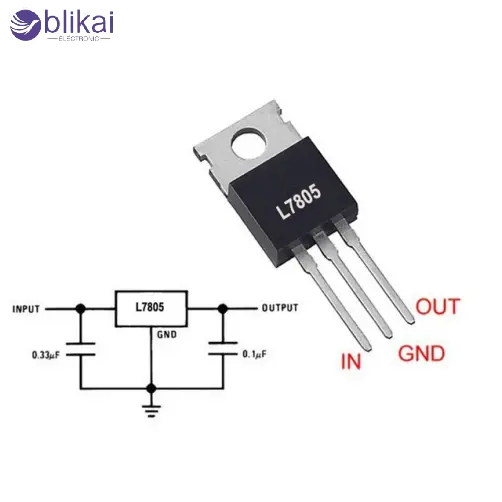
The TO-220 L7805 package has three pins that can be in a fixed sequence that should not be damaged permanently unless positioned correctly. Pin 1 is the Input (VIN), which accepts an unregulated DC voltage higher than 7V; Pin 2 is Ground (GND), serving as the common reference; and Pin 3 is the Output (VOUT), delivering a regulated +5V DC. When mounted with the metal tab facing away from the user, the pin order from left to right is Input, Ground, Output, a convention shared across most 78xx series regulators.
Common L7805 Packages
There are various package styles of L7805 to meet a variety of thermal and mechanical needs, including TO-220 through-hole, TO-92 low current compact and surface mount versions such as D2PAK (TO-263) in PCB-based power supplies. The TO-220 package is still the most popular because it can be connected to a heatsink to be operated with higher output current to avoid overheating.
L7805 Electrical Specifications
Input Voltage Range
The input voltage range that the L7805 is recommended to operate with is usually 7 V to 35 V, though absolute maximum values might have been slightly different across manufacturers. Minimum input voltage should be higher than the output voltage by the dropout voltage, which is about 2V in nominal load conditions, i.e. minimum requirement is about 7V to ensure the 5V output is stable.
Output Voltage and Accuracy
When the L7805 is running under nominal conditions, the nominal output voltage of the L7805 is +5.0V with a tolerance of +-4%. This accuracy is adequate for most digital logic circuits and TTL / CMOS ICs, as well as microcontrollers and low-voltage sensors, where a high regulation ability is preferable but not a requirement.
Output Current Capability
When heatsinkled, the L7805 is capable of delivering up to 1A of output current, but in practice, current is usually constrained by thermal dissipation and not the available current-carrying ability. The highest safe current that can be conducted without a heatsink can be only several hundred milliamperes, depending on the input voltage and ambient temperature.
How the L7805 Voltage Regulator Works
Internal Linear Regulation Principle
The L7805 has a fixed voltage reference and an error amplifier that compares the output voltage with the fixed voltage reference at any point in time. Any difference between the target 5V will lead to the internal pass transistor changing its conduction, reducing or increasing current flow to recover regulation. Unnecessary voltage is lost through heat across the pass element, and this is the reason why linear regulators also inherently have a lower efficiency compared to switching options.
Dropout Voltage and Regulation Behavior
Voltage Regulation Behavior Dropout Voltage and Regulation Behavior
The dropout voltage of the L7805 is the smallest difference between the input and output voltage needed to properly regulate, of normal order 2V. At an input voltage that is lower than this threshold, the output voltage will begin to track the input with less internal losses, and this will result in low regulation. Understanding dropout behavior is essential when designing battery-powered or low-headroom power supplies.
Power Dissipation and Thermal Considerations
Power Loss Calculation
Power dissipation in the L7805 is calculated using the formula:
P = (VIN − VOUT) × IOUT.
For example, converting 12V to 5V at 500mA results in (12 − 5) × 0.5 = 3.5W of heat, which is substantial for a small IC and requires effective thermal management to prevent overheating.
Heatsink Selection and Thermal Resistance
In order to be able to act safely at higher currents, the L7805 needs to be mounted on a suitable heatsink that lowers the junction to ambient thermal resistance. The TO-220 metal tab is electrically connected to ground, allowing it to be directly bolted to grounded heatsinks without electrical isolation in most designs, simplifying thermal design while improving heat dissipation.
Typical L7805 Application Circuits
Basic 5V Power Supply Circuit
A standard L7805 application circuit includes input and output bypass capacitors, typically 0.33µF on the input and 0.1µF on the output, placed close to the regulator pins to ensure stability and suppress high-frequency noise. Larger electrolytic capacitors are often added to improve transient response under load changes.
Microcontroller Power Supply
The L7805 is commonly used to power 5V microcontrollers such as Arduino-compatible boards, logic ICs, and peripheral modules. Its low output noise and easy design make it best suited to educational kits, development boards and other small embedded systems where efficiency is not a significant concern, as well as reliability.
Advantages of Using the L7805
Simplicity and Reliability
The fact that the L7805 is very easy to use is one of its greatest benefits, as it needs few external components and does not need detailed feedback networks. Its internal protective features have made it extremely resistant to short circuits, overloads and thermal stress, lessening the design risk.
Low Output Noise
The L7805 has extremely low output ripple and electromagnetic interference compared to switching regulators, and is used in the analog circuit, audio electronics, RF modules and sensor systems, where clean power is required.
Disadvantages of the L7805
Low Efficiency
Since any surplus voltage is dissipated in terms of heat, the efficiency of the L7805 reduces greatly with the difference between the input and output voltage. This renders it inappropriate in high-power or battery-operated systems, which are sensitive to energy efficiency.
Heat Generation
Thermal management is often the primary design challenge when using the L7805, particularly in enclosed systems or high ambient temperature environments. Lack of consideration for heat dissipation may result in thermal shutdown or long-term reliability issues.
L7805 vs Switching Regulators
The L7805 and buck converters differ in that the former does not use high-frequency switching and inductors to efficiently reduce the voltage, but instead causes the voltage to be dissipated linearly. Although switching regulators are more efficient, they add switching noise, and more complex designs are needed, so L7805 should be used in the case of low-noise, low-complexity applications.
When to Choose L7805
L7805 is most appropriate when the current demand in and out ought to be moderate, the input voltage is not too high, and board space is adequate for the heatsink, and low noise is desired more than efficiency.
Common L7805 Design Mistakes
Insufficient Input Voltage Margin
Designers sometimes provide insufficient input voltage, forgetting to account for dropout voltage and ripple on the unregulated supply, resulting in unstable or undervoltage output.
Missing Bypass Capacitors
It is possible to miss the suggested input and output capacitors and oscillate, have unstable voltage, or have a poor transient response, most particularly in powering digital loads with fast current variations.
L7805 Applications in Modern Electronics
Industrial and Automation Systems
L7805 finds extensive application in the control panels, sensor interfaces and logic power rails placed in most industrial automation equipment where performance and noise immunity are needed.
Educational and Prototyping Use
Due to its low cost and forgiving nature, the L7805 remains a staple component in electronics education, breadboard prototyping, and hobbyist projects.
FAQ
What is the L7805 used for?
L7805 is employed to rectify a larger DC voltage into a constant 5 V supply to provide power to logic ICs, microcontrollers, sensors and other power-negligible electronic circuits having high voltage stability and low-distortion voltage regulation criteria.
How much current can an L7805 supply?
With fully heatsinked L7805 capable of 1A of output current, the applicability of the current varies with the input voltage, ambient temperature and thermal dissipation capacity.
Does L7805 need a heatsink?
A heatsink is required when the L7805 dissipates significant power, which occurs at higher input voltages or load currents, to prevent thermal shutdown and ensure reliable operation.
Can L7805 power a microcontroller directly?
Yes, the L7805 is commonly used to power 5V microcontrollers directly, provided the input voltage and current requirements are within safe operating limits, and proper bypass capacitors are used.
Conclusion
One of the most important and classical electronic components of the power supply design that can illustrate its relevance even with the emergence of high-efficiency switching regulators is the L7805 voltage regulator, which is seen as a tradeoff between simplicity, reliability, and clean output voltage. L7805 works well when operated within its electrical and thermal boundaries as a reliable 5V power supply in a very broad spectrum of applications, from educational projects to industrial control systems, and it is a vital piece of the electronics engineer's toolkit.
Some images are sourced online. Please contact us for removal if any copyright concerns arise.





