


S8550 Transistor: Features, Specifications & Applications
 331
331What is the S8550 Transistor?
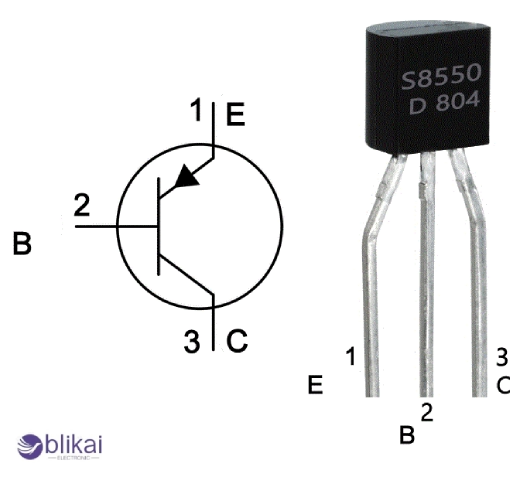
Consumer electronics heavily depend on the general-purpose PNP transistor known as the S8550 for their operation. This device provides powerful performance when operating in environments with low voltage and low current, so it serves as the preferred selection for multiple user groups, including both professionals and students, as well as hobbyists.
Key Features of the S8550 Transistor
Low voltage operation
People recognize the S8550 transistor because of its extraordinary ability to operate at low voltages. Its low-operating voltage capabilities recommend the S8550 transistor for battery equipment as well as power-efficient applications. The S8550 can function effectively in power supply circuits between 3V to 12V because it has a -25V VCEO voltage.
High current gain (hFE)
The main standout characteristic of the S8550 transistor is its exceptionally high current gain, rated as hFE. The S8550 transistor has a standard hFE rating between 120 to 240, which delivers effective amplification of tiny input currents into enlarged output currents. The S8550 demonstrates superior gain capability because of which it excels in situations where signal amplification or current control is needed.
Fast switching speed
The S8550 transistor has high-speed capabilities suitable for applications needing quick state changes. This transistor uses a 100 MHz fT transition frequency to react swiftly to input signals, therefore making it effective in high-speed digital applications.
Compact TO-92 package
The S8550 transistor implements its compact TO-92 package for excellent space efficiency alongside continued excellent performance characteristics. These small physical dimensions enable the S8550 transistor to fit into tightly spaced circuit boards. The TO-92 package design enables effective heat dissipation by delivering good thermal performance when the transistor operates.
Technical Specifications of S8550
|
Parameter |
Value |
|
Type |
PNP |
|
Collector-Emitter Voltage (Vce) |
-25V |
|
Collector-Base Voltage (Vcb) |
-40V |
|
Emitter-Base Voltage (Veb) |
-5V |
|
Collector Current (Ic) |
-700mA |
|
Total Power Dissipation |
625mW |
|
DC Current Gain (hFE) |
85–300 |
|
Transition Frequency (fT) |
100 MHz |
|
Package Type |
TO-92 |
Applications of S8550 Transistor
Audio amplifiers
The audio amplifier circuit requires the S8550 transistor to function properly in low-power systems. The device demonstrates excellent performance in signal amplification of weak audio signals while maintaining minimal signal distortion through its high current gain functionality and low noise features. The S8550 serves as one of the components in pre-amplification sections because it increases the strength of incoming signals before power amplification kicks in.
Switching circuits
The S8550 transistor functions extensively as a part of switching circuits. Due to its rapid switching ability with low saturation voltage, this device works best in digital logic systems and provides high-quality support for relays and LEDs. When operating as an electronic switch, the S8550 controls current distribution depending on incoming signals.
Signal processing
The S8550 transistor serves numerous signal-processing requirements across different systems. The linear properties of the S8550 transistor, combined with its high-frequency performance, fit it perfectly for analog signal processing applications, including filters, oscillators and modulators. The S8550 serves to manipulate and transform signals when used in these applications for achieving precise output signal specifications.
Power management systems
S8550 transistors maintain critical roles during voltage regulation alongside current control operations in power management systems. The S8550 device functions well under moderate power conditions due to its thermal stability and works in voltage regulators as well as current limiters and battery charging systems. Through its operation, the S8550 regulates voltage levels and defends sensitive components against potential overcurrent damage.
Consumer electronics
The S8550 transistor finds wide application in consumer electronic products because of its flexible operation. The transistor appears inside portable audio players as well as remote controls and toys as well as small electronic gadgets. The S8550 transistor serves amplification functions as well as accomplishes switching and signal conditioning tasks to boost the operational capabilities of these devices.
Advantages of Using S8550 Transistor
High current gain
The S8550 transistor remains distinctive because of its exceptional hybrid-forward current gain referred to as hFE. Signal boosting applications have an ideal usage of this transistor because its high gain enables effective amplification of small input signals. Optional input signals allow this transistor to operate effectively on significant current levels, hence boosting both circuit efficiency and performance performance.
Low noise performance
An essential quality of the S8550 transistor consists of remarkable low noise behavior. The superior low noise capability of this device stands vital, especially in applications that need pristine signal quality, such as audio products and delicate electronic systems. The transistor maintains very minimal unwanted signal interference and also avoids signal distortion, which leads to higher system performance through cleaner output.
How to Use the S8550 Transistor in Circuits
Circuit Design Considerations
The successful implementation of S8550 transistors in circuits depends on following both its PNP design configuration and fundamental properties. Mark the emitter point and the base point together with the collector point. Because of its low saturation voltage alongside high current gain, the S8550 transistor proves suitable for amplifier circuits and switching applications.
Biasing the S8550
The S8550 requires appropriate biasing to achieve its peak operational state. Proper biasing of the S8550 requires the emitter to be connected to a positive source while the base sees a voltage lower than the emitter voltage, and the collector is connected to the ground through the load. The operational setup of this arrangement lets the transistor act inside its active zone, thus supporting either amplification or switching operations.
S8550 vs S8050 Transistor: Key Differences
|
Parameter |
Difference Description |
||
|
Transistor Type |
PNP |
NPN |
Opposite polarity |
|
Max Collector-Base Voltage (VCBO) |
-40V |
40V |
Same magnitude, different polarity |
|
Max Collector-Emitter Voltage (VCEO) |
-25V |
25V |
Same magnitude, different polarity |
|
Max Collector Current (IC) |
-1.5A |
1.5A |
Same value, opposite direction |
|
Max Power Dissipation (Ptot) |
1W |
1W |
Same |
|
DC Current Gain (hFE) |
85 – 300 |
85 – 300 |
Same |
|
Package Type |
TO-92 |
TO-92 |
Same |
|
Typical Use |
Amplification/Switching (Low-side drive) |
Amplification/Switching (High-side drive) |
PNP for low-side, NPN for high-side |
|
E-B-C Pin Configuration |
E (Left) - B (Middle) - C (Right) |
E (Left) - B (Middle) - C (Right) |
Same |
Installation and Usage Tips
Proper handling and ESD precautions
Appropriate measures against electrostatic discharge must be taken while working with the S8550 transistor. You must use an anti-static wrist strap that connects to the ground when you handle sensitive electronic components. You should store S8550 transistors inside anti-static bags together with conductive foam during times when they are not active.
Soldering recommendations
To achieve the best results from your S8550 transistor, you need to operate a temperature-controlled soldering iron between 300-350°C (572-662°F). Aided by heat for about two to three seconds, ensure proper solder joins form. Derive the best outcomes by using flux-core solder with tin-lead combinations of 60/40 or 63/37.
Circuit design considerations
During S8550 transistor implementation for your circuit, focus on the maximum specifications for both collector-emitter voltage and collector current requirements. The design process should include proper heat dissipation methods because high-power applications require it. Heat sinks can be employed when such a design requires additional cooling.
Troubleshooting common issues
The first troubleshooting step for S8550 transistor circuit problems should check both device orientation and wiring connection. Confirm that all voltage, along with current measurements, falls within defined parameters. A warm or hot sensation when touching the transistor indicates improper operating parameters or wrong biasing status. An oscilloscope provides essential information about unexpected amplifier signals and distortions.
Conclusion
The S8550 transistor provides an economical and space-saving transistor solution that suits multiple electronic application needs. Its dependable current performance, together with quick switching ability and high gain factor, makes it an essential resource for engineers and makers. The S8550 serves as a trusted selection for any application that includes audio amplifiers together with sensor interfaces and smart switches.
FAQs
Q1: What is the maximum current of the S8550?
A: This device operates using 700mA as its maximum continuous current through the collector area.
Q2: Can I use the S8550 for audio amplifiers?
A: A direct power flow suits this device for the generation of low-power audio signals.
Q3: What is the difference between S8550 and BC557?
A: The S8550 showcases better performance for power applications because it utilizes higher current and performs faster switching operations in comparison to the S8550.
Q4: Is the S8550 a power transistor?
A: No, it’s a small signal transistor, but it can drive relatively high currents for its size.
Related Articles
Infineon IRF3808PBF MOSFET – High Power N-Channel Transistor
IRLZ44N MOSFET Transistor: Specs, Features, and Applications
BC557 Transistor Pinout, Features & Applications [Electronics Guide]





