


What Is an LED Driver IC? Complete Technical Guide
 448
448What Is an LED Driver IC?
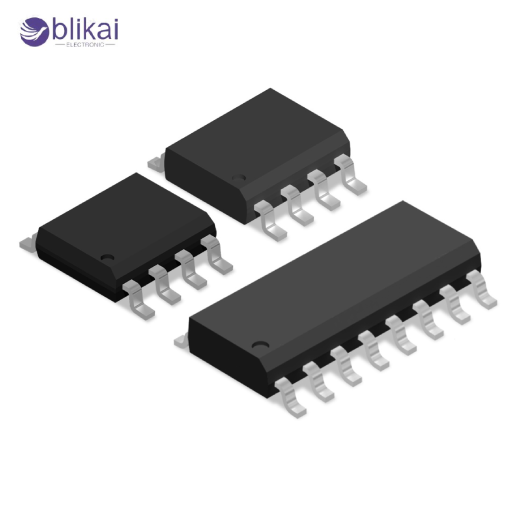
An LED driver IC is a specialised power management IC that functions to manage and regulate electrical current conducted to one or more LEDs in order to sustain a constant light output despite variations in supply voltage due to supply voltage variation or variations in load due to changes in load. Unlike general voltage regulators, LED drivers operate primarily as constant-current sources because LED brightness is proportional to forward current rather than applied voltage. The IC continuously monitors output conditions through feedback loops and dynamically adjusts switching behavior to maintain precise current levels, enabling reliable operation across varying temperatures, input voltages, and operating environments.
How an LED Driver IC Works
Constant Current Regulation Principle
At the core of every LED driver IC is a closed-loop current regulation system that senses LED current through a resistor or internal sensing mechanism and compares it with a reference value. When the measured current deviates from the target level, the controller adjusts switching duty cycle or conduction time to restore equilibrium. This feedback operation occurs continuously at high speed, ensuring constant brightness even when supply voltage changes or LEDs age over time, thereby maintaining visual uniformity and predictable performance.
Switching Regulation and PWM Control
Most modern LED driver ICs use switching converter topologies such as buck, boost, or buck-boost configurations, where an internal or external MOSFET rapidly switches on and off at high frequency to transfer energy efficiently. Pulse-width modulation (PWM) control adjusts average current by varying duty cycle, allowing precise dimming without altering LED color characteristics. PWM dimming is widely used in display backlighting because it preserves color accuracy and efficiency across wide brightness ranges while minimizing power loss.
Key Internal Functional Blocks
An LED driver IC typically integrates multiple functional modules including an oscillator for switching timing, an error amplifier for feedback comparison, a current sense circuit for regulation accuracy, gate drivers for switching transistors, and protection circuits that monitor abnormal conditions. The blocks combine to form a small self-regulated power subsystem which replaces a large number of discrete components; they are also more reliable and easier to design circuits.
Types of LED Driver ICs
Linear LED Drivers
Linear LED drivers regulate current by dissipating excess voltage as heat, offering low electrical noise and minimal external component requirements. They find widespread application in low-power indicators or in other applications where the electromagnetic interference is to be kept to a minimum, but their efficiency is reduced by large factors to input voltage that is substantially more than LED forward voltage.
Switching LED Drivers
Switching LED drivers dominate modern designs due to superior efficiency and flexibility. Buck converters step voltage down for systems where supply voltage exceeds LED voltage, boost converters increase voltage for series LED strings, and buck-boost architectures handle wide input ranges. Some of these devices such as RT4526GJ6 and RT4533GJ6 allow them to be effectively utilized in portable electronic and display backlighting applications.
Constant Current vs Constant Voltage Drivers
Constant voltage drivers are used when LED modules already include current regulation circuitry, whereas constant current drivers directly control LED current and are preferred for discrete LED strings. Selecting between these approaches depends on system architecture, thermal requirements, and brightness consistency goals.
Key Specifications of LED Driver ICs
Input Voltage Range
The input voltage range determines compatibility with power sources such as lithium batteries, USB supplies, or industrial rails. High input range enables designers to have consistent lighting performance when there is a battery discharge, or power fluctuation, especially with portable and automotive applications.
Output Current Accuracy
Existing accuracy has a direct impact on brightness matching of LEDs where uneven light distribution is obvious as in display backlighting. Very efficient switching drivers allow the LEDs and the other components around them to be stressed thermally, so smaller PCB layouts can be made, and large heat sinks are not required in compact equipment.
Efficiency and Thermal Performance
Efficiency influences system temperature, reliability, and battery runtime. High-efficiency switching drivers reduce thermal stress on both LEDs and surrounding components, allowing smaller PCB layouts and eliminating the need for large heat sinks in compact devices.
Dimming Methods (PWM and Analog)
LED drivers often support PWM dimming, analog dimming, or hybrid approaches. PWM maintains color consistency while analog dimming adjusts current amplitude for smoother transitions and reduced switching noise. Designers select dimming methods based on visual requirements, EMI constraints, and system complexity.
Protection Features
Both the LEDs and the power circuitry are also subject to combination of over-current protection (OCP), over-voltage protection (OVP), thermal shutdown and short-circuit protection. These capabilities enhance safety of the products and minimize probability of failure in harsh operating conditions.
RT4526GJ6 LED Driver IC Overview
Key Features of RT4526GJ6
The RT4526GJ6 is a small high-efficiency LED driver which can be used in portable electronics and LCD backlighting systems and offers switching control, current regulation and protection features in a small package footprint. It allows efficient conversion of power, and current output is constant, which makes it applicable to space-constrained designs, such that thermal performance and battery efficiency is of the essence.
Typical Applications
Common applications of RT4526GJ6 are notebook display backlights, handheld applications, portable instrumentation and compact lighting modules in which the ability to adjust brightness reliably and the minimization of the number of components make system integration easier. Its optimized architecture enables designers to achieve consistent illumination while minimizing PCB area.
Functional Operation and Design Benefits
A switching regulation scheme is adopted to balance efficiency and stability of the device to allow it to operate in varied conditions of load and ensure proper regulation of current. Integrated protections reduce design complexity, enabling faster development cycles and improved long-term reliability.
RT4533GJ6 LED Driver IC Overview
Key Features of RT4533GJ6
The RT4533GJ6 builds on the LED driver operation to provide greater performance of backlighting applications and greater control versatility. It is intended to be used in high-brightness applications and offers stable current regulation and better dimming behavior that is acceptable by high-resolution display systems and high-end electronic products.
Application Scenarios
The equipment is typically used in industrial displays, larger LCD displays, smart home interfaces, and equipment that needs a consistent light display in varying operating situations. Its design enables it to operate efficiently and to have a correct brightness control over wide operating ranges.
Performance Advantages
Enhanced regulation accuracy and optimized switching behavior allow RT4533GJ6 to deliver improved efficiency and reduced ripple compared with simpler driver solutions. The features help in enhancing the visual performance and reducing thermal stress in high-brightness conditions.
RT4526GJ6 vs RT4533GJ6 — Specification Comparison
|
Parameter |
||
|
Driver Type |
Switching LED Driver |
Switching LED Driver |
|
Typical Application |
Portable Backlight |
High-Brightness Backlight |
|
Current Regulation |
Constant Current |
Constant Current |
|
Efficiency |
High |
Very High |
|
Dimming Support |
PWM |
PWM / Advanced Control |
|
Protection Features |
OCP, OVP, OTP |
OCP, OVP, OTP |
|
Integration Level |
Compact |
Enhanced Performance |
|
Target Systems |
Mobile Devices |
Industrial & Display Systems |
Key Differences Explained
Both devices are used in LED driving applications, but RT4526GJ6 is focused on smaller size efficiency and easy implementation in portable electronics, whereas RT4533GJ6 focuses on higher brightness and more challenging display programs that need more control and regulation performance. The engineers that choose one out of the other have to take into account the power level, uniformity of brightness requirements, and thermal design considerations.
Which One Should You Choose?
Designers focused on battery-powered or space-limited systems typically benefit from RT4526GJ6 due to its compact efficiency, while systems requiring stronger illumination consistency or larger displays are better suited to RT4533GJ6. Proper alignment of device capability with application requirements is a guarantee of maximum efficiency and cost performance.
Typical Applications of LED Driver ICs
LCD and OLED Backlighting
The LED driver ICs are commonly utilized in display backlight where consistency of brightness and accurate dimming are required to be displayed on an image. Drivers regulate multiple LED strings simultaneously, ensuring consistent luminance across screens ranging from smartphones to industrial monitors.
Automotive Lighting Systems
Automotive LEDs require robust drivers capable of handling voltage transients and temperature extremes. The LED driver ICs allow adjustable headlights, dashboard lights and interior ambient lights and are also reliable in operation in harsh electrical environments.
Smart Lighting and IoT Devices
In smart lighting systems, LED drivers integrate dimming and energy management capabilities, allowing intelligent brightness adjustment based on environmental conditions or user control through connected platforms.
Industrial and Medical Displays
Industrial and medical equipment relies on constant light to be able to interpret the object visually. Precise LED drivers are used to provide flicker-free operation and high operational lifetimes that are essential in the professional environment.
Common LED Driver IC Troubleshooting
LED Flickering Issues
Flickering often results from unstable feedback loops, insufficient input filtering, or incorrect dimming signals. These issues are usually addressed by proper compensation design and stable sources of power.
Overheating Problems
Overheating could be a sign of ineffective conversion, wrong choice of the components, or poor thermal dissipation. Airflow can be increased or copper area can be improved to considerably lower the operating temperature.
Brightness Instability
Brightness variation may arise from poor current sensing accuracy or layout noise coupling into feedback paths. Precision components and optimized grounding techniques help maintain stable illumination.
FAQ
What is the difference between RT4526GJ6 and RT4533GJ6?
RT4526GJ6 is aimed at compact portable, and RT4533GJ6 has more brightness and display-system demanding applications.
How do I choose an LED driver IC?
Selection depends on input voltage range, required current, efficiency targets, thermal design, and dimming requirements.
Some images are sourced online. Please contact us for removal if any copyright concerns arise.





