


SDRAM vs DRAM: Which Memory Is Faster and Better?
 425
425Introduction
Computer memory is very important in the speed at which modern electronic systems can perform, and it can affect not only the responsiveness of the operating system but also the data processing throughput of servers, embedded systems, and personal computers. Dynamic Random Access Memory (DRAM) and Synchronous Dynamic Random Access Memory (SDRAM) are two similar but fundamentally dissimilar types of volatile memory technologies, used as a transient store of data. Although both of them store data in capacitor-based memory cells, the timing of the operation, the behavioral characteristics and the real-life applications are quite different. Knowledge of the distinctions between SDRAM and DRAM assists engineers, students, and consumers of the modern day PCs to consider the speed of the memory, its efficiency and appropriateness to the modern computing environment.
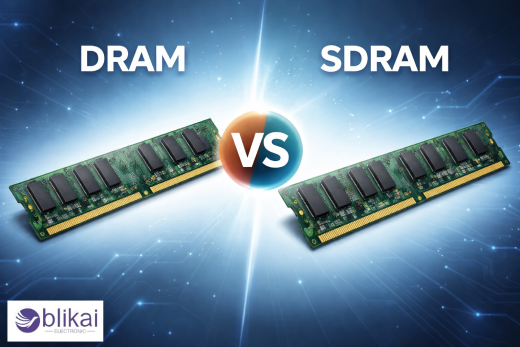
What Is DRAM (Dynamic Random Access Memory)?
Dynamic Random Access Memory, also referred to as DRAM, is a semiconductor-based memory technology that temporarily stores digital information in the form of electrically charged capacitors that have to be periodically refreshed to hold information. The DRAM is not durable enough to store data that can be reused later, unlike non-volatile storage devices (SSDs or flash memory), since when power is removed, all data stored is lost, and therefore it can only be used to execute active programs as opposed to storing data. DRAM became popular since it offers high storage density at a comparatively low cost of production, enabling large memory sizes to be embedded into computing systems.
Basic Definition of DRAM
DRAM is referred to as dynamic, as the memory cells constantly lose electrical charge, and thus must have a refresh op being done to them several thousand times every second. Each cell consists of one transistor and one capacitor, enabling compact memory arrays but requiring constant maintenance by the memory controller to preserve stored bits.
How DRAM Works
DRAM architecture. Data is represented in charged or discharged capacitors arranged in rows and columns, and the memory controller serves a particular address by enabling row and column signals independently. Due to the asynchronous operation of traditional DRAM, the operation of the DRAM is directly responsive to control signals without the coordination of action based on a centralized clock; this is a source of variable delays under conditions of system timing changes.
Key Characteristics of DRAM
Traditional DRAM provides large capacity and cost efficiency but suffers from unpredictable timing behavior due to asynchronous operation, refresh overhead, and limited ability to pipeline operations. Access latency depends on signal propagation and control coordination, making performance less consistent compared to later memory technologies.
Common DRAM Applications
Earlier generations of desktop computers, graphics subsystems, and industrial electronics widely relied on asynchronous DRAM before clock-synchronized memory designs emerged, and simplified DRAM variants are still used internally in specialized hardware where ultra-high speed synchronization is unnecessary.
What Is SDRAM (Synchronous Dynamic Random Access Memory)?
Synchronous Dynamic Random Access Memory SDRAM is a better version of DRAM that has been developed to run in sync with a system clock signal, which means that the memory operations can be performed at a specific timing. SDRAM makes memory accesses much more predictable, which in turn reduces the uncertainty that surrounds asynchronous memory access and greatly enhances the data throughput.
SDRAM Definition
SDRAM is fundamentally still DRAM because it uses capacitor-based storage cells, but its defining characteristic is synchronous communication with the processor’s clock, enabling predictable execution of read and write commands.
How SDRAM Works
SDRAM breaks operations into clock-driven phases, which enables two or more memory commands to overlap in pipelining and burst transfer. Once an address is accessed, consecutive data blocks can be transferred automatically without reissuing individual commands, improving efficiency and reducing idle cycles between operations.
Main Features of SDRAM
The most important features of SDRAM are deterministic timing, increased bandwidth, reduced wait states, and increased compatibility with other modern processors, which require fine timing coordination to perform optimally.
Typical SDRAM Applications
A personal computer, servers, networking equipment, game systems, and embedded processors were the first to use SDRAM as the standard memory technology, which led to subsequent generations of DDR, DDR2, DDR3, DDR4, and DDR5 memory modules.
SDRAM vs DRAM — Key Differences Explained
Despite its direct development of DRAM, there are differences in the architectures and modes of operation as to why SDRAM has taken over the current computing systems.
Synchronization (Clocked vs Asynchronous)
The most important difference is synchronization: DRAM operates asynchronously using independent control signals, whereas SDRAM synchronizes all operations with a system clock, ensuring predictable execution timing.
Speed and Performance
Because SDRAM coordinates actions with clock cycles and supports burst transfers, it achieves significantly higher effective bandwidth than asynchronous DRAM, which must complete each operation sequentially.
Architecture Differences
SDRAM incorporates internal banks and pipelines that allow simultaneous preparation of future operations while current data transfers occur, whereas traditional DRAM handles commands one at a time.
Power Consumption
Although SDRAM may operate at higher frequencies, improved efficiency per transferred bit often results in better overall energy utilization in modern systems.
Reliability and Stability
The clock synchronization also enhances stability by minimizing the uncertainty in timing, which leads to greater compatibility in the high-speed processors and multitasking operating systems.
Comparison Table — SDRAM vs DRAM
|
Feature |
DRAM |
SDRAM |
|
Operation Type |
Asynchronous |
Clock synchronized |
|
Speed |
Lower |
Higher |
|
Timing Predictability |
Variable |
Precise |
|
Data Transfer |
Single access |
Burst transfer |
|
Efficiency |
Moderate |
High |
|
Modern Usage |
Limited |
Standard memory |
|
CPU Compatibility |
Older systems |
Modern processors |
Why SDRAM Is Faster Than Traditional DRAM
The main reason why SDRAM performs better is that it is possible to synchronize the operations of the memory controller to schedule them effectively, instead of waiting until the response time is known to be great. Clock alignment ensures commands execute in defined cycles, burst mode transfers multiple data words per access, pipelining overlaps operations internally, and reduced idle states minimize wasted clock cycles, collectively delivering far greater throughput compared to asynchronous DRAM designs.
Advantages and Disadvantages
Traditional DRAM has the benefits of simplicity, reduced design complexity, and historic significance, but has reduced performance, poor timing coordination, and is less scalable. SDRAM has the disadvantage of higher architectural complexity and stricter timing guarantees.
Real-World Performance Comparison
SDRAM is used in gaming systems to allow quicker loading of assets, smoother multitasking, in servers to allow large-scale databases and virtualization loads to be synchronized, in embedded applications to allow deterministic timing, and in operating systems to allow more responsiveness when memory bandwidth is comparable to CPU processing speed.
When Should You Use DRAM vs SDRAM?
DRAM can still be used on legacy systems or highly specialized low-speed applications; however, SDRAM is the choice when almost all modern design is done since it is compatible with clock-based processors, has a higher bandwidth and is more efficient for the system and is therefore required in the modern computing architecture.
SDRAM vs DRAM in Modern Computers
Asynchronous DRAM is no longer used as a main system memory in modern computers due to high-clock frequency and extremely high clock speeds of processors, which need synchronized communication to operate. SDRAM-based technologies, especially DDR variants, integrate tightly with memory controllers built into modern CPUs, enabling optimized data flow and reduced latency across computing platforms.
Common Misconceptions About SDRAM and DRAM
There seems to be a frequent misconception that SDRAM and DRAM are entirely distinct systems, whereas the fact of the matter is that SDRAM is merely a modification of DRAM that adds the concept of clock synchronization. Another misconception is equating higher clock speed directly with lower latency, whereas actual performance depends on multiple timing parameters working together.
Future of DRAM Technologies
The future of memory technology is still based on the principles of SDRAM, with such innovations as DDR5, high-bandwidth memory architectures, and AI-optimized memory subsystems being developed to manage wide data workloads and to enhance energy consumption and reduce latency bottlenecks in future computing systems.
FAQ
Is SDRAM the same as DRAM?
SDRAM is a form of DRAM that runs in sync with a clock signal and is therefore an advanced development and not a separate form of memory.
Which memory type is faster?
SDRAM is significantly faster because synchronized timing enables burst transfers and pipelined operations.
Why did SDRAM replace traditional DRAM?
Asynchronous DRAM is not able to deliver predictable timing and higher bandwidth, which are the requirements of modern CPUs.
Is DDR memory a type of SDRAM?
Yes, each and every DDR memory generation is a high-tech version of SDRAM technology.
Conclusion
In comparison to SDRAM and DRAM, the latter has obviously better performance, efficiency, and compatibility with modern processors, as it has better clock synchronization and sophisticated mechanisms of data transfer. Despite the similarity of the operating principle of the two technologies, the predictability of timing and the superior bandwidth of SDRAM make it the preferred technology in almost all modern applications, both personal computers and servers, as well as embedded electronics. This knowledge of such differences enables engineers and users of technology to admire how memory evolution has made it possible to have the high-performance digital systems that we have today.
Some images are sourced online. Please contact us for removal if any copyright concerns arise.





