


What Are Photoresistors? How LDR Light Sensors Work
 150
150What Is a Photoresistor (LDR)?
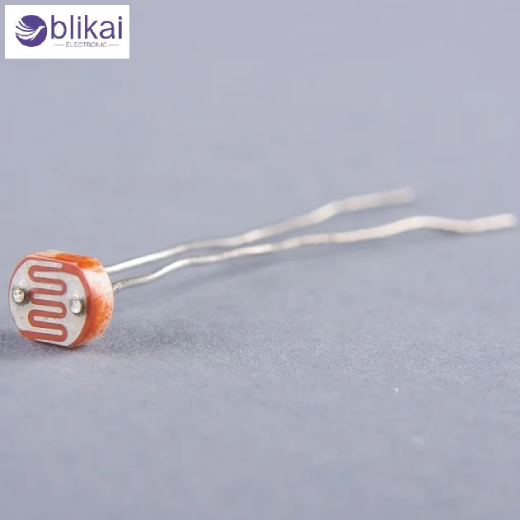
A Photoresistor or Light Dependent Resistance (LDR) is a passive electronic component whose resistance varies with the intensity of light striking it on the surface. The brighter the surrounding environment, the lesser the opposing force on the device, and the bigger the quantity of current that can pass through the circuit. On the other hand, when it is dark, the resistance is very high, thus limiting the flow of current. Due to such light-controlled behavior, photoresistors are popular for use as light sensors in automatic lighting systems, brightness detectors, and other electronic controls.
Common Materials Used in LDR Sensors
Photoresistors are mostly produced with photoconductive semiconductors. The most common material is cadmium sulfide (CdS), which makes it sensitive to visible light with the highest sensitivity comparable to the human eye. The other material that is occasionally used is cadmium selenide (CdSe), which has slightly different spectral properties and increased sensitivity under some lighting conditions.
How Photoresistors Work
Principle of Photoconductivity
The operation of a photoresistor is based on a phenomenon called photoconductivity. When photons from light strike the semiconductor surface of the LDR, they transfer energy to electrons within the material. This energy can cause the electrons of the valence band to be transferred to the conduction band to form more charge carriers that enhances the electrical conductivity.
How Light Changes Electrical Resistance
The more charge carriers we have as a result of illumination, the lower the electrical resistance of the material. Very few free electrons are present in the dark, meaning that there is a strong resistance. Some of the electrons become very active, and when subjected to light, the resistance is considerably lower and thus current can find an easy passage through the component.
Relationship Between Light Intensity and Resistance
Photoresistor resistance is directly proportional to incident light intensity. As an example, the resistance of an LDR can be several megaohms in the time of darkness, ten ohms under moderate conditions, and a few hundred ohms under high conditions. This connection has allowed circuits to detect or react to the changing light intensity.
Response Time and Sensitivity
Even though a photoresistor is sensitive to visible light, it is not the quickest light sensor. They have a response time of an average of several milliseconds to hundreds of milliseconds. Such a slower rate of response is acceptable where the control of lighting is required, but unacceptable in high-speed optical communications.
Photoresistor Symbol and Circuit Representation
Standard Circuit Symbol for an LDR
An electronic schematic would use a resistor symbol with two arrows pointing to it to indicate an incoming light in the form of a photoresistor. This is a graphical representation that differentiates it from normal fixed resistors and variable resistors.
How a Photoresistor Is Used in a Voltage Divider
One of the most common ways to use an LDR is in a voltage divider circuit. The photoresistor in this setup is in series with a constant resistor. It is a change in the resistance of the LDR, as the intensity of the light varies, which will change the output voltage of the divider. Analog or digital circuits have the ability to measure or process this voltage.
Basic LDR Light Sensor Circuit Example
A simple light sensor circuit may consist of a photoresistor, a fixed resistor, and a microcontroller or comparator. The output voltage is modulated at a specific threshold set point when the light level in the surrounding drops, and can switch a device, such as a lamp, alarm or indicator.
Photoresistor Specifications and Key Parameters
Dark Resistance
The value of resistance of the photoresistor when the material is in total darkness is known as dark resistance. This value is typically extremely large, usually between hundreds of kilohms and several megaohms.
Light Resistance
Light resistance is the resistance when the device is illuminated to a given amount of light, usually in lux. In sunny conditions, the resistance may reduce significantly to a handful of hundreds of ohms.
Spectral Response Range
Photoresistors can be made to react to light of particular wavelengths. Photoresistors made with CdS usually have a spectral response that is similar to human vision, with a peak in the green part of the visible spectrum.
Response Time
Response time is the measure of the speed with which the device responds to the upsurge or downsurge in the intensity of light. This parameter aids in the design of circuits where there is a need to detect light very fast.
Maximum Voltage and Power Rating
Photoresistors, like any other resistive components, possess maximum voltage and power values to which they should not be subjected so as to avoid the damage or deterioration of the device.
Types of Photoresistors
Cadmium Sulfide (CdS) Photoresistors
CdS photoresistor is the most common one because it provides good sensitivity in the range of the visible spectrum, and it is not too costly to manufacture.
Cadmium Selenide (CdSe) Photoresistors
CdSe photoresistors have better sensitivity to some conditions of light and can be implemented in an application where a stronger light signal is needed.
High-Sensitivity LDR Sensors
Some specialized photoresistors are designed for extremely low light detection and can respond to very small changes in illumination.
Common Applications of Photoresistors
Automatic Street Lighting Systems
Photoresistor-based streetlights and outdoor lighting systems automatically increase the activities of outdoor lights at dusk and decrease their activities at dawn.
Light and Dark Detection Circuits
Photoresistors are found in circuits that sense when an environment is either bright or dark, and activate an alarm, indicators or a switching device.
Camera Light Meters
Photoresistors can be used with traditional cameras that determine the amount of ambient light and determine the correct amount of exposure.
Security and Alarm Systems
Light sensors can be used to detect when the lighting conditions have suddenly altered, which may be due to tampering or intrusion.
Consumer Electronics and IoT Devices
Many smart devices use LDR sensors to adjust display brightness, control lighting, or collect environmental data.
Photoresistor vs Photodiode vs Phototransistor
Sensitivity Comparison
Photoresistors generally have high sensitivity to visible light but are slower than photodiodes and phototransistors.
Response Speed Differences
Photodiodes and phototransistors are faster to respond to changes in the light intensity, hence can be used in optical communications and fast detection.
Typical Application Scenarios
Photoresistors are commonly used in simple light detection circuits, while photodiodes and phototransistors are preferred in high-speed or precision optical systems.
Advantages and Disadvantages of Photoresistors
Advantages of LDR Sensors
Photoresistors are cheap, user-friendly and do not need a lot of supporting circuitry. They are compatible with single-zone analog light detection.
Disadvantages and Design Considerations
The primary limitations are slowness of response, rather low accuracy relative to semiconductor sensors, and possible environmental constraints because of the presence of cadmium in some of the equipment.
How to Use a Photoresistor in Electronic Circuits
Simple Arduino Light Sensor Circuit
An LDR can be connected to an analog input pin on a microcontroller using a voltage divider configuration. The microcontroller then interprets the amount of voltage and identifies the amount of light around.
Using LDR with a Comparator
A comparator circuit can compare the voltage from a photoresistor divider with a reference voltage to trigger an output when light reaches a specific threshold.
Using LDR in Analog Measurement Circuits
Photoresistor has applications in analog circuits to measure the relative light intensity and convert optical signals into electrical signals to be used in additional processing.
FAQ
Why does resistance decrease when light increases?
Photons entering the material of the semiconductor stimulate electrons and make the material conduct better, and have smaller resistance.
What are the limitations of LDR sensors?
They are less accurate and slower in response than semiconductor light sensors.
Can photoresistors measure precise light intensity?
They can detect relative light levels but are generally not suitable for highly precise optical measurements.
Some images are sourced online. Please contact us for removal if any copyright concerns arise.





