


What Is a Magnetoresistive Sensor? Working & Applications
 233
233Introduction to Magnetoresistive Sensors
A magnetoresistive sensor is a solid-state electronic device that works to sense the magnetic field by converting the strength or direction of the magnetic field into a measurable change in electrical resistance, thus it is a vital sensing element in the current electronics of high precision non-contact measurements that must be measured.
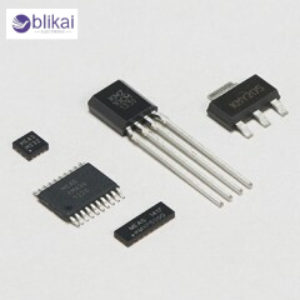
What Is a Magnetoresistive Sensor?
A magnetoresistive sensor is a sensor of the magnetic field based on the magnetoresistive effect, a physical phenomenon, where the electrical resistance of some materials varies with an external magnetic field. Unlike mechanical or inductive sensors, magnetoresistive sensors contain no moving parts and rely entirely on changes in electron transport behavior within thin-film materials, enabling precise magnetic field measurement even at very low field strengths. Such sensors are often combined with signal conditioning circuits to give either analog or digital outputs that can be directly connected to microcontrollers, control units and data acquisition systems.
Working Principle of Magnetoresistive Sensors
The principle of working of a magnetoresistive sensor lies in the interaction of an external magnetic field and the internal magnetic domains or electron spin orientation within the material that cannot be a sensor, which changes the electrical resistance of the material. A variation in resistance is transformed into a voltage or a digital signal, as the magnetic field varies, by an internal circuit, and this allows precise real-time measurement of the magnetic field. This is a very repeatable, linear process and can be applied over a fixed operating range to both static and dynamic magnetic field detection of a magnetic field.
Magnetoresistive Effect Explained
The magnetoresistive effect is the influence on the scattering of charge carriers of a conductive or semi-conductive material produced by the application of an external magnetic field to change its resistance. Anisotropic magnetoresistance (AMR) is a resistance change that is dependent on the angle between the direction of current flow and the direction of the magnetization, whereas giant magnetoresistance (GMR) and tunneling magnetoresistance (TMR) are resistances that depend on spin-dependent electron transport through multilayer structures.
Signal Conversion and Output Characteristics
In practical sensor designs, magnetoresistive elements are arranged in a Wheatstone bridge configuration to maximize sensitivity and temperature stability, converting small resistance changes into differential voltage outputs. Integrated amplifiers, filters, and analog-to-digital converters further process the signal to deliver clean, stable outputs compatible with modern electronic systems. Depending on the sensor type, outputs may be ratiometric analog voltages, PWM signals, or digital data via interfaces such as I²C or SPI, simplifying system integration and improving noise immunity.
Types of Magnetoresistive Sensors
AMR (Anisotropic Magnetoresistive) Sensors
The AMR sensors are based on the anisotropic magnetoresistive effect, in which resistance varies with the angle of magnetic field and current flow in a piece of ferromagnetic material. They have been appreciated in terms of their strength, comparatively straightforward design, and affordability, which is suitable for compass modules, simple position sensing, and industrial magnetic field sensing. Even though AMR devices have lower sensitivity compared to GMR and TMR sensors, they have high linearity and long-term stability in most applications.
GMR (Giant Magnetoresistive) Sensors
GMR sensors are based on multilayer thin-film structures, i.e., alternating ferromagnetic and non-magnetic layers, in which the resistance varies dramatically with the relative alignment of the magnetization of the layers. The giant magnetoresistive effect makes GMR sensors sensitive to very weak magnetic fields with great precision and much higher sensitivity than AMR technology. GMR sensors are widely used in automotive wheel speed sensing, current measurement, and precision position detection in industrial automation systems.
TMR (Tunneling Magnetoresistive) Sensors
TMR sensors are the most recent type of magnetoresistive devices, where magnetic tunnel junctions are used, in which electrons tunnel between ferromagnetic layers through an insulating barrier. The tunneling probability, and thus resistance, varies sharply with magnetic field orientation, resulting in extremely high sensitivity and low noise performance. TMR sensors are also finding use in high-precision sensors like electric vehicle current sensors, robotics and next-generation IoT devices where accuracy and power efficiency are important.
Key Performance Characteristics
Sensitivity and Resolution
Sensitivity is a measure of the change per unit of magnetic field in the sensor output, and resolution is the smallest change in a magnetic field that can be detected. Magnetoresistive sensors, and especially GMR and TMR, have extremely high sensitivity and resolution, allowing the detection of small magnetic variations that could not be easily detected with Hall effect sensors.
Linearity, Hysteresis, and Noise
The extent to which the sensor output is related by a straight line to the magnetic field is defined by the value of linearity, whereas the variation observed in the sensor output when it experiences an increasing or decreasing field strength is defined by hysteresis. The architectural design of high-quality magnetoresistive sensors is developed with a minimum hysteresis and noise to maintain constant and reproducible measurements even in dynamic conditions.
Power Consumption and Operating Voltage
The magnetoresistive sensors can be conveniently applied in the low-power electronic systems because of their efficient working principle and because they can operate with low voltages supply rails. Most of the current devices are also available on voltage as low as 1.8 V and are able to use only a small amount of current, which makes these devices excellent battery-powered and energy-sensitive devices, like wireless sensors and portables.
Magnetoresistive Sensor vs Hall Effect Sensor
Magnetoresistive sensors and Hall effect sensors are commonly contrasted due to the fact that both are commonly utilised in magnetic field detection, but are very different in terms of both performance and application validation.
Working Principle Comparison
In contrast to magnetoresistive sensors, Hall effect sensors produce a voltage that is proportional to the strength of the magnetic field, as a result of deflection of charge carriers in a semiconductor, and magnetoresistive sensors operate on the basis of resistance variation due to the combination of magnetic fields and material characteristics. This basic distinction enables the magnetoresistive sensors to have increased sensitivity and accuracy, especially in low magnetic field levels.
Applications of Magnetoresistive Sensors
Position and Angle Sensing
In position and angle sensing applications, magnetoresistive sensors enable non-contact measurement of rotational or linear movement using simple permanent magnets. This approach eliminates mechanical wear, improves durability, and provides accurate feedback for motors, actuators, and control systems used in robotics, industrial machinery, and automotive subsystems.
Current Sensing in Power Electronics
The magnetoresistive sensors are widely used in present-day sensing of current to sense the magnetic field that is generated around a current-carrying conductor. The approach has been used to offer galvanic isolation, high bandwidth and precise measurement of both DC and AC currents, and is suitable for power supplies, motor drives, inverters and electric vehicle powertrains.
Automotive and Industrial Applications
In automotive and industrial environments, magnetoresistive sensors support functions such as wheel speed detection, gear position sensing, torque measurement, and safety monitoring. They are very suitable in demanding applications because of their capability to work under extreme temperature conditions, electromagnetic interference, among others.
Consumer Electronics and IoT Devices
Magnetoresistive sensors are also applied in consumer electronics and IoT devices, such as electronic compasses, motion tracking, and smart sensing applications, which need low-power consumption and small-scale enclosures. Their adoption in sensor hubs and system-on-chip platforms continues to increase their functions in connected and intelligent devices.
Advantages of Magnetoresistive Sensors
The important benefits of magnetoresistive sensors are high sensitivity, excellent resolution, contactless mode, rapid response time, and high environmental contamination, such that they offer long service life and stable operation in challenging electronic systems.
Disadvantages of Magnetoresistive Sensors
Characteristic drawbacks of magnetoresistive sensors are that they are sensitive to external magnetic signals, that their behavior varies with temperature and that they are expensive relative to less complex magnetic sensing solutions, which may in turn have to be shielded, calibrated or compensated to reduce inaccurate systems.
FAQ
What is the difference between AMR, GMR, and TMR sensors?
AMR sensors are robust and cost-effective magnetic sensing, GMR sensors are more sensitive with multilayer thin-film formats, and TMR sensors are the most sensitive and have the lowest noise with magnetic tunnel junction technology.
Are magnetoresistive sensors better than Hall sensors?
Magnetoresistive sensors tend to be more sensitive and accurate compared to Hall sensors, especially in low-level magnetic fields, but Hall sensors are also an economical choice in simple magnetic sensing.
Some images are sourced online. Please contact us for removal if any copyright concerns arise.





