


Battery Shunt Explained: Working Principle & Key Specs
 341
341What Is a Battery Shunt?
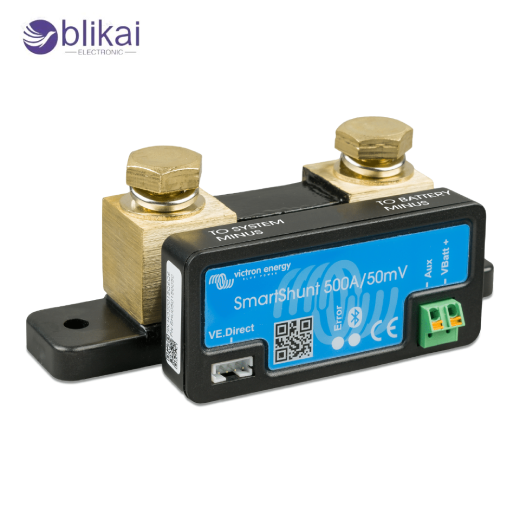
A battery shunt is an accuracy low-resistance device that can be used to measure the current into or out of a battery by sensing a very slight voltage drop across its terminals. To avoid interruptions to the circuit or complicated magnetic sensing, a battery shunt may be used, in which a series resistor is introduced between the battery circuit, with a known resistor value, and the current measured, preferably using Ohm's law.
How Does a Battery Shunt Work?
The principle of a battery shunt working is Ohm's law, in which the voltage is equal to current multiplied by resistance (V = I x R). The resistance of a shunt is very small and has a well-defined value, which is usually in the micro-ohm or milli-ohm range. When current is passed through the shunt, it has a small voltage drop that is proportional to the current. A battery monitor, data acquisition system, or ADC measures this voltage drop and calculates the actual current passing through the circuit without a major impact on system operation.
Types of Battery Shunts
DC Battery Shunts
DC battery shunts are the most common type and are specifically designed for measuring direct current in battery systems. They are widely used in solar energy storage, telecom power systems, EV battery packs, and off-grid installations. DC shunts (tolerate continuous current) are specially designed to determine continuous current and can typically be used in bidirectional current flow, and both charging and discharging currents can be determined accurately.
AC Battery Shunts
AC battery Shunts are not so common but are usually employed in special work where an alternating current measurement is necessary. While shunts can measure AC, they are generally less suitable than current transformers or Hall effect sensors for higher-frequency AC signals due to phase shift and heating considerations.
External Shunt vs Integrated Shunt
External shunts are independent pieces that are mounted between the battery and the load or charger and have flexibility and increased current-carrying capacity. Integrated shunts, on the other hand, are built directly into battery monitors or battery management systems (BMS), reducing wiring complexity and installation time.
Key Specifications of Battery Shunts
Rated Current
Rated current defines the maximum continuous current a battery shunt can handle without overheating or losing accuracy. Common ratings range from tens of amps for small battery systems to several thousand amps for industrial and EV applications. When using a shunt, it is necessary to choose one that has enough headroom to operate safely and be reliable over time and with maximum load.
Shunt Resistance Value
The values of battery shunt resistances are very low, usually ranging between 50 uO and some mO. In lower resistance, power loss and heat production are minimized, but the resulting voltage drop is smaller, and this could pose a challenge to the resolution of measurements. Higher resistance improves voltage signal resolution but increases power dissipation.
Accuracy and Tolerance
Accuracy describes the difference between the nominal value and the actual one, as well as how the actual resistance changes with time. Good quality battery shunts normally provide accuracy in the form of +-0.25%, +-0.1 or even +-0.05. Tight tolerance is particularly important in energy metering, state-of-charge calculations, and long-term battery health monitoring.
Temperature Coefficient
The temperature coefficient of resistance (TCR) is the ratio of the change in the resistance of the shunt with temperature. Low TCR means that the measurement will not vary significantly over a large operating range of temperature. This is essential in field applications of solar, EV battery packs and industrial settings where ambient temperatures may have a large variation.
Power Dissipation
Power dissipation is calculated using P = I² × R and represents the heat generated by the shunt during operation. High-current applications can generate substantial heat even with very low resistance values. Proper thermal design, adequate ventilation, and suitable mounting surfaces are necessary to prevent overheating and ensure measurement stability.
How to Select the Right Battery Shunt
Matching Shunt Rating to Battery System
The first step in the choice of the appropriate battery shunt is to be acquainted with the maximum continuous and peak currents of the system. The current rating of the shunt must be well above the maximum current that the system is designed to carry so as to prevent saturation, overheating, or permanent damage. The insulation requirements and voltage rating should also be in accordance with the operating voltage of the system.
Measurement Accuracy vs Power Loss
There is always a balance between measurement accuracy and power efficiency when choosing a shunt. Lower resistance minimizes power loss but reduces signal amplitude, while higher resistance improves measurement resolution at the cost of increased heat. System designers have two aspects to look at when making a choice: electrical efficiency and monitoring precision.
Environmental and Installation Factors
Environmental conditions such as temperature, humidity, vibration, and airflow play a major role in shunt performance. Effective location of installation, mechanical hard mounting and fast electrical interconnection are also used to ensure accuracy and minimize noise. Shunts in imposing conditions, such as shunts coated or enclosed.
Common Applications of Battery Shunts
In battery management systems, battery shunts are used to measure charge current and discharge current in batteries and compute the state of charge. They are used in solar power storage systems to monitor the energy flow, electric vehicles to monitor the battery performance, UPS systems to control the backup power and industrial DC power systems where the accuracy of current measurement is imperative to safety and efficiency.
Battery Shunt vs Hall Effect Current Sensor
Two radically different methods of current measurement include Battery shunts and Hall effect current sensors. Shunts are the most accurate, quickest, and least expensive, yet they create a little power loss and are not electrically isolated. Hall effect sensors provide galvanic isolation and lower power loss, but are generally more expensive and may be less accurate at low currents.
Installation and Wiring Considerations
Proper Placement in Battery Circuits
Battery shunts are typically installed on the low side (negative terminal) of the battery for ease of measurement and safety, although high-side installation is possible with appropriate isolation. Proper positioning guarantees proper measurement of all current in and out of the battery.
Wiring and Connection Best Practices
Kelvin connections, using separate sense wires for voltage measurement, are essential for minimizing errors caused by contact resistance and wiring losses. Short, thick conductors for current paths and properly routed sense leads help reduce noise and improve measurement accuracy in high-current environments.
Advantages of Battery Shunts
High Measurement Accuracy
Battery shunts offer very high accuracy in the measurement of current since the shunts cannot operate due to the magnetic field estimate, but instead due to a well-determined value of resistance. That is why they are well-suited to the use of battery management systems, energy metering, and state-of-charge calculations, where small measuring errors can result in significant errors over time.
Fast Response Time
Because a battery shunt is directly proportional to the voltage drop, which is due to current flow, it reacts immediately to any alteration in current. It is also highly useful in systems with dynamic loads (that is, electric vehicles, motor drives, and high-power DC supplies) due to this rapid response.
Disadvantages of Battery Shunts
Power Loss and Heat Generation
Since the battery shunt will add resistance to the current flow, it will always lose power and generate heat that is directly proportional to the square of the current. In high-current systems, this heat must be carefully managed through proper shunt sizing, mounting, and thermal design to avoid accuracy drift or component damage.
No Electrical Isolation
Battery shunts do not provide galvanic isolation between the measured circuit and the monitoring electronics. This may be a safety issue where high voltages are involved, or in sensitive measurement applications where it may be necessary to add more isolation circuits or other sensing technology.
FAQ
Can Battery Shunts Measure Bidirectional Current?
Yes, bidirectional current can be measured with battery shunts, and this makes it possible to correctly measure both charging and discharging current in battery systems, and also in energy storage applications.
Are Battery Shunts Accurate?
Battery shunts are extremely precise as they are based on the definition of a particular resistance value. Shunts of high quality usually have an accuracy level of +-0.1% or higher.
Do Battery Shunts Cause Power Loss?
Yes, battery shunts cause a small power loss due to their low resistance. The loss, however, is small in most applications and is acceptable in the measurement of the current precision.
Battery Shunt vs Hall Effect Sensor: Which Is Better?
Battery shunts make more accurate decisions and cost less, whereas the Hall effect sensors are electrically isolated and reduce power loss. Selection will depend upon the system voltage, safety requirements and budget.
Conclusion
Battery shunts are, by all means, one of the most precise and consistent methods of current measurements in battery systems. Given their mode of operation, major specifications, and installation factors, engineers and system designers will be able to choose the best shunt to use in their application. Battery shunts are important in the efficient, safe, and accurate monitoring of batteries, whether in energy storage, electric vehicles, industrial power systems, and so on.
Some images are sourced online. Please contact us for removal if any copyright concerns arise.





