


Switched Power Distribution Unit: Smart PDU Guide
 258
258What Is a Switched Power Distribution Unit?
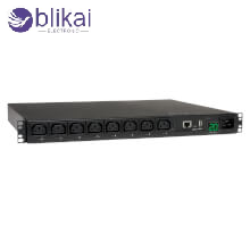
A switched power distribution unit (PDU) is a smart power distribution appliance that delivers electrical power to many devices connected to it and allows individual outlets to be remotely controlled, which is a key component in both modern data centers and telecommunication systems, as well as industry automation systems where high uptime and efficiency are required. A switched PDU, in contrast to the traditional PDUs, which merely passively supply power, also incorporates built-in control electronics, network interfaces, and monitoring capabilities, enabling an administrator to remotely switch outlets on or off, reboot equipment, and control real-time power consumption, thereby enhancing operational flexibility and eliminating the physical intervention previously necessary in server racks or remote installations.
How Does a Switched PDU Work?
A switched PDU is achieved by integrating conventional electrical distribution equipment with a smart control circuitry to enable power passing and digital control in a single device, and it usually contains a microcontroller, current sensing circuits, relay or solid-state switching devices, and a network interface that connects to Ethernet or serial interfaces. A request sent by a user, via a web interface, SNMP manager, or cloud-based DCIM system, is processed by the internal controller, and triggers the appropriate switching mechanism, which may energize or de-energize individual outlets without affecting the overall system, and constantly monitors data, including voltage, current, power factor, and energy consumption, to offer actionable information to optimize the system and detect faults.
Key Features of Switched PDUs
The switched PDUs come armed with a large selection of sophisticated capabilities that not only improve operational efficiency but also system reliability, such as outlet-level control that allows remote rebooting of unresponsive equipment, real-time power monitoring that can help prevent overload conditions and also load balancing features that allow even distribution of electrical demand over circuits. Other functionality, like programmable power sequencing, enables devices to be powered up or down in a defined sequence to prevent inrush current problems, and alert systems are able to indicate to administrators abnormal conditions, including overcurrent, overheating or fluctuating voltages, and integration with data center infrastructure management (DCIM) software enables centralized visibility and control over many racks and sites.
Types of Switched Power Distribution Units
Switched PDUs are available in a variety of configurations to suit various power and installation needs.
Single-Phase vs Three-Phase PDUs
Single-phase PDUs are applicable to smaller systems, whereas in high-power applications, like data centers, three-phase PDUs are applied to enhance efficiency and minimize the wiring complexity.
Rack-Mount vs Vertical PDUs
Rack-mounted PDUs are mounted in a horizontal position, and vertical (0U) PDUs are mounted in a vertical position, making better use of rack space and are typically utilized in highly dense deployments.
Switched PDU vs Other PDU Types
Being aware of the differences between switched PDUs and the other types assists in choosing the appropriate solution for particular applications.
Basic vs Switched PDU
Basic PDUs are simple and do not have control and monitoring, whereas switched PDUs have intelligent power management and remote switching.
Metered vs Switched PDU
Metered PDUs only display power usage, while switched PDUs combine monitoring with control functionality.
Advantages of Using a Switched Power Distribution Unit
Staggered PDUs have provided organizations with a myriad of benefits, such as better remote control of power, where IT personnel can control power even when they are not physically in the facility, less downtime due to the ability to quickly reboot failed devices and better energy efficiency achieved by identifying unused equipment and better load balancing. Moreover, switched PDUs help enhance equipment protection by avoiding overload conditions and allowing proactive maintenance based on real-time monitoring and warning systems, which in the end results in reduced operational costs and reliability of a critical infrastructure.
Real Component Example: RT9742 Power Distribution Switch ICs
In practical PDU designs, semiconductor components such as the RT9742 series are widely used to implement reliable and efficient power switching functions, offering compact size, low resistance, and integrated protection features that support modern intelligent power distribution architectures.
RT9742EGJ5 Overview
The RT9742EGJ5 is a high-side power distribution switch designed for applications requiring efficient load control, featuring a low on-resistance of approximately 70mΩ, a 2.7V to 6V input range, and integrated current limiting and thermal shutdown, making it suitable for USB power control, embedded systems, and compact smart PDU designs.
RT9742GGJ5 Overview
An equivalent high-side load switch IC, the RT9742GGJ5, which can have a slightly different package type or optimization behavior, is appropriate in a slightly different layout or thermal considerations in the power distribution design.
RT9742EGJ5 vs RT9742GGJ5 Comparison Table
|
Parameter |
||
|
Device Type |
High-side load switch |
High-side load switch |
|
Input Voltage Range |
2.7V – 6V |
2.7V – 6V |
|
Maximum Output Current |
1.5A |
1.5A |
|
On-Resistance (Rds(on)) |
~70mΩ |
~70mΩ |
|
Package Type |
SOT-23-5 |
TSOT-23-5 |
|
Protection Features |
Current limit, thermal shutdown |
Current limit, thermal shutdown |
|
Application Focus |
Compact embedded systems |
Industrial / IT systems |
Common Applications of Switched PDUs
Switched PDUs have found extensive application in various industries with high stability and smartness of power distribution, such as data centers, telecommunication infrastructure, industrial automation, and edge computing systems, where remote operation and continuous operation are paramount.
Data Centers and Server Rooms
They allow the remote operation and monitoring of servers and enhance the efficiency of operation and maintenance costs.
Industrial Automation Systems
Switched PDUs are used to deliver power to machines and sensors in a controlled manner, making their operation safe and efficient.
How to Choose the Right Switched PDU
When choosing the appropriate switched PDU, it is important to pay close attention to a variety of technical specifications, such as the overall power capacity required to provide the devices connected, the number and type of outlets necessary to be connected, and the existence of network management capabilities, such as SNMP, web interfaces, or cloud connectivity. The environmental conditions such as operating temperature, humidity and available space to install the PDU should also be taken into consideration along with scalability requirements to make sure that the chosen PDU is capable of sustaining future growth and compliance with safety standards and certifications to deliver safe and reliable operations under harsh conditions.
Installation and Setup Guide
Installation and setup of a switched PDU requires proper installation and configuration to obtain the best possible performance and safety, and generally, this is done by mounting the unit in a rack, connecting it either to an appropriate power supply and ensuring all electrical connections meet the appropriate safety standards. Once the network interface is installed, proper IP settings should be configured so that remote access can be made to the network interface. After this, initial testing should be conducted so that all outlets are controlled as intended and that data monitoring is reported properly, so that the system is complete before rolling it out into a production environment.
Common Issues and Troubleshooting
Even with better features, switched PDUs can experience the following problems: network connectivity problems that hinder remote access, overload situations that activate circuit protection systems, and hardware failures or software bugs that cause switching failures. The troubleshooting of such problems includes checking network settings, load balancing, physical connection inspection, upgrading firmware when required, and built-in diagnostic applications and event logs can offer valuable information on the underlying causes of the problems, so that they can be resolved faster and system downtime minimized as much as possible.
Future Trends in Smart PDUs
The future of switched PDUs is tightly connected to the development of digital infrastructure and energy management systems, and trends that include AI-based power optimization that allows predictive load balancing and anomaly detection, smart grid integration that can allow dynamic power allocation based on demand and availability, and improved cybersecurity that can help prevent unauthorized access to power infrastructures. Switched PDUs will become a more and more vital component of the smart, automated, and resilient power management solution as data centers develop to become more efficient and sustainable.
FAQ
What is the main advantage of a switched PDU?
Remote outlet-level control is the key benefit, as it allows managing power efficiently and minimizing downtime.
Can switched PDUs improve energy efficiency?
Yes, real-time monitoring and control will assist in maximizing the use of energy.
Are switched PDUs suitable for small systems?
They may be applied in smaller systems, although their full advantages are achieved in bigger and more complicated systems.
Conclusion
A switched power distribution unit is an important development in the power management technology, integrating traditional power distribution with enhanced monitoring and control efforts to address the needs of traditional IT and industrial systems, and by incorporating intelligent components such as RT9742 series load switch ICs, they can provide a high level of reliability, efficiency and flexibility, and therefore cannot be ignored in applications where data centers are needed or where edge computing is required, where precise power control and continuous operation are essential for success.
Some images are sourced online. Please contact us for removal if any copyright concerns arise.





