


What Are Power Amplifiers? Types, Working & Examples
 293
293Introduction to Power Amplifiers
Power amplifiers are important electronic devices that are required to amplify the magnitude of electrical signals to the extent that they may be utilized to drive real world loads, speakers, antennas, and motors, and are an essential element in the modern electronics, such as audio systems, wireless communication, broadcasting, and industrial control systems where the degree of signal power and output capacity is directly proportional to performance and reliability.
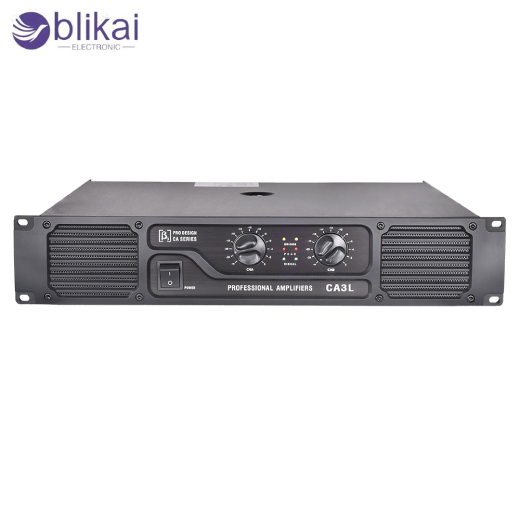
What Is a Power Amplifier?
A power amplifier (also known as a power amplifier circuit) is an electronic circuit or device that magnifies an input signal, that is, it increases the power of the input signal, but does not alter its waveform characteristics (i.e., does not distort it), a process known as gain amplification.
How Does a Power Amplifier Work?
A power amplifier is a kind of power amplifier that controls the flow of electrical energy from a power supply to the load, and the input signal controls the conduction of these devices in a controlled amplification manner to amplify the response of the output signal to the input waveform, effectively transferring power through a controlled and amplified method.
Key Components of a Power Amplifier
A typical power amplifier circuit includes active components like transistors or integrated amplifier ICs, biasing networks that set the operating point, coupling and bypass capacitors for signal integrity, resistors for current control, a stable power supply for energy delivery, and heat sinks or thermal management systems to dissipate excess heat generated during operation.
Types of Power Amplifiers
There are various classes of power amplifiers depending on the orientation of conduction, efficiency, and design methodology, with each category having its own strengths and limitations that qualify it to be used in applications like amplifying high-fidelity sound, radio transmission, and energy-conservation portable electronics.
Class A Power Amplifier
Class A power amplifiers use their active devices throughout the 360 degrees of the input signal cycle, and thus exhibit a very high linearity and low distortion but a very low efficiency, typically about 25-30 percent, since the current is flowing at all times, even when the signal is not present, and therefore produces a lot of heat.
Class B Power Amplifier
Class B amplifiers only operate half-cycle or 180 degrees, in a push-pull arrangement to recreate the complete signal, and this offers a significant improvement in efficiency over Class A, but crossover distortion happens at the junction point between the two devices.
Class AB Power Amplifier
Class AB amplifiers, like Class A and Class B, differ only in being able to carry somewhat more than half the signal cycle, eliminating crossover distortion with less efficient circuitry than Class A, and are more widely used than Class A forms of amplifiers in audio.
Class C Power Amplifier
Class C amplifiers operate during a period of less than 180 degrees of the signal cycle, and thereby have high efficiency, but introduce large distortion, which is not noticeable in radio frequency applications where tuned circuits can filter and recover the desired signal waveform.
Class D Power Amplifier
Class D amplifiers operate as a switching circuit in which output devices are switched rapidly on and off, reducing power wasted to about 1 ohm, and the efficiencies are over 90 percent, thus being suited to modern-day audio, battery-powered devices and high power efficiency.
Power Amplifier Classes Comparison
Different power amplifier classes vary significantly in efficiency, linearity, complexity, and heat generation, with Class A offering the best signal fidelity but lowest efficiency, Class B and AB providing a balance between performance and efficiency, and Class D delivering superior efficiency at the cost of increased circuit complexity and switching noise considerations.
Applications of Power Amplifiers
Power amplifiers have many different applications: in home audio, professional audio, RF transmitters, television, medical imaging, and industrial automation systems, to which amplified signals are needed to drive high-power loads or transmit signals extending over long distances.
Advantages of Power Amplifiers
Power amplifiers have various benefits, such as providing high output power, which can enhance the strength of the signal, audio quality, the efficient transfer of energy to loads, and they are compatible with a wide variety of electronic systems, and this makes them unavoidable in consumer and industrial electronics.
Disadvantages of Power Amplifiers
However significant, there are limitations of power amplifiers, including heat dissipation, energy inefficiency in some classes, possible signal distortion, circuit complexity, which makes them more difficult to manage and power supply design, which needs suitable thermal management and a power supply that ensures proper functioning.
Real-World Examples of Power Amplifiers
Typical physical applications of power amplifier systems are the speaker power amplifiers in the home theater system, the RF power amplifiers in a wireless transmitter or communication system, the integrated amplifier chips in smartphones and portable speakers, and the industrial motor driver circuit to which high-power signals are needed.
Power Amplifier vs Voltage Amplifier
Power amplifiers do not resemble voltage amplifiers because power amplifiers are intended to provide large amounts of power to a load by amplifying voltage and current, whereas voltage amplifiers are intended to amplify signal voltage with low amounts of current and are typically employed in signal processing stages, but not in output stages.
How to Choose the Right Power Amplifier
The selection of the appropriate power amplifier depends on issues related to needed power output, efficiency, frequency range of operation, load impedance, thermal considerations, size considerations, and application issues in order to achieve the best system operation and reliability.
Common Power Amplifier Design Considerations
To design a power amplifier, care should be taken in the choice of the impedance matching of the amplifier to the load, heat dissipation with thermal design, stable biasing to avoid distortion, wide frequency response to signal accuracy, and power supply regulation to ensure the same performance under different conditions.
FAQ
Which class of power amplifier is most efficient?
Class D power amplifiers are the most efficient in the sense that they employ the switching technology, which minimizes energy loss and heat generation, and the efficiency may very well reach 90 percent or even higher.
Why do power amplifiers generate heat?
Power amplifiers generate heat due to power dissipation in active components like transistors, especially in low-efficiency designs where excess energy is lost as thermal energy during signal amplification.
What is the difference between Class A and Class D amplifiers?
Class A amplifiers are high linearity, low distortion, low efficiency and Class D amplifiers are high efficiency and achieve switching operation but necessitate filtering to minimize noise.
Conclusion
Power amplifiers: Modern electronic systems would not be possible without them, since it is possible to take relatively-weak signals and convert them into relatively-strong signals that can drive relatively-weak signals into relatively-strong loads, and by learning how they work, what types they come in, what their benefits are, and what their constraints are, engineers and designers can be able to select the most appropriate amplifier class with respect to the selection of both weak and strong signals to use.
Some images are sourced online. Please contact us for removal if any copyright concerns arise.





