


LM386 vs TDA2822: Audio Amplifier IC Comparison Guide
 564
564What Is LM386?
The LM386 is a low-voltage, low-power audio amplifier IC specifically developed to drive small speakers and headphones directly from a single low-voltage power supply. It has an internal design that combines a differential input stage, a voltage gain stage and a class-AB output stage, which means that it can offer clean amplification of audio with very limited external components. One of the defining features of the LM386 is its internally preset gain of 20, which can be externally increased up to 200 using a single capacitor, allowing designers to achieve flexible signal amplification without complex resistor networks.
What Is TDA2822?
TDA2822 is a relatively low-voltage, dual audio, power amplifier IC used in stereo audio and high-end output mono applications. It is also possible to have the TDA2822 set to work in stereo; two channels of amplifier functions are installed on a single package, giving the TDA2822 flexibility in its operation, i.e., stereo mode (dual-speaker) or bridge-tied load (BTL) mode (to get additional output power to a single speaker). Its internal amplifiers have a differential input stage and a class-AB output stage to provide them with the ability to provide efficient power delivery and to provide a comparatively low distortion as well. The voltages required to supply the device are in the range of 3 V to 15 V, therefore allowing the use of both battery-based and regulated supply architectures.
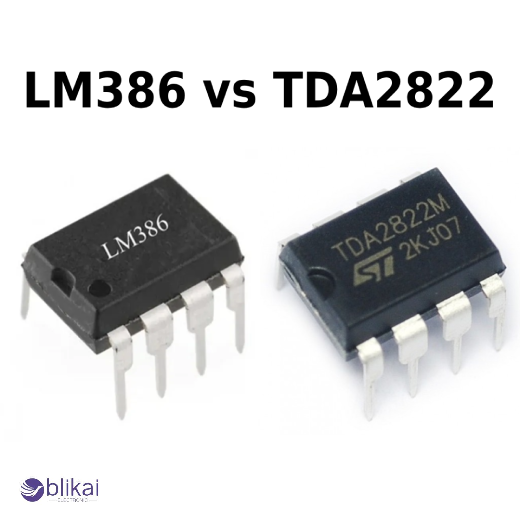
LM386 vs TDA2822: Core Technical Specifications Comparison
Electrical Specifications Comparison
LM386 and TDA2822 have a significant variation in the range of supply voltage, power output, quiescence current, gain control and efficiency, which are all technical. The LM386 is commonly powered by 4V to 12V, with others going all the way to 18V, with the output power range of 0.25W to 0.5W to an 8O load. Its mellow current has an average of 4mA, a factor that contributes to high battery life. The TDA2822, by contrast, works between 3V and 15V and can supply up to 1W per channel in bridge mode, but at a higher current consumption.
Power Output Capability Comparison
LM386 in common designs has enough output power to drive small speakers and headphones, and is therefore applicable in applications related to small-volume audio. TDA2822 has much more output capacity, particularly in bridge mode, which allows a lot more sound to be produced and the speakers to be driven better.
Operating Voltage Range Comparison
Both ICs can be operated with a single supply, which is easy to design in power systems. LM386 is the best in ultra-low voltage battery designs, whereas TDA2822 offers greater flexibility in the operating range to ensure battery-powered and regulated power supply systems with its wider operating range.
Pinout Comparison: LM386 vs TDA2822
LM386 Pin Configuration Explained
The LM386 has an 8-pin design, which has an input pin, an output pin, a power supply connection, a bypass pin, and a gain adjustment pin. Pins 1 and 8 are devoted to gaining control, where designers can get the voltage gain with only one external capacitor. Pin 7 has bypass capability to enhance power supply rejection and noise performance whilst the output is taken directly out of pin 5.
TDA2822 Pin Configuration Explained
The TDA2822 typically comes in an 8-pin or 16-pin package, depending on manufacturer variants, with pins dedicated to dual input channels, dual outputs, power supply, and ground. The layout can be used in both stereo and bridge mode layouts, making it more flexible for the designers.
Internal Architecture and Working Principle Comparison
LM386 Internal Circuit Structure
The LM386 integrates a differential input stage, a voltage amplification stage, and a class-AB output stage, optimized for low distortion and low power consumption. Its internally set gain simplifies external circuitry and ensures stable operation across a wide range of conditions.
TDA2822 Dual Amplifier Architecture
The TDA2822 has two channels of independent amplifiers, and each has a signal processing and output stage. These channels are used complementary in bridge mode, in which the channels provide double the output voltage swing and power delivery to the speaker is greatly improved.
Signal Path and Amplification Differences
LM386 is focused on simplicity, low noise, but TDA2822 is on higher output power and flexibility for multi-channel. These architectural variations have a direct effect on the level of sound output, efficiency, and the complexity of a circuit design.
Audio Performance Comparison
Sound Quality and Noise Performance
In low-power audio applications, LM386 delivers clean and stable sound with minimal background noise, especially when proper bypassing and decoupling techniques are employed. TDA2822 also offers good audio fidelity, though its higher output capability can introduce slightly higher noise levels if PCB layout and grounding are not carefully managed.
Total Harmonic Distortion (THD) Analysis
At moderate volume levels, both ICs exhibit low THD, typically below 0.2%. However, at higher output power, TDA2822 can have a small bit of increased distortion than LM386, especially in bridge mode, as the output stage is now stressed and also because of thermal effects.
Frequency Response Comparison
Both amplifiers offer a flat frequency response in the audible region of frequency between 20Hz and 20kHz, making them accurate sound reproducers. Minor differences may appear at low-frequency roll-off due to coupling capacitor selection and output configuration.
Output Power and Speaker Driving Capability
LM386 Output Power Characteristics
LM386 is optimized for small speakers and small headphones, providing up to 0.5W into 8O loads. This power level is only enough to use in personal listening devices, alarm clocks, and small-size audio modules, but not very suitable when used in high-volume applications.
TDA2822 Output Power in Stereo and Bridge Modes
The supplied and loaded TDA2822 has a maximum stereo output of 1W per channel, or a maximum bridge output of 2W. Better still, it is preferable to drive larger speakers and get a higher acoustic performance.
Speaker Compatibility and Load Considerations
LM386 can be connected with 8O speakers to achieve the best efficiency, and TDA2822 can be connected with 4O and 8O loads, which provides more options in terms of the choice of speakers and system design.
Power Consumption and Efficiency Comparison
Quiescent Current Analysis
LM386 has a very low quiescent current that results in long battery life in portable devices. TDA2822 has more idle current because of its two-channel design that has a minimal effect on battery performance.
Battery Life Impact
LM386 is also giving better resistance in battery-designed systems, whereas TDA2822 is giving better audio output at the cost of more power consumption, which requires more battery capacity or less operational time.
Thermal Performance and Heat Dissipation
LM386 produces little heat when it is in operation, making it easy to manage the heat. TDA2822, especially when used in bridge mode, can be designed thermosensitive to avoid overheating in the process of continuous and high-output operation.
Typical Application Circuit Comparison
LM386 Typical Application Circuit
A standard LM386 circuit requires only a few capacitors and optional gain-setting components, making it extremely easy to implement. This simplicity accelerates prototyping and reduces manufacturing complexity.
TDA2822 Typical Stereo Application Circuit
The TDA2822 stereo version should be coupled and decoupled with extra coupling and decoupling components, channel separation and grounding done appropriately, in order to enhance the best performance.
TDA2822 Bridge Mode Circuit
TDA2822 circuits are a little more complicated in bridge mode, but provide much more output power, and are therefore more suitable in compact speaker systems that need more power.
PCB Design and Layout Considerations
Noise Reduction Techniques
Proper decoupling, short signal paths, and star grounding techniques are essential for both ICs, though TDA2822 demands stricter layout discipline due to higher output currents.
Grounding and Decoupling Strategies
High-quality bypass capacitors placed close to the IC power pins improve noise immunity and transient response in both designs.
Layout Differences Between LM386 and TDA2822
LM386 allows simpler PCB routing, while TDA2822 requires more careful trace routing to avoid crosstalk and oscillation.
Advantages and Disadvantages Comparison
LM386 Pros and Cons
LM386 excels in simplicity, low power consumption, and ease of use, but offers limited output power and mono-only operation.
TDA2822 Pros and Cons
TDA2822 is more powerful and stereo capable, but more complicated and consumes more power.
FAQ
Can TDA2822 replace LM386?
Yes, in most instances, but there is always a need to redesign the circuit because of architectural variations.
Which is louder, LM386 or TDA2822?
TDA2822 has much greater sound output, especially in bridge mode.
Which IC is better for battery-powered audio?
LM386 is more efficient in batteries with low volume.
Which is better for stereo sound?
TDA2822 can be clearly used in stereo audio.
Final Verdict
The decision between LM386 and TDA2822 is finally determined by the demands of a project. LM386 is the best choice in case simplicity and low power usage, or the quick implementation are the main objectives. On the other hand, stereo sound, high sound, and high output power are necessitated, and TDA2822 will be the best option. Knowing their technical dissimilarity and trade-offs in practice, designers can now be sure of finding the most appropriate audio amplifier IC for their particular applications, which will be as efficient as possible, reliable, and economical.
Some images are sourced online. Please contact us for removal if any copyright concerns arise.





