


High Voltage Linear Regulator: Features & Applications Guide
 89
89Introduction to High Voltage Linear Regulators
High voltage linear regulators are fundamental power management devices that can be used to convert high and typically unregulated input voltages to stable, lower output voltages needed by sensitive electronic circuits, and as modern systems are increasingly required to operate over a wide voltage range in an industrial, automotive and communication context, high voltage linear regulators offer a simple, low-noise and highly reliable means of maintaining voltage stability without the complexity of switching topology.
What Is a High Voltage Linear Regulator?
A high voltage linear regulator is a voltage regulator that can take much higher input voltages, typically between 20V and hundreds of volts, and provide a regulated and constant output voltage, so that unlike standard linear regulators, which are restricted to low or moderate voltage levels, these devices are designed with high internal impedance to withstand high voltages, and can be used in high-stress areas like automation systems in industry, high-voltage DC power rails, and off-line power supplies.
Working Principle of High Voltage Linear Regulators
A high voltage linear regulator works on the principle of a closed-loop control system, where a pass element (usually a transistor) is varied to keep a constant output voltage independent of input variations and load variations, where an internal reference voltage is compared to the output in a feedback network, and a difference is corrected by adjusting the conduction of the pass transistor, and hence is inherently less efficient than a switching regulator but provides very clean and stable outputs.
Key Features of High Voltage Linear Regulators
High voltage linear regulators have a number of defining features that make them invaluable in particular applications: a wide input voltage range enabling them to use high-voltage sources directly, a very stable output voltage allowing them to rely on accurate operation of a particular circuit, low output noise vital in analog and RF systems, built-in protection features like thermal shutdown and current limiting that increase system safety, and a straightforward design philosophy that reduces the need to use complex external components, thereby reducing design time and potential failure points.
Types of High Voltage Linear Regulators
Fixed Output Regulators
Fixed output high voltage regulators are a fixed output voltage, e.g., 3.3V, 5 V or 12 V and are very popular where a fixed and known voltage is needed without any adjustment, which is very convenient and saves on components and are ideal in mass-produced electronic devices and embedded systems.
Adjustable Output Regulators
Adjustable high voltage regulators give the designer the flexibility to specify the desired output voltage with external resistors, and with this flexibility, they can be used in prototyping, custom power supplies, and systems where a fine voltage adjustment is required.
Low Dropout (LDO) High Voltage Regulators
Low dropout high voltage regulators are specially designed linear regulators designed to work with a small difference between input and output voltage; this results in better efficiency than the older style linear regulators and finds particular use in battery-powered or energy-sensitive devices where maximum available voltage is a concern.
High Voltage Linear Regulator vs Switching Regulator
Comparing high voltage linear regulators to switching regulators, the main trade-offs are efficiency, complexity, noise, and cost since linear regulators are simpler, cause much less electromagnetic interference, and fewer components are needed, whereas switching regulators have much higher efficiency and are better matched to high power uses, but at the cost of increased circuit complexity, possible noise problems, and increased design effort, so linear regulators are the choice in low noise and precision analog systems despite their lower efficiency.
Key Specifications to Consider
To select the appropriate high voltage linear regulator, it is very important to consider the important specifications like the maximum input voltage rating so that the regulator can be operated safely under all conditions, the accuracy of the output voltage that determines how accurately the regulator maintains the desired voltage, the dropout voltage that determines the efficiency and the input range that the regulator can operate, the output current that the regulator can produce which defines the load supported by the regulator, power dissipation which directly affects thermal performance, and thermal resistance which influences how effectively heat can be managed in the system.
|
Parameter |
||
|
Regulator Type |
Ultra-low noise LDO |
General-purpose LDO |
|
Output Voltage |
3.3V (fixed) |
3.3V (fixed) |
|
Input Voltage Range |
2.5V – 5.5V |
1.2V – 5.5V |
|
Output Current |
300mA |
600mA |
|
Dropout Voltage |
~220mV @300mA |
~310mV @600mA |
|
Quiescent Current |
Ultra-low (<0.01µA shutdown) |
Very low (~2µA) |
|
Output Noise |
Ultra-low (RF optimized) |
Low (~42µV RMS) |
|
PSRR |
High (RF-grade) |
~75dB @1kHz |
|
Special Feature |
Noise bypass pin |
Enable pin, high current capability |
|
Startup Speed |
Fast (~50µs) |
Standard |
|
Typical Application |
RF, analog, sensors |
MCU, digital, portable systems |
Advantages of High Voltage Linear Regulators
There are a number of benefits that make high voltage linear regulators very desirable in numerous designs, such as the low noise they produce by design, their simplicity in design which saves on development time and cost, their rapid transient response which ensures a stable operation under dynamic load, and their reliability due to reduced number of components and the simplicity of operation, all of which continue to make them highly relevant in current electronic systems.
Disadvantages of High Voltage Linear Regulators
Although they have their advantages, high voltage linear regulators also have a few limitations, the most evident being that they are inefficient when the difference between the input voltage and the output voltage is large, creating a lot of heat that has to be carefully handled, and their inefficiency means that they cannot be used in high-power applications where energy loss is a concern so that designers must consider thermal management solutions and in some cases alternative methods of regulation such as switching regulators.
Common Applications
The high voltage linear regulators have many applications in all kinds of industries and applications such as industrial control systems where the voltage must remain constant to avoid sensor and controller instability, automotive electronics where they are needed to maintain constant voltage in onboard systems, telecommunications equipment where low noise is important and LED drivers where they are needed to maintain constant current and voltage, and power supplies in microcontrollers and analog circuits, indicating their versatility and significance in modern electronics.
Basic Circuit Design Example
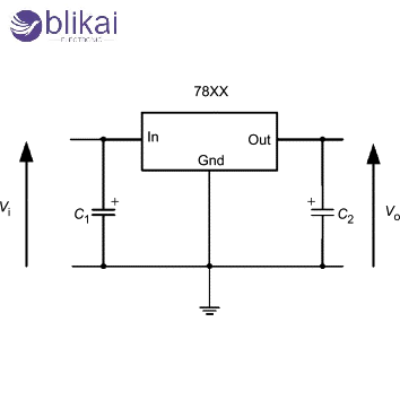
A typical circuit of a high voltage linear regulator consists of the regulator IC, input and output capacitors to stabilize the voltage and to filter noise, resistors to adjust the voltage (though these are not always needed), and layout considerations to minimize trace length and provide grounding to a reasonable level are important to designers to reach the best performance.
Thermal Management and Efficiency Optimization
Dissipation of excess voltage as heat is a significant factor in the use of high-voltage linear regulators since power dissipation is proportional to the voltage drop and current through the load, and strategies like heat sink usage, PCB layout optimization with thermal vias, and regulators with lower dropout voltage can be useful in improving efficiency and operating at safe temperatures.
Design Tips and Best Practices
The design of high voltage linear regulators should take into account sufficient input voltage margin, proper capacitor selection according to the recommendations of the manufacturers, thermal considerations early in the design cycle, proper PCB layout techniques to reduce noise and heat dissipation and to evaluate the trade-offs between efficiency and simplicity to decide whether a linear regulator would be the best choice in the application.
Future Trends in High Voltage Linear Regulation
The next generation of high voltage linear regulators is geared towards improved efficiency, the addition of more protection capabilities and a smaller package size, and semiconductor technology has further allowed improved thermal operation and higher voltage operation capabilities, thus making these regulators more flexible and capable of a wider range of applications in renewable energy systems, electric vehicles, and more sophisticated industrial automation.
FAQ
What is a high-voltage linear regulator used for?
High input voltages are stepped down and stabilized to safe and usable levels in electric circuits with the help of a high voltage linear regulator (especially in low noise and high reliability applications).
What is the difference between LDO and standard regulators?
In some applications, low dropout regulators are more efficient than conventional linear regulators because they can work with smaller differences between input and output voltage.
When should I use a linear regulator instead of a switching regulator?
A linear regulator is preferred when low noise, simplicity, and fast response are more important than efficiency.
Some images are sourced online. Please contact us for removal if any copyright concerns arise.





