


LDO Voltage Regulator: Types, Applications & Guide
 14
14What Is an LDO Voltage Regulator?
A low dropout (LDO) voltage regulator is a linear voltage regulator that ensures a constant output voltage even when the input voltage is similar to the output voltage, making it critical for low power and low noise applications, like IoT, communication and embedded systems; in contrast to switching mode power supplies operating at high switching frequencies, LDOs are linear mode voltage regulators with low output noise, easy to integrate, suitable for analog and RF circuits, but they are not as efficient as switching mode power supplies when input and output voltages are very different.
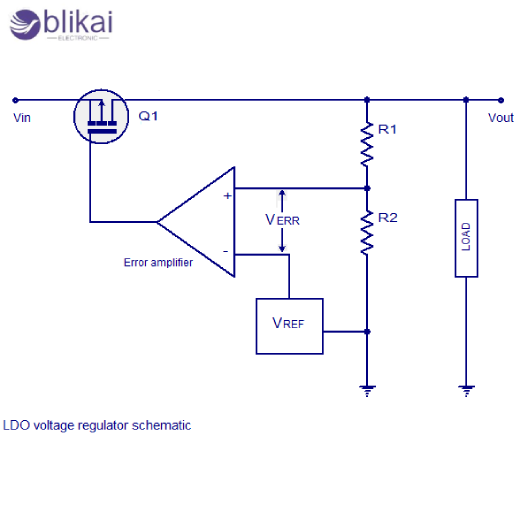
How Does an LDO Voltage Regulator Work?
LDO voltage regulators are a negative feedback control system in which the output voltage is compared to an internal reference voltage and the pass transistor resistance is varied to maintain a constant output voltage; that is, when the output voltage drops (typically due to an increase in the load), the LDO opens the pass transistor so that more current can flow, and vice versa, when the output voltage rises, the LDO closes the pass transistor; another key feature of LDOs is the dropout voltage, which defines the minimum voltage difference between the input and output for the LDO to operate, making LDOs ideal for low-voltage battery-powered applications.
Key Features of LDO Voltage Regulators
LDO voltage regulators are low dropout voltage, low output noise, high power supply rejection ratio (PSRR), high transient response and low quiescent current, making them very efficient for low-power supply applications; they are simple designs that do not require inductors (less space, less electromagnetic interference (EMI) and can provide clean and stable power, making them suitable for sensitive analog, radio frequency (RF) and measurement applications.
Types of LDO Voltage Regulators
Fixed Output LDO Regulators
Fixed output LDO regulators have a fixed output voltage (1.8V, 3.3V, 5V, etc.) and are easy to use with standard digital circuits where the output voltage is not adjustable and are commonly used in microcontrollers, memory and general logic circuits due to their simplicity and robustness.
Adjustable LDO Regulators
The output voltage of adjustable LDO regulators is determined by external feedback resistors and is used when it is necessary to be able to set the output voltage in a circuit, such as when experimenting or in applications with power-sensitive circuits, or when a single LDO regulator is required to output multiple voltages.
High-Current LDO Regulators
High-current LDO regulators are capable of delivering higher currents (typically greater than 1A) and are used in RF power modules, processors, and display drivers, where maintaining a stable high current output with low output noise and a higher power dissipation is necessary.
Low-Noise LDO Regulators
Low-noise LDO regulators are designed to provide minimal output ripple and noise, making them ideal for use in audio systems, communication RF circuits, power supplies for ADC/DAC converters and high-precision analog sensors where maintaining low noise and Voltage Ripple is important.
Advantages and Ddisadvantages of LDO Regulators
LDO voltage regulators provide several benefits, including low noise output, easy-to-implement circuit design, minimal component count and are suitable for low voltage differences. Still, they also have drawbacks such as low efficiency when the input-output voltage differences are high, as the excess power is lost as heat. Caution needs to be taken in high-current applications due to thermal considerations.
Applications of LDO Voltage Regulators
Consumer Electronics
LDO regulators are commonly used in consumer electronics devices (phones, tablets, and wearables) to provide stable and clean power to critical blocks like RF transceivers, sensors and audio circuits to enable best performance with the most efficient use of battery.
Communication Systems
In communication systems, LDOs are used to power RF front-end modules, oscillators, and PLL circuits, where low noise and high PSRR are essential for maintaining signal integrity and reducing phase noise.
Automotive Electronics
LDO regulators are employed in automotive infotainment systems, ADAS sensors and ECU modules where voltage regulation is needed in varying battery conditions and an electrically harsh environment.
Industrial Equipment
LDOs are used in industrial applications for PLCs, measurement equipment and control circuits where stability, reliability, and accuracy are essential for proper functionality and long-term reliability.
LDO vs DC-DC Converter Comparison
LDO and DC-DC converters are used for voltage regulation but vary in efficiency, noise, and suitability for different types of applications; LDOs are low noise and easy to design but inefficient due to linear operation, whereas DC-DC converters are efficient due to switching operation but introduce more noise and require more external components.
|
Feature |
||
|
Efficiency |
Low to medium |
High |
|
Noise Level |
Very low |
Higher (switching noise) |
|
Design Complexity |
Simple |
Complex |
|
External Components |
Minimal |
Inductor, capacitors, diode |
|
Heat Dissipation |
High at large voltage drop |
Low |
|
Best Use Case |
Low-noise analog/RF circuits |
High-efficiency power systems |
|
Cost |
Low |
Medium to high |
How to Choose the Right LDO Voltage Regulator
When choosing an LDO voltage regulator, designers must consider the input to output voltage difference, the maximum load current, dropout voltage, thermal information, quiescent current and PSRR, and also the package and PCB thermal design to ensure stability under load and temperature variations, particularly for miniaturised and high-power designs.
Design Considerations for LDO Circuits
In LDO regulator design, designers need to pay attention to heat management as excess voltage is wasted as heat, stability, by choosing suitable output capacitors with appropriate equivalent series resistance (ESR) characteristics, PCB trace resistance to improve performance, and layout to minimise noise, particularly in mixed-signal systems which include both analog and digital stages.
FAQ
What is dropout voltage?
Dropout voltage is the smallest input-output difference for the LDO to be in regulation.
Why use LDO instead of DC-DC?
LDOs are used for quiet, stable and simple power supply, DC-DC for efficiency.
Where are LDOs used?
LDOs are commonly found in mobile phones, RF circuits, IoT and other analog circuits that require high precision.
Are LDO regulators efficient?
They are only efficient when the input and output voltages are nearly equal; otherwise, heat is generated.
Conclusion
LDO voltage regulators continue to be essential in electronics because they are simple, have low noise and can provide regulated power in low voltage applications. Despite being less efficient than switching regulators, their benefits in terms of signal integrity and ease of design make them invaluable in consumer electronics, industrial and communication systems, particularly as device sizes shrink and power integrity becomes more critical.
Some images are sourced online. Please contact us for removal if any copyright concerns arise.





