


Seven Segment Display Explained: Types, Pinout & Applications
 428
428Introduction
One of the most familiar electronic display elements is a seven-segment display, which is commonly used to show numerical data in a straightforward and simple manner. Seven-segment displays, despite their low cost, high brightness and simple control logic, are, despite all the advances in LCD, OLED and graphical displays, highly popular. Since digital clocks and calculators, industrial meters and counters have required this display technology to be fundamental in contemporary electronics. This paper offers a full description of seven types of segment displays, their operation, types and pinout specifications, driving techniques and their use.
What is a Seven-Segment Display?
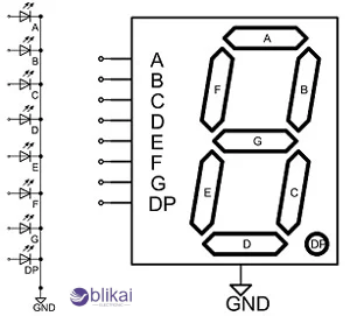
A seven-segment display (also known as a 7-segment display) is an electronic display device to display decimal numbers by lighting certain combinations of seven individual light-emitting elements. These segments are normally designated as A-G and positioned in a rectangular shape, which has the visual image of a number 8 when all the segments are on. The optional eighth segment, the decimal point (DP), is commonly added in order to show values in fractions. The display can be used to display numbers between 0 and 9, and in a very easily readable format by selectively powering various segments.
How a Seven-Segment Display Works
The principle behind the working of a seven-segment display is the individual LED segments, which emit light when forward-biased. Each segment is a distinct LED, and the digit that is displayed is created by switching off or on certain segments. E.g., only two vertical lines would be needed to show the number 1, whereas all seven lines would be needed to show the number 8. Simple switches, logic ICs or microcontrollers could be used as the control logic, which makes the device suitable for both beginner projects and industrial systems.
Types of Seven Segment Displays
Common Anode Seven Segment Display
In a common anode seven-segment display, the terminals of all the LED segments are internally connected to a common positive supply of voltage. Each segment lights up when its corresponding cathode pin is pulled low (connected to ground). This type is commonly used with systems that sink current, such as certain microcontrollers and driver ICs. Common anode displays are widely available and frequently used in multiplexed multi-digit configurations.
Common Cathode Seven Segment Display
The common cathode seven-segment display operates all the cathodes internally to ground. All the segments have lights that indicate the presence of a positive voltage applied to the anode pin of the segment. This setup can be commonly desired in an educational environment since the reasoning is straightforward: a HIGH signal activates one of the segments. Common cathode displays are easy to interface with microcontrollers that source current directly from GPIO pins.
Single-Digit vs Multi-Digit Displays
Single-digit seven-segment displays are those that have a single set of seven segments and are suitable for those counters or indicators requiring simplicity. Multi-digit displays package two, three or four digits in a single package, and commonly share segment lines to minimize the number of pins. These displays are usually based on the principle of multiplexing, in which the digits are switched on a single line at a time, but at a very rapid frequency, to produce the appearance of all the digits being on.
LED Color Variations
The seven-segment displays come in different colors, which include red, green, blue, white and amber. Red displays are most common since they are highly efficient and low cost, whereas blue and white displays are associated with a modern look, yet they may need more forward voltage and use more power.
Seven Segment Display Pinout Explained
To be able to design a circuit and to be able to write the circuit, the pinout of a seven-segment display is imperative. Each part (A-G and DP) has its pin, and one or more common pins depending on the type of display. The overall number of pins is normally 10 in a single-digit display and 12 or even more in a multi-digit display. The pinout of the display is specific to the manufacturer, and therefore should always consult the datasheet before connecting the display to a circuit.
Seven Segment Display Truth Table
A truth table defines which segments must be turned on to display each digit from 0 to 9. This table is fundamental for designing control logic, whether using discrete components or software-based solutions. For example, displaying “0” requires segments A, B, C, D, E, and F to be on, while segment G remains off. Truth tables are especially useful when working with BCD-to-seven-segment decoder ICs or writing microcontroller firmware.
Driving a Seven-Segment Display
Using Current-Limiting Resistors
Every segment of the LED is connected with the current-limiting resistor to avoid the overflow of current that may cause the destruction of the display. Resistor value will be determined using supply voltage, forward voltage of LED and the current in that desired operating current. The correct choice of resistors is used to provide uniform brightness and increase the lifespan of the display.
Using Logic ICs and Driver ICs
Dedicated driver ICs simplify the process of controlling seven-segment displays. BCD-to-seven-segment decoders convert binary-coded decimal inputs directly into the correct segment outputs. These ICs reduce wiring complexity and are commonly used in counters, clocks, and measurement equipment.
Using Microcontrollers
Microcontrollers offer the most flexibility when driving seven-segment displays. They can control segments directly through GPIO pins or use multiplexing techniques to manage multi-digit displays with fewer pins. Other features that can be done using software-based control include brightness control, animations and custom display patterns.
Seven Segment Display vs LCD Display
Seven-segment displays and LCDs are used in electronic design to serve other purposes. Seven-segment displays are bright, can be read at a distance and are simple and, thus, are the best in numeric displays only. LCDs, in their turn, use less power and can be used to display more complex characters and graphics. The predicament between the two will be based on power consumption, complexity of information and the environmental factors.
Applications of Seven Segment Displays
Seven-segment displays have been accepted in most industries because of their reliability and convenience. Common applications include digital clocks, calculators, frequency counters, multimeters, voltmeters, industrial control panels, elevators, and household appliances. Their ability to present numeric data clearly makes them especially valuable in measurement and monitoring systems.
Advantages of Seven-Segment Displays
The simplicity of seven-segment displays is one of their principal benefits. They are user friendly, user friendly and cheap. They are very bright and can be seen clearly even in bright surroundings, and their strong body can withstand the working conditions in the industrial area.
Disadvantages of Seven-Segment Displays
Despite their benefits, seven-segment displays have limitations. They are not suitable for displaying text or complex symbols, and their design restricts them primarily to numeric information. Dot matrix or graphical displays are better in applications that need alphanumeric or graphical displays.
Common Problems and Troubleshooting
Common problems with seven-segment displays are that the segments are too dim, that they are showing the wrong numbers, or that the brightness is not even. These issues are commonly brought about due to improper wiring, lack of current-limiting resistors, or lack of power supply capacity. These can be overcome by careful attention in connection and observance of datasheet specifications.
FAQs
What Voltage Does a Seven-Segment Display Need?
The majority of seven-segment displays are powered by 3.3 V or 5V. Precise voltage varies with the color of the LED, and current-limiting resistors must always be used.
Do Seven-Segment Displays Need Resistors?
Yes, in each segment, there must be a resistor to restrain the current and to avoid damage. There is no resistor in the LED segments, which may overheat and go dead soon.
Conclusion
With simplicity and long life, as well as a high level of visibility, seven-segment displays continue to be the mainstay of electronic display technology. By understanding their types, pinout configurations, and driving methods, designers and hobbyists can confidently integrate them into a wide range of projects. The seven-segment display remains a stable and effective solution to numeric display requirements, whether in a simple counter or in an industrial control system.
Some images are sourced online. Please contact us for removal if any copyright concerns arise.





