


What Is a Digital to Analog Converter? Full DAC Guide
 221
221What Is a Digital to Analog Converter (DAC)?
A Digital to Analog Converter or DAC is an electronic component or integrated circuit which transforms digital binary data to an analog voltage or current signal, which also represents the same information in the form of a continuous signal. Digital systems are formed to manipulate binary numbers, i.e. numbers constructed out of ones and zeros, but in practice, devices will only correctly handle continuously varying quantities, e.g. audio waveforms in the case of speakers or control voltages in the case of actuators. A DAC accepts the value of a digital input, converts its numeric value into an analog output level that is representative of the value in relation to a reference voltage. What determines the number of discrete output levels generated is the converter resolution, i.e. the finer the DAC is, the smoother and more accurate the output analogs become.
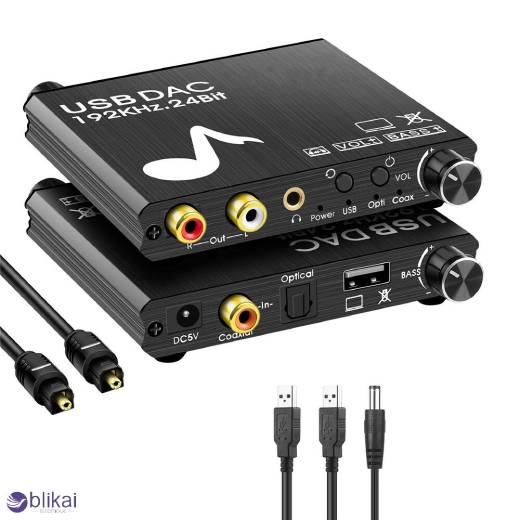
How Does a Digital-to-Analog Converter Work?
A DAC converts a binary number into an electrical value using weighted inputs of each bit in the digital input word, which generates an analog signal that follows a continuous waveform in rough stages. A bit corresponds to a fraction of a reference voltage, and internal switching circuitry assembles the fractions based on the binary value sent by a microcontroller, processor or digital signal processor. Where the input does not change slowly with time, the DAC outputs a series of voltage steps, which recreate the desired signal shape, followed by an analog low-pass filter, which usually smooths these steps to a continuous signal.
Types of Digital to Analog Converters
Binary-Weighted Resistor DAC
The binary-weighted resistor DAC makes the resistance of resistors proportional to the binary weights so that each bit in the word adds the same current or voltage to the output, and this makes design implementation conceptually simple, but very difficult at a high-resolution level since resistor tolerances need to be very small.
R-2R Ladder DAC
R-2R ladder DAC is one of the most common architectures as it uses a small number of resistor values configured as a repeating lattice of ladder-like networks, which is easy to manufacture, and it is also accurate and scales well to higher resolutions.
Sigma-Delta (ΔΣ) DAC
Sigmaldel DACs involve noise shaping and oversampling methods to get an extremely high resolution, that is, converting digital data to a high-frequency bitstream, which is then filtered to an analog signal, which makes them useful in high-quality audio applications.
PWM-Based DAC
Pulse-width modulation DACs generate analog output by varying the duty cycle of a digital pulse signal, which is then filtered to produce an average voltage level, offering a low-cost solution often implemented directly in microcontrollers.
Current-Steering DAC
In current-steering DACs, exactly synchronized current sources are switched very rapidly, allowing very high conversion rates to be achieved, which are needed in radio-frequency transmitters, video systems and high-speed data communication equipment.
Key DAC Specifications Explained
When selecting or evaluating a DAC, engineers must understand several critical performance specifications that determine signal quality and system compatibility.
Resolution (Bit Depth)
The number of levels of discrete output of a DAC is called its resolution, and is represented as a number of bits (quantity of bits), with a larger resolution representing a more precise signal and a smaller quantization error that enables a more accurate reproduction of a waveform.
Sampling Rate
The rate of sampling determines the rate at which the DAC will refresh its output signal, and higher rates allow reproduction of high-frequency signals like audio signals or communication signals.
Accuracy and Linearity
Accuracy is the quality of agreement between the actual output and the expected one, and linearity is the degree of uniformity with which the output steps across the entire range, which is required in precision instrumentation.
Signal-to-Noise Ratio (SNR)
SNR provides the ratio of the required signal to the background noise, which has a direct influence on the clarity of the audio and measurement systems.
Total Harmonic Distortion (THD)
THD evaluates distortion introduced during conversion, which is especially important in audio applications where unwanted harmonics degrade sound quality.
Settling Time
Settling time defines how quickly the output stabilizes after a change in input value, affecting performance in high-speed control and communication systems.
Power Consumption
Low-power DAC designs are becoming important in contemporary electronics because such devices need to be battery-powered and portable.
DAC vs ADC: What’s the Difference?
A DAC is the inverse operation of an Analog to Digital Converter (ADC), since an ADC takes analog signals in the real world and translates them into digital data to be processed, and a DAC takes the result of processing digital data and translates it into an analog signal to be sent back into the real world. Most electronic devices operate converters in combination and include audio recording devices where analog signals produced by microphones are converted by ADCs and sound is reproduced by speakers by converting DAC outputs. The digital signal processing systems are based on the interaction between ADCs and DACs that allow recording, transmission, analysis and reproduction of real-life signals at high precision.
Applications of Digital to Analog Converters
Audio Systems and Music Playback
DACs decode digital audio files that have been stored and produce analogue waveforms that cause headphones and speakers to work, and this affects sound quality and listening quality directly.
Video and Display Systems
In display electronics, DACs generate analog colour signals or control voltages used in legacy video interfaces and certain display driver circuits.
Telecommunications
Communication transmitters rely on DACs to generate modulated analog signals required for wireless transmission across radio-frequency channels.
Industrial Control Systems
Industrial automation equipment uses DAC outputs to control motors, valves, and actuators through analog control signals derived from digital controllers.
Embedded and IoT Devices
Microcontrollers integrate DAC modules to produce analog outputs for sensors, waveform generation, and control applications in compact embedded systems.
Medical Electronics
DACs are used in medical equipment in imaging systems, monitoring devices and high precision signal generation in areas where accuracy and reliability cannot be compromised.
Automotive Electronics
DACs are currently used on modern vehicles in infotainment units, engine control units, and in technologies such as advanced driver-assistance systems that need to have accurate analog outputs.
Advantages and Disadvantages of DACs
DACs have important benefits in that they allow digital accuracy despite operating in analog worlds, they allow the generation of a programmable signal, repeatability and the ability to interface with digital processing systems. But among its limitations are the quantization noise, sensitivity to the reference voltage stability, component mismatch, and distortion it may add in conversion.
Practical DAC Circuit Example
A simple DAC implementation may involve a microcontroller sending digital data through an SPI interface to an external DAC chip, which converts the data into an analog voltage used to generate audio tones or control analog hardware. The DAC output typically passes through a low-pass filter and buffer amplifier to remove switching artifacts and stabilize the signal before reaching the load.
Future Trends in Digital to Analog Conversion
The DAC technology is still developing as the electronic systems require higher performance, reduced power consumption and more integration. Advances in semiconductor fabrication allow higher-resolution converters with reduced noise and smaller footprints, while system-on-chip designs increasingly integrate DAC functionality alongside processors and communication modules. New uses of artificial intelligence hardware, edge computing devices, and high-resolution multimedia systems are pushing the state of the art of DAC architecture to faster and more energy-efficient versions that can address tasks involving the generation of complex signals.
FAQs
What does a DAC actually do?
A DAC transforms digital numeric data into an analog electrical signal, which is capable of communication with real-life devices like speakers, motors or transmitters.
What resolution DAC do I need?
The required resolution depends on the application, with audio systems commonly using 16 to 24 bits while control applications may require lower resolutions.
Can a microcontroller generate analog output without a DAC?
Some microcontrollers simulate analog signals using PWM outputs filtered into analog voltages, but dedicated DAC hardware generally provides higher accuracy and lower noise.
What is the difference between internal and external DACs?
Microcontrollers are provided with internal DACs as a convenience and cost saving, though external DACs are usually of higher precision, better performance, and more flexible.
Conclusion
DACs are important in the modern electronics industry since they allow digital systems to interact with the analog world, and thus technologies like audio playback, wireless communication, industrial automation, and embedded control exist. Knowing the principles of DAC operation, DAC architectures, specifications and applications, engineers have the ability to choose appropriate converters that match the requirements of the system in terms of accuracy, speed, and efficiency. With electronics still on the road to higher performance and increased integration, the DACs will still play a key role as it helps in combining digital smartness with real-world applications.
Some images are sourced online. Please contact us for removal if any copyright concerns arise.





