


What Is an AC-DC Converter? Working and Applications Guide
 241
241What Is an AC-DC Converter?
An AC-DC converter is a power supply converter that changes alternating current, which periodically reverses direction, into direct current that flows in a single direction with stable polarity. AC power is typically supplied at set frequencies (i.e. 50 Hz or 60 Hz), whereas semiconductor devices, integrated circuits, LEDs and digital systems need DC power. The main objective of converting AC to DC power is to supply controlled voltage and current to be used in the electronic functions safely and efficiently. Although the terms adapter, power supply, and converter are used synonymously, what is meant by adapter is the exterior consumer item, power supply refers to the entire regulated electricity framework, and converter is a reference to the electrical conversion stage. In practical applications, AC-DC converters appear inside phone chargers, televisions, LED drivers, desktop computers, and industrial control systems, where they continuously convert mains electricity into usable DC energy.
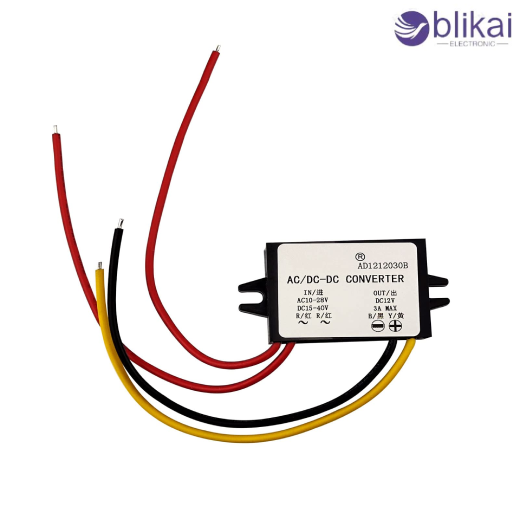
How an AC DC Converter Works
Step 1 – AC Input Rectification
The initial process in an AC-DC converter is the rectification process, in which the AC voltage is fed through a bridge rectifier consisting of four diodes designed in a way that they conduct in alternate half-cycles. In half the cycles of the AC signal, the current is carried by a different pair of diodes, and the current is always carried in the same direction over the load. It transforms sinusoidal AC into pulsating DC voltage and forms the basis of further regulation procedures, as well as determining the preliminary efficiency and thermal behaviour of the converter.
Step 2 – Filtering Stage
Following the rectification, the signal has a very high ripple due to the fact that the waveform continues to vary with the AC frequency. Electrolytic capacitors are enormous but serve the purpose of smoothing the pulsating DC by storing the energy during the rise in voltage and discharging on the falling voltage. This filtering step minimizes the amplitude of the ripple voltage, and it forms a more stable DC bus that is necessary to avoid the spread of noise and to guarantee adequate functionality of the downstream switching regulators and delicate electronic devices.
Step 3 – Switching Regulation
In modern AC to DC converters, the switching regulation is used as opposed to the linear dissipation to provide high efficiency. A PWM (pulse width modulation) controller uses a high-frequency on-off switch of a power MOSFET to pass energy in a circuit by inductive or transformer coupling. It can also be used to control the output power at a precise value to allow converters to produce a constant voltage output despite variations in the input voltage or conditions of the load with the help of the feedback, and can be used to regulate the duty cycle in such a way that the voltage output is constant.
Step 4 – Output Stabilization
The last phase guarantees a stable production supply by the use of feedback control loops and second image filters. Voltage sensing circuits monitor output conditions and send correction signals—often through optocouplers in isolated designs—to the controller IC. Output inductors and capacitors further smooth switching noise, improving load response and maintaining tight voltage regulation even during sudden current changes.
Main Components Inside an AC-DC Converter
AC DC converter is a combination of several electronic parts that cooperate with each other to achieve the effective conversion of energy. The conversion of the waveforms in AC is performed by the rectifier diodes, and the manipulation of the energy transfer at a high rate is performed by switching MOSFETs. Transformers in remote converters ensure galvanic isolation, as well as scaling voltages. In isolated converters, transformers provide galvanic isolation for safety and voltage scaling. PWM controller ICs manage switching timing, protection logic, and feedback regulation, while optocouplers transmit feedback signals across isolation boundaries. Output capacitors and inductors filter high-frequency switching noise, stabilize voltage, and improve transient response, forming a critical electronic components cluster that defines reliability and efficiency.
Types of AC DC Converters
Linear AC DC Converters
Linear AC-DC converters operate by reducing voltage through resistive or linear regulation methods after rectification, dissipating excess energy as heat. These converters provide low noise output and a simple design but suffer from poor efficiency, especially when input-output voltage differences are large. Heat dissipation requirements limit their use to low-power applications or noise-sensitive analog systems.
Switching AC DC Converters (SMPS)
Switched-mode power supplies (SMPS) are variants of AC-DC converters that utilize high-frequency switching technology to transfer energy with a minimum amount of power loss. Since switching elements are fully on or fully off, losses are extremely small and allow small sizes, lighter transformers and efficiencies of 85-90 or more. The industry standard in consumer electronics and industrial electronics has thus developed as SMPS designs.
Isolated vs Non-Isolated Converters
Isolated converters isolate circuits of input and output with a transformer to enhance the safety and shock reduction in mains power-related applications. Non-isolated converters omit this isolation for higher efficiency and lower cost but are typically used in internally protected systems where safety isolation is unnecessary. Application requirements largely determine which architecture is preferred.
AC DC Converter Topologies Explained
The circuit topologies are the best suited to power ranges and to particular applications. Flyback converters are widely used in adapters and chargers due to their simplicity and isolation capability. Buck-derived converters efficiently step down voltage in non-isolated systems. Forward converters improve efficiency for medium power applications by transferring energy continuously. LLC resonant converters achieve extremely high efficiency and low EMI using soft-switching techniques, making them popular in modern TVs and high-end power supplies. Half and full-bridge designs are applied in industrial and server applications with high power and needing efficient energy transfer and lower switching stress.
Applications of AC-DC Converters
AC-DC converters are central in almost all electronics industries. They are dependent on consumer electronics such as phone chargers, televisions, gaming systems, and laptops. LED lighting systems have dedicated AC-DC drivers working under constant current operation and efficiency. The automation equipment in industries relies on controlled DC rails in sensors and controllers, and the telecommunications system needs steady power modules in order to maintain a continuous supply. Small converters to embedded power products are incorporated in smart home devices and IoT equipment, and isolated converters to provide patient safety and regulatory compliance are used in medical electronics.
RT3663BCGQW vs RT7736BGE AC DC Controller Comparison
Overview of RT3663BCGQW
The RT3663BCGW is an AC-DC PWM controller of high performance that is used in advanced power supply applications that require optimized efficiency and accuracy of regulation. It is aimed at the demanding systems like television and monitor power supply, where dynamic load conditions and high efficiency standard is a norm. Its sophisticated control structure allows better switching optimization, less standby consumption, and better regulation accuracy, which meets the current energy efficiency needs.
Overview of RT7736BGE
The RT7736BGE is an AC-DC flyback controller focused on cost-effective switched-mode power supply designs, particularly adapters and chargers operating in low-to-medium power ranges. It incorporates the basic protection and simplified control logic to lower the system complexity and the number of components and ensure effective functioning. Its design is focused on functionality and low cost, and thus, it fits well in the mass-produced consumer electronics.
RT3663BCGQW vs RT7736BGE Comparison Table
|
Feature |
||
|
Converter Type |
AC-DC PWM Controller |
AC-DC Flyback Controller |
|
Application Focus |
High-performance power supply |
Cost-optimized SMPS |
|
Efficiency Optimization |
Advanced control |
Standard PWM control |
|
Protection Features |
Multiple protections |
Essential protections |
|
Typical Applications |
TV/monitor PSU |
Adapters & chargers |
Which One Should You Choose?
RT3663BCGW has been developed to be used in high-efficiency, tightly regulated, high-performance, and sophisticated power systems, but cost-sensitive adapter design applications would make use of the simpler architecture of RT7736BGE. The choice ultimately depends on efficiency targets, complexity tolerance, thermal requirements, and bill-of-material constraints within the intended application.
Common Problems and Troubleshooting
Problems with output ripple can be caused by poor-quality capacitors or ineffective filtering, whereas overheating can be caused by switching losses or ineffective thermal design. Failure of the startup may happen because of inaccurate feedback loops or inadequate bias provision requirements, and EMI issues often result from bad PCB design or grounding practices. With time, aging of the components, particularly the electrolytic capacitors, may diminish the converter stability; hence, it is a requirement to conduct a periodic evaluation on long-lasting equipment.
FAQ
What is the difference between an AC DC converter and a power adapter?
An AC-DC converter is the circuitry that does the conversion between electrical circuits, but a power adapter is a complete packaged product consisting of the converter itself, housing, connectors and safety certification to be used by the consumer.
Can AC-DC converters change the voltage level?
Yes, most AC-DC converters both rectify AC power and adjust voltage levels through transformer ratios or switching regulation to match device requirements.
What IC controls an AC-DC power supply?
A flyback controller IC or a PWM controller IC is used to control timing of switching, feedback regulation and protection functionality; in that sense, they form the power supply control centre.
Conclusion
AC DC converters are essential building blocks of modern electronics, transforming grid-supplied alternating current into stable direct current required by nearly all electronic systems. They are operated by a combination of rectification, filtering, high-frequency switching regulation and feedback stabilization to attain efficient conversion of energy. As the need to be efficient, miniaturized, and smart with power management, controller ICs are becoming more critical to the performance and reliability. The examples of RT3663BCGQW and RT7736BGE illustrate how a variety of controller designs can meet a variety of design priorities to give designers and engineers some flexibility in creating a reliable, efficient, and future-proof power supply.
Some images are sourced online. Please contact us for removal if any copyright concerns arise.





