


Bidirectional TVS Diode Explained: Working and Applications
 110
110What Is a Bidirectional TVS Diode?
A bidirectional TVS diode is a semiconductor protection device designed to suppress transient overvoltage events occurring in either polarity across a circuit line. Unlike standard rectifier diodes that conduct current in only one direction, a bidirectional TVS diode can respond symmetrically to both positive and negative voltage spikes, making it ideal for AC signals and bidirectional data lines. When the current is not flowing, the device is non-conductive, but as soon as the voltage reaches a predetermined breakdown threshold, the device is diverted to avalanche conduction, bypassing the sensitive components and preventing the surge energy from flowing through them. It is basically two avalanche diodes packaged in one package, where each can be configured as a diode in either direction and be used to clamp voltage independent of the signal polarity.
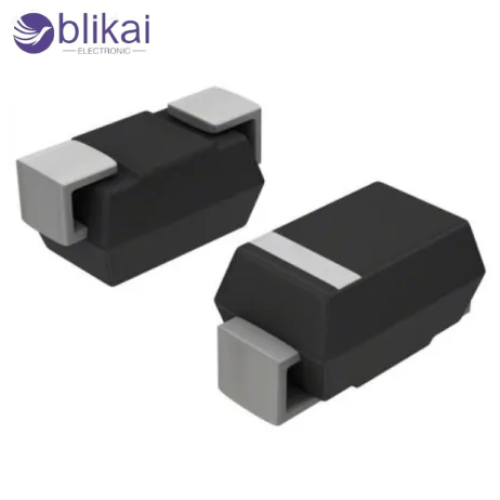
How a Bidirectional TVS Diode Works
In normal operation, a bidirectional TVS diode is very high impedance and permits a very small leakage current to pass through it; that is, it does not distort the operation of the circuit. When a transient voltage spike appears and exceeds the breakdown voltage, the semiconductor junction enters avalanche mode almost instantly, creating a low-resistance path that conducts surge current away from protected components. During this event, the diode clamps the voltage to a safe level known as the clamping voltage, preventing further increase even if the surge current rises sharply. After the transient dissipates, the device automatically returns to its high-impedance state without requiring manual reset or replacement. This rapid transition between insulating and conducting states occurs within picoseconds to nanoseconds, enabling protection against extremely fast ESD and lightning-induced pulses that would otherwise destroy integrated circuits.
Bidirectional vs Unidirectional TVS Diodes
The main difference between bidirectional and unidirectional TVS diodes lies in their polarity response and application suitability. A unidirectional TVS diode behaves similarly to a Zener diode, providing avalanche protection in reverse bias while acting like a regular diode in forward bias, making it ideal for DC power rails. In contrast, a bidirectional TVS diode offers identical protection characteristics in both voltage directions, making it better suited for alternating signals or differential communication lines. Bidirectional devices are typically chosen for AC circuits, RS-485 interfaces, CAN bus networks, and audio signal paths, whereas unidirectional versions dominate DC supply protection applications.
Common Package Types and Power Ratings
Bidirectional TVS diodes are manufactured in a variety of package styles to meet different thermal and mechanical requirements. Surface-mount packages such as SMAJ, SMBJ, and SMCJ are widely used in compact electronics because they provide high power handling with efficient PCB assembly compatibility. Larger axial-leaded packages are still used in industrial or through-hole designs where mechanical robustness is required. Power ratings are usually in the range of signal-protecting devices of several hundred watts or a power line surge suppressor of several kilowatts. In choosing the right device to use in an application, engineers should strike a compromise between the size of the package, its ability to dissipate heat, and its board space.
Applications of Bidirectional TVS Diodes
Bidirectional TVS diodes are extensively used across modern electronics due to their versatility and fast response. In AC power systems, they protect equipment from switching spikes and lightning surges that can enter through mains lines. Bidirectional protection is used in communication interfaces like RS-485, CAN bus, Ethernet and audio signal lines since the signal swings in both directions when it is used. TVS diodes are used in industrial automation equipment to shield control circuits against transients of inductive load switching, as well as in automotive electronics to deal with load dumping and electromagnetic interference. TVS protection is also applied in consumer electronics such as televisions, routers, smart home devices, and so on, to enhance durability and to ensure electromagnetic compatibility.
How to Choose the Right Bidirectional TVS Diode
To choose the right bidirectional TVS diode, that is, to choose a standoff voltage which will just assure no unwanted conduction, one must first determine the maximum normal operating voltage of the line he is protecting and then pick a slightly higher standoff voltage. The engineers should make sure that the clamping voltage is less than the largest allowance of downstream components, and on the other hand, enable a good margin to prevent false triggering. The peak pulse power rating required depends on the industry standards or environmental factors in the form of surge energy expectations. Capacitance of the high-speed data lines should also be taken into account by designers, as the high capacitance may worsen signal integrity. Depending on the environmental conditions, such as the temperature range, reliability, and regulatory compliance, the ultimate device selection is also affected.
Circuit Design and Placement Guidelines
The correct TVS diode is as well as a proper circuit layout. The apparatus must be as near to the external connector or entrance point of a surge as possible, to cause the transient energy to pass around rather than damaging the sensitive circuitry. PCB traces are made short, and grounding paths of low inductance reduce the voltage overshoot of fast surge events. The TVS diode is also normally paralleled with the protected line and ground by engineers so that the current of surges may pass towards the reference plane.
Advantages and Disadvantages
Bidirectional TVS diodes have many benefits, such as very high response times, large surge capacity, automatic recovery following temporary faults, miniature size and long lifespan when of the correct rating. They provide superior protection compared to slower devices, such as metal oxide varistors, in many electronic circuits. However, they also have limitations, including finite energy absorption capacity and junction capacitance that may influence high-frequency signals. They are, however, also limited (to finite energy absorption capacity and junction capacitance, which can affect high-frequency signals). There is also no continuous overvoltage capability of TVS diodes, and they will fail when subjected to sustained overvoltage instead of transient overvoltages.
Typical Application Circuit Examples
In practical circuits, bidirectional TVS diodes are typically connected across signal or power lines to ground or across differential pairs to clamp voltage spikes symmetrically. AC input protection circuits place TVS devices across the line and neutral connections to suppress surge events. Communication interfaces often use low-capacitance bidirectional TVS diodes directly at connectors to prevent ESD damage during cable insertion. Power supply input stages combine TVS diodes with filters and fuses to create layered protection systems capable of handling both fast spikes and longer-duration surges.
Common Mistakes When Using TVS Diodes
A frequent design mistake is selecting a TVS diode with a standoff voltage too close to normal operating voltage, causing unwanted heating or signal distortion. A second mistake that can be made is to locate the device a long distance away from the connector and letting the surge energy find its way to the PCB, then suppressing the surge. One of the mistakes made by designers is the use of one designation, bidirectional, to represent a different designation, unidirectional. Sometimes, designers fail to provide full protection to an AC or differential circuit. Underestimating power capability or not accounting for thermal situations may also lead to an early failure of the device in the actual surge situation.
Bidirectional TVS Diode vs MOV and Zener Diode
While metal oxide varistors (MOVs) and Zener diodes also provide voltage protection, their characteristics differ significantly from bidirectional TVS diodes. MOVs are used with large energy bursts but are slower responding and also become more degraded with repeated operation, and should therefore be employed in the mains level protection rather than sensitive electronics. Zener diodes control voltage, but do not have the capability of surge current needed to suppress transients. Bidirectional TVS diodes have a high peak power operation at fast response speeds and provide better protection to electronic interfaces and semiconductor devices, which demand accuracy in voltage clamping.
Future Trends in Transient Voltage Protection
The global trend in the electronics industry is the reduction in size and speed of devices; therefore, transient protection devices are now developing to be of less capacitance, greater surge, and built-in protection. New markets in automotive electrification and electric vehicle development are emerging as sources of demand for very strong protection against severe electrical conditions, and high-speed communication protocols demand very low capacitance TVS devices to guarantee signal integrity.
FAQs
Can a bidirectional TVS diode be used for DC protection?
Yes, but it is usually not the best choice for DC power supplies because forward conduction characteristics may introduce unwanted behaviour. Unidirectional TVS diodes typically provide tighter clamping for fixed-polarity circuits.
Can a TVS diode fail short or open?
Yes. Following heavy surge activity or repetitive surge activity, a TVS diode can either enter a short-circuit state or an open-circuit state, and this is the reason why a protection circuit is often provided with a fuse or current-limiting element.
How do you test a bidirectional TVS diode with a multimeter?
A multimeter can only check for shorts or leakage. Clamping performance requires special equipment that is capable of producing controlled surge pulses to conduct a proper test.
Conclusion
Bidirectional TVS diodes are vital in safeguarding the recent electronic frameworks from destructive transient voltages through speedy and symmetrical voltage clamping of signals with both directional values. Their operating principle of avalanche enables them to respond nearly instantly to events of a surge, but be invisible when operating in a normal circuit. From communication interfaces and AC power systems to automotive and industrial electronics, these devices enhance reliability, extend product lifespan, and ensure compliance with electromagnetic compatibility standards. Knowing their operating principles, electrical characteristics, and appropriate placement methods, engineers can easily incorporate bidirectional TVS diodes in their designs and provide robust and long-life circuit protection in the ever-challenging electronic systems.
Some images are sourced online. Please contact us for removal if any copyright concerns arise.





